A newsletter for Ukrainians, for the Ukrainian diaspora, and for anyone who has watched a country be told that survival is a line item on someone else's budget.
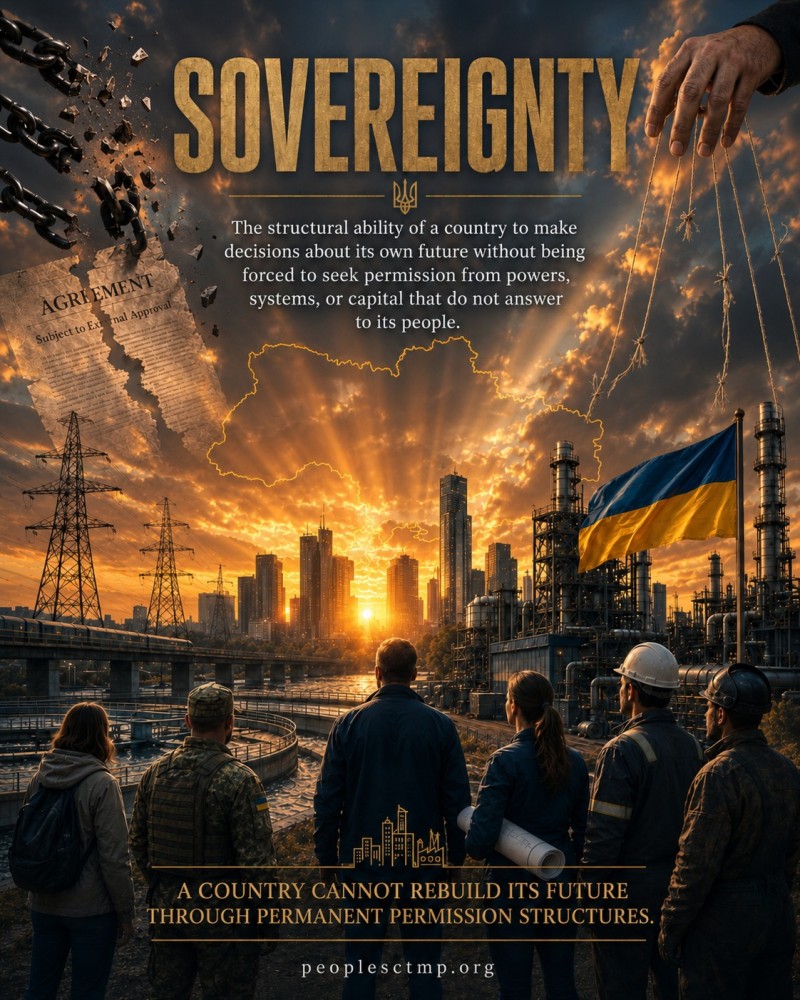
I want to start by saying something most people who write about Ukraine from outside Ukraine should not say, but that I am going to say anyway, because I believe it is true.
The world has been preparing Ukraine for permanent dependency.
Not deliberately. Not maliciously. Not in any single conscious decision made in a single conscious room. The system that has wrapped itself around Ukraine since February 2022 was built for a different kind of crisis, and it has been doing what it was built to do, which is to keep a country breathing while attaching to that country every instrument of conditional support that a multilateral system knows how to apply.
I am writing about Ukraine here because Ukraine is one country on The Wall, and because its reconstruction math is now impossible to ignore. But this is not an endorsement of Ukraine over Lebanon, Palestine, Iraq, Yemen, Jordan, Liberia, Canada, or any other country. The Wall is not built to let me choose favourites. It is built so the people choose the order.
A loan here. A guarantee there. A grant with reform requirements. A pledge that disburses a year late. A reconstruction conference. A facility from the IMF. A facility from the EU. A facility from the World Bank. A bilateral programme from one capital. A bilateral programme from another.
Each one of these things is real. Each one is delivered by people who are sincerely trying to help. Each one of them, individually, is a number that can be defended in a meeting.
In aggregate they form a structure, and that structure is the slow conversion of Ukraine from a sovereign country with its own industrial future into a long-term recipient of conditional life support from people who do not live there.
I do not say that to insult the people who are trying. I say it because the math is now unmistakable, and somebody has to say it out loud before the math becomes destiny.
Ukraine’s public and publicly guaranteed debt at the end of 2025 stood at roughly two hundred and thirteen billion dollars, just under one hundred percent of GDP. The Ministry of Finance placed it preliminarily at 98.4 percent of projected GDP for 2025. Forecasts then push the ratio above one hundred percent, with the Ministry projecting debt around two hundred and forty billion dollars, or roughly one hundred and six percent of GDP, by the end of 2026. IMF debt-sustainability framing has pointed to a peak far higher, with targets that require Ukraine to bring debt back toward eighty-two percent of GDP by 2028 and sixty-five percent by 2033, under assumptions and reform schedules no country at war should have to pretend are normal.
External debt at the end of 2025 was two hundred and thirty-six billion dollars, or one hundred and ten percent of GDP.
In 2025, Ukraine paid the IMF approximately two point three billion dollars in principal and around eight hundred million dollars in interest, and received nine hundred and twelve million dollars in new loans from the IMF. The net flow with the Fund was negative two point two billion dollars. Ukraine, in the middle of a full-scale invasion, paid the International Monetary Fund more than twice what it received from it.
That is not a typo. That is the fiscal position.
And on top of all of that, the World Bank, the Government of Ukraine, the European Commission, and the United Nations released their fifth Rapid Damage and Needs Assessment in February 2026. The total reconstruction and recovery cost: five hundred and eighty-eight billion dollars over the next decade. Nearly three times the projected GDP of Ukraine for 2025. Direct damage one hundred and ninety-five billion. Transport sector reconstruction needs ninety-six billion. Energy sector ninety-one billion. Housing ninety billion. Demining alone twenty-eight billion.
Stack those numbers next to each other. Five hundred and eighty-eight billion dollars in reconstruction need. Two hundred and forty billion dollars in projected debt by year end. A country whose entire annual economic output is roughly two hundred and thirty billion dollars. A war that has killed over fifteen thousand civilians and displaced six point nine million people, with three point seven million still displaced inside the country and five point nine million abroad. Seventy percent of the national energy infrastructure hit in twelve months. Some citizens facing up to eighteen hours of power outages a day in the coldest winter in decades.
There is no donor model that closes that gap.
It is mathematically impossible.
Every dollar of "support" that comes in as a loan adds to the debt that must be repaid. Every grant comes with reform conditions written by institutions that have lived through none of the bombing and bury none of the dead. Every reconstruction pledge produces less disbursement than headline. Every conference produces a communique. Every communique produces another conference.
Ukraine is being asked to rebuild a country, fight a war, repay sovereign debt to the same institutions that are extending the loans, and meet a reform schedule designed for peacetime, all at the same time, on a fiscal base that is roughly forty percent of what it needs to be for a single one of those tasks.
This is not solidarity. This is the slow conversion of a country into a permanent client.
I refuse to accept that model for any country.
There is another way.
It is not a better donor programme. It is not a more generous reconstruction fund. It is not a smarter loan facility from a more sympathetic creditor. It is structurally different from any of the instruments currently being applied to the Ukrainian situation, and the difference is the entire point.
It is called the People's CTMP.
It is a physical infrastructure platform built around a 300 gigawatt subsurface ocean-fed hydroelectric module, with sixteen industrial verticals built around it. The hydro core produces firm continuous baseload power at less than one tenth of one cent per kilowatt-hour internally and at a posted external price of two and a half cents, fixed by public charter. Around that core are sixteen industrial verticals, owned by the platform, operating at internal transfer prices of zero. Desalination at national scale. Steel without coal. Concrete with most of the carbon stripped out. Hydrogen, ammonia, methanol, and synthetic natural gas, made clean and cheap. Sovereign chip foundries. Sovereign data centres. Workforce housing. Hospitals on site. Ports. Transmission. Manufacturing.
Ukraine is one country on The Wall, which is the public verification race that determines which countries are reviewed first for deployment. The Wall does not favour Ukraine, Lebanon, Palestine, Iraq, Yemen, Jordan, Canada, or any other country. It records public demand. Countries move because people move them.
Now I want to walk through what this would actually mean for Ukraine, in the specific, with the math.
A CTMP module sited on the Ukrainian Black Sea coast, near Odessa or Mykolaiv, would deliver firm baseload power continuously, twenty-four hours a day, three hundred sixty-five days a year, at the prices stated above. That single module produces approximately two thousand five hundred terawatt-hours of electricity per year. Ukraine's pre-war annual electricity consumption was roughly one hundred and fifty terawatt-hours. The module produces in a year more than fifteen times the entire Ukrainian electricity consumption from before the war.
That is one module. From a single coastal corridor. Continuous, firm, clean, indifferent to weather, indifferent to drone attack on a substation in Sumy, indifferent to a missile strike on a converter station in Kharkiv, because the architecture is subsurface and the powerhouses are deep underground caverns. The fuel cannot be cut off because the fuel is the ocean and gravity. There is no single point of failure that a hostile actor can hit to bring it down.
Russia has spent four years systematically targeting Ukrainian energy infrastructure precisely because the existing grid was built around a small number of large central nodes. Coal plants. Nuclear plants. Heating and power stations. Transmission backbones. High-voltage substations. Each one a target. Each one, when destroyed, taking out heat and water and light and hospital function for hundreds of thousands of people.
CTMP is designed not to be vulnerable in that way.
The intake is at sea level. The penstocks descend through rock. The powerhouses are caverns hundreds of metres below the surface. The transmission exits as HVDC through buried cables. Even the converter stations can be hardened beyond any plausible kinetic threat. The single module produces enough firm power for Ukraine's national needs many times over, with surplus available to export to Poland, Romania, Moldova, the Baltics, the Balkans, and Germany through the European HVDC ring.
For the first time in a hundred years, Ukrainian energy security would not be a function of which substations have been hit this week, which gas pipeline is currently being sabotaged, which storage facility caught fire, which winter is colder than the last. It would be a function of the same physics that makes the ocean rise and fall every day. P equals rho g Q H eta. Density times gravity times flow times head times efficiency. There is no conventional fuel supply chain to interdict, and the critical generation architecture is far harder to target than exposed thermal plants, fuel depots, and substations.
That is the energy security argument.
Now reconstruction.
The World Bank assessment puts the ten-year reconstruction need at five hundred and eighty-eight billion dollars. Of that, ninety-six billion is transport, ninety-one billion is energy, ninety billion is housing, sixty-three billion is commerce and industry, fifty-five billion is agriculture, twenty-eight billion is demining.
These numbers are calculated at international market prices for steel, concrete, and engineered components.
A CTMP module sited in Ukraine produces internally green steel at approximately two hundred dollars per tonne and green concrete at approximately thirty-five dollars per cubic metre. Conventional Ukrainian reconstruction is being priced against international market steel at fifteen hundred dollars per tonne and ready-mix concrete at one hundred to two hundred dollars per cubic metre.
Read those numbers carefully.
Ukrainian reconstruction at CTMP internal materials costs is not a different reconstruction. It is the same reconstruction at a fraction of the price. Steel for the housing sector. Steel for the rail sector. Steel for the energy grid sector. Concrete for foundations, for tunnels, for bridges, for substations, for highway corridors, for hospitals, for schools, for water treatment plants. Every cubic metre of concrete poured in Ukraine over the next decade, if poured under a CTMP-supplied internal-cost regime, costs the country a fraction of what it costs under the current global market regime.
I am not going to give you a precise dollar figure on the savings, because the rebuild scope itself is going to evolve and because how much of the bill of materials flows through CTMP-internal versus external sourcing depends on deployment timing. What I will say is that the order of magnitude is enormous. The five hundred and eighty-eight billion estimate becomes a meaningfully smaller number, and the smaller number is paid for in production from the platform itself, not in loans extended against future Ukrainian tax revenue.
Reconstruction stops being a debt question.
It becomes a production question.
Now industrial return.
This is the part I want Ukrainians, and especially the Ukrainian diaspora, to read twice.
For four years, the conversation about Ukraine's industrial future has been framed as recovery. Returning to where the country was before February 2022. Restoring the agricultural exports. Restoring the metallurgical sector. Restoring the chemical sector. Restoring the IT sector. Restoring the defence sector. Restoring the railways.
That framing is a trap.
If Ukraine succeeds entirely, on the recovery framing, what Ukraine ends up with is the industrial base it had in early 2022. A country whose primary export was grain. A country whose largest industrial sector was metallurgy at relatively low value-added. A country whose IT sector was talented but operating mostly as outsourced labour for clients in San Francisco and London and Berlin. A country whose energy mix was still dominated by Soviet-era nuclear and coal assets.
That was a vulnerable industrial base. It is precisely that vulnerability that allowed Russia to attempt to break the country economically in addition to militarily. Recovery to that baseline is recovery to the conditions that made the present catastrophe possible.
CTMP offers something else.
A CTMP deployment in Ukraine builds, around the hydro core, a sovereign industrial base that did not exist there before. Sovereign chip foundries, producing 300-millimetre wafers from endemic polysilicon, fabricated in Ukrainian facilities powered by Ukrainian hydro and cooled by Ukrainian water. Every chip cryptographically signed at fabrication, every die traceable from polysilicon ingot to deployed socket, no foreign jurisdiction holding an off-switch. Sovereign data centres, immersion-cooled, running at PUE near 1.05, producing managed compute and Charter-Constrained Learning AI services for Ukrainian government, Ukrainian banking, Ukrainian healthcare, Ukrainian education, Ukrainian defence, and for the European market that currently runs on hyperscale clouds in countries that are not Ukraine.
Sovereign green steel at two hundred dollars per tonne, supplied at zero internal margin to the construction of the next module, the next platform, the next module after that. Sovereign green concrete supplied to Ukrainian housing, Ukrainian rail, Ukrainian ports. Sovereign green molecules, hydrogen, ammonia, methanol, synthetic natural gas, supplied to Ukrainian fertilizer production, Ukrainian shipping, Ukrainian heavy industry, and exported to European markets where cleaner versions of these molecules currently trade at three to six times the fossil price and where CTMP versions trade at a discount to the fossil price.
Ukrainian agriculture, currently fertilizer-dependent on Russian and Belarusian gas, becomes fertilizer-independent because the ammonia comes from a Ukrainian platform powered by Ukrainian electrons. Ukrainian shipping becomes fuel-independent because the methanol and synthetic natural gas come from the same source. Ukrainian heating, in winters as cold as the one that just ended, becomes pipeline-independent because the gas grid runs on synthetic natural gas produced on Ukrainian soil from Ukrainian water and Ukrainian power.
The five million additional workers that the Ukrainian Ministry of Economy estimates the country will need for reconstruction would not have to be attracted from somewhere abroad. The work would draw the existing diaspora home. After four years of Ukrainian engineers, Ukrainian welders, Ukrainian software developers, Ukrainian researchers, Ukrainian doctors having to leave the country to find work, the industrial base would now exist where they came from. The work would come to where they are from.
Read that sentence twice as well.
The work would come to where they are from.
After a hundred years of Ukrainian talent flowing outward to Moscow, to Warsaw, to Berlin, to Toronto, to San Francisco, the direction would reverse. Not because anyone forced them to come back. Because the work would be there.
Now sovereignty.
This is the most important part, and the part most consistently misunderstood by outside observers of the Ukrainian situation.
Sovereignty is not a flag. It is not an anthem. It is not a seat at a multilateral table. It is not a treaty. It is not a constitutional clause. It is not a defence pact.
Sovereignty is the structural ability to make decisions about the future of a country without first asking permission from people who do not live there.
By that definition, Ukraine's sovereignty has been steadily eroded, not by any single actor, but by the cumulative weight of the conditions attached to its survival. Every IMF reform requirement. Every EU accession criterion. Every World Bank loan covenant. Every bilateral support agreement. Every reconstruction pledge with strings. Each one is, in isolation, defensible. In aggregate they form a network of permissions Ukraine must seek before doing anything large with its own future.
CTMP gives back the part of sovereignty that the donor model cannot.
The Stewardship Charter that governs the platform forbids debt. There is no creditor whose covenants must be met. There is no rate to roll over. There is no refinancing cliff. The capital structure is exclusively equity, in a public real-return corridor of three to six percent, with outside ownership capped at thirty-five percent in any vertical. No single party, foreign or domestic, can acquire control of any vertical. No public stock listing exists, ever, anywhere, on any exchange. No synthetic ETF or listed proxy can be constructed against any vertical's equity. The constitutional architecture is enforced by the Sovereign Logic Engine, which is air-gapped, deterministic, and cannot be talked out of doing its job.
Ukraine, hosting a CTMP module, would not owe anyone for it. Ukraine would not be subject to reform conditions imposed by a creditor whose loans secured the deployment, because there are no loans. Ukraine would not be subject to political conditions imposed by a strategic partner whose grants underwrote the deployment, because there are no strategic-grant strings. The platform operates regardless of which government is in Kyiv next year, regardless of which government is in Washington next year, regardless of which government is in Berlin or Brussels or Beijing next year, because the architecture does not depend on continued goodwill from any of them.
The platform cannot be foreclosed on because there is no debt to foreclose against. It cannot be expropriated under domestic insolvency proceedings because there is no insolvency. It cannot be acquired by hostile capital because there is no listed equity to acquire. It cannot be quietly captured by a regulatory capture process because the Charter is a published constitutional document and the SLE enforces it deterministically against every internal transfer in real time.
Sovereignty is not what you are given.
Sovereignty is what you cannot have taken away.
CTMP is built so that what is given to a host country cannot be taken away from that country, regardless of who later wishes it could be.
Over the past few years, I have refused access to more than four hundred billion dollars in capital, including a one hundred billion dollar rated bond proposal in November 2024, because that capital required forms of attachment to the platform that the Charter forbids. I refused the capital. The architecture is the architecture. It does not bend to the size of the cheque, because if it bent it would not be the thing it is, and if it is not the thing it is, no host country gets sovereignty out of it. They just get another conditional facility. And conditional facilities are exactly what Ukraine has too many of already.
A fifty billion dollar equity letter of intent from Dubai dated July 2025 is in good standing because it conforms to the Charter's no-debt, capped-equity, no-IPO architecture. That kind of capital, structured the way the Charter requires it, can be deployed to any host country including Ukraine, without converting that country into a client.
This matters because the question Ukrainians have been asked to consider, repeatedly, over four years, is whether each new instrument of support that arrives is worth the conditions attached. Each individual instrument has been more or less worth it, in isolation, given the alternatives. In aggregate the conditions form a structure that has begun to look very much like the structure that has been applied, over decades, to other countries which have not subsequently recovered their full sovereignty.
I am offering a different deal.
Power, water, steel, concrete, chips, molecules, jobs, reconstruction, and industrial return, none of it in the form of debt, none of it conditional on reform schedules written by people who do not live in Ukraine, none of it requiring Ukraine to fit into anybody else's geopolitical thesis. Just a physical platform that produces the master inputs of civilization continuously, owned in a way that prevents anyone from cutting it back into pieces and selling the pieces back to Ukraine at a markup.
The diagram has been engineered for thirty-five years. The numbers have been modeled, published, and prepared for hostile technical review. The Charter is at version 3.2 and published. The Sovereign Logic Engine is specified. The Wall is live. Ukraine is on the board.
Under the public rule of The Wall, every country needs at least 250,000 people to sign, and that number must also be at least 5 percent of the country's population. Ukraine's current Wall population figure is 36.7 million, which puts its threshold at approximately 1.835 million signatures. At the current count shown on The Wall, Ukraine has 60 signatures and needs approximately 1,834,940 more to reach verification threshold.
That is a number the Ukrainian people and the Ukrainian diaspora can move if they decide to. The Wall also allows anyone, anywhere on Earth, to sign for the country they believe should be considered.
This project will not end the war.
I have to say that plainly because I am not in the business of selling false hope to people who have lost too much already.
CTMP cannot bring back the dead. It cannot return the destroyed home. It cannot heal the wound of having watched a child grow up under air-raid sirens. It cannot give back the four years that have been taken. It cannot put back together the family scattered across three countries by displacement. It cannot undo what has been done to Mariupol, to Bakhmut, to Avdiivka, to Bucha, to Kherson, to the towns and villages whose names became known to the world only through their destruction. It cannot reach inside any Ukrainian life and put back together what war broke there.
It was never built to.
What it was built to do, what it can actually do, is end the conditions that turn the rebuild into a permanent debt and the survival into a permanent dependency.
The grief stays. The country stays. The sovereignty returns.
That last word is the one I want Ukrainians to hold onto, because it is the one that has been most quietly eroded over the last four years, and the one that the donor model cannot give back regardless of how generous it becomes.
CTMP returns it structurally. Not as a gesture. Not as a slogan. As a feature of the architecture itself.
The Wall is the public mechanism by which people say, on a public ledger, in a way no closed room can override, that a country should be considered for deployment. Not by giving anyone any data. Not by paying anything. Not by joining anything. By signing once, anonymously, on a public count that is verifiable in real time.
Ukraine has 60 signatures and needs approximately 1,834,940 more to reach verification threshold.
Reaching verification threshold does not award deployment. It awards the right to be reviewed publicly, on geographic, geological, bathymetric, corridor, grid, and reconstruction-relevance grounds, with government responses publicly recorded and the entire process auditable in real time.
I am not asking anyone to believe me on faith. I am asking Ukrainians, the Ukrainian diaspora, and anyone who believes Ukraine deserves to be considered to look at the numbers, look at the Charter, look at the mechanism, and decide whether what is on the table is worth registering for.
The fiscal math will not get better waiting. The reconstruction estimate will rise. The debt will rise. The IMF schedule will tighten. The donor pledges will narrow. The reform conditions will multiply. The slow conversion of Ukraine into a permanent client will continue, unless something structurally different is offered.
I am offering the structurally different thing.
The Wall is live. The countries are moving. Ukraine is on the board.
The next move belongs to the people who decide whether Ukraine crosses its verification threshold this month, this season, this year, or never. They may be inside Ukraine, in the Ukrainian diaspora, or anywhere else on Earth. The Wall allows any person to say that any country deserves to be considered.
I have built what I came to build.
The decision is the only variable left.
peoplesctmp.org
Christopher M. Coode Founder and CEO, Hutchison Lea ConneXions Inc. Architect and Steward, People's CTMP