Peru Is Not Just Leading The Wall. It Is Showing What The Wall Was Built To Reveal.
May 15, 2026
Peru has moved into first place on the global verification race.
That does not mean Peru has been awarded deployment. It means Peru is currently leading The Wall by completion rate against its population-adjusted threshold. The movement reflects both organic signatures and active outreach. Over the past several weeks, I have been in direct conversation with government officials, journalists, and senior figures across multiple regions whose engagement can move public awareness of the mechanism faster than passive distribution can. Some of those conversations are public. Most are not yet.
What the leaderboard reflects this week is the visible layer of a process that has been compounding underneath, country by country, since the public phase reopened. The Wall has begun to do what it was built to do. Much of those conversations involved showing how the system has been designed, what it would do for the country that selects it, the amount of power it would produce, how that power is produced, the vertical integration behind it, the 10% compounding of all the verticals, and how that compounding becomes possible through a financial structure that is intentionally different from conventional infrastructure finance. I have also been explaining how that compounding directly affects the volume of people required per module, and what the next steps become if a country can mobilize the people required for the verification process.
Peru is the current leading edge of that work.
The Country, Stated Plainly
Peru is a country of approximately thirty-five million people, on the Pacific coast of South America, with a coastline of roughly twenty-four hundred kilometres and one of the most geologically complex territories in the Western Hemisphere. The economy is structurally dominated by extractive industries: copper, gold, silver, zinc, lead, fishmeal, and natural gas. Mining alone accounts for roughly ten percent of GDP and over sixty percent of total exports. Peru is one of the world’s largest copper producers and exporters, historically second only to Chile, though recent production rankings have shifted with the rise of the Democratic Republic of the Congo. Peru also remains one of the largest silver producers globally.
The country also carries a set of compounding stresses that the global press has under-covered.
In 2024, approximately 27.6% of Peruvians lived in monetary poverty, down from 29% in 2023 but still well above pre-pandemic levels. Chronic malnutrition remains a major issue in rural districts, especially in parts of the Andean highlands. Anaemia in young children has also remained severe.
The political situation has been volatile. Peru has had repeated presidential turnover since 2018. Dina Boluarte assumed the presidency in December 2022 following the impeachment of Pedro Castillo. She was later removed by Congress in October 2025. José Jerí then assumed office, and in February 2026 José María Balcázar Zelada became interim president after another congressional transition. The broader point is not one individual leader. The broader point is that Peru has been operating through a prolonged institutional crisis, with executive authority repeatedly interrupted and public trust under sustained pressure.
The protests of December 2022 and January 2023, concentrated in the southern Andean regions, resulted in dozens of civilian deaths, the highest political-violence casualty count in Peru in a quarter century.
The water situation is acute. Lima, the capital, is considered one of the driest major capital cities in the world. The city of roughly ten million people receives most of its water from the Rímac, Chillón, and Lurín rivers, all of which are heavily glacier-dependent. Andean glaciers in Peru have lost more than half of their surface area since 1962. Peru holds the majority of the world’s tropical glaciers, and those glaciers are receding faster than almost any comparable system on Earth.
The grid has a substantial fossil component, with natural gas providing a major share of generation and hydroelectric capacity providing much of the rest. Peru is currently a net energy exporter to Ecuador and Brazil, but the underlying generation mix is structurally exposed to the same glacier decline that threatens the country’s water supply. Hydroelectric output in Peru depends on the same glacier-fed river systems that feed the cities, and those rivers are shrinking.
These are the conditions in which Peru’s population has, this week, registered the highest verification-race completion rate of any country on the global leaderboard.
What a CTMP Module Means for Peru, Specifically
A People’s CTMP module sited on the Peruvian Pacific coast, in a corridor potentially north or south of Lima depending on geological and bathymetric assessment, would produce approximately three hundred gigawatts of firm clean baseload power, year-round, at an internal cost of less than one tenth of one cent per kilowatt-hour, with an external posted price of two and a half cents fixed by public charter.
Peru’s total national electricity consumption is approximately fifty-five terawatt-hours per year. A single CTMP module produces approximately two thousand five hundred terawatt-hours per year. The module produces in a single year approximately forty-five times the entire annual electricity consumption of the country.
The implication for the country’s energy mix is structural. The natural-gas-fired plants that currently supply a major share of Peruvian electricity become economically uncompetitive against CTMP-sourced power at the posted external tariff. As determined months ago, however, natural gas remains the only logical bridge power source for the first module. The glacier-dependent hydroelectric plants that supply much of the remainder retain their existing capacity, but no longer have to bear the full burden of the country’s electricity demand as the glaciers continue to recede.
It should also be noted that while the deployment of a CTMP module will avoid in the order of 1.5 gigatons of carbon annually, it may also have a direct impact on the ability to preserve some of the glacial ice by reducing the need to strain glacier-dependent hydro systems and by changing the broader energy structure underneath Peru’s economy.
The country would be positioned to become a primary clean-power exporter for the Pacific coast of South America, with HVDC interconnection feasible to Ecuador, Colombia, Brazil, Bolivia, and Chile.
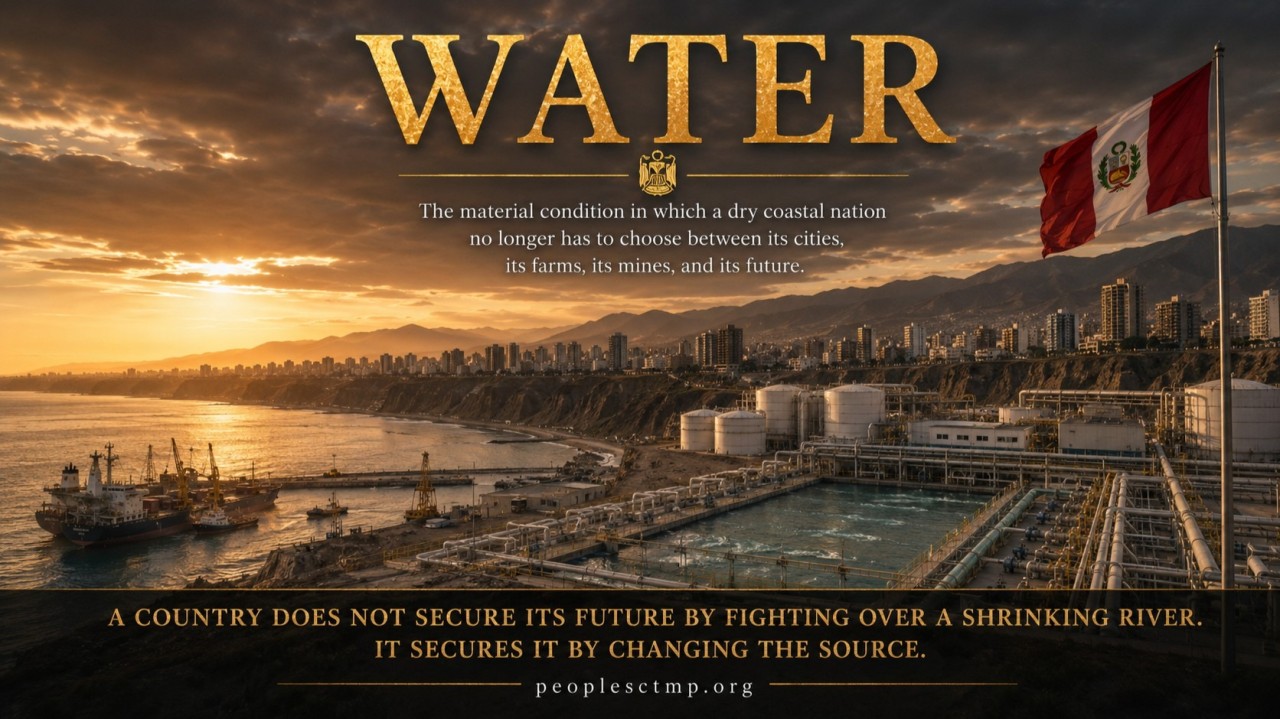
The desalination output is, for Peru, transformative.
A CTMP module produces approximately two and a half billion cubic metres of fresh water annually, of which two billion are allocated free of charge to the host country at the WHO basic-needs threshold of fifty litres per person per day. For a population of approximately thirty-five million, that allocation supports the basic domestic water needs of the entire Peruvian population more than three times over.
The strategic implication is that Lima, one of the driest major capital cities on the planet, would no longer be dependent on the glacier-fed rivers whose decline is currently accelerating. The agricultural belt of the Peruvian coast, currently irrigated through fragile river-fed canal systems, would have access to bulk desalinated water at a price that reflects the actual cost of energy rather than the scarcity rent of a stressed system.
The mining sector, which currently consumes substantial volumes of water in regions where rural communities are themselves water-stressed, would be able to source water from a desalination network rather than from glacial and aquifer systems on which Andean communities depend for drinking and agriculture. The decades-old social conflict between Peruvian mining operations and rural communities over water rights would have a structural pathway toward resolution.
The mineral implications run in both directions. The brine refinery that processes the desalination outputs would recover lithium, magnesium, potassium, and other minerals from concentrated seawater, adding sovereign mineral output to a country whose economic identity is already heavily anchored in mining. The country’s existing mining infrastructure, expertise, and workforce could be partially redeployed onto higher-value, lower-water-intensity production from the brine refinery alongside existing extractive operations.
The industrial verticals attached to the platform, green steel, green concrete, green hydrogen, green ammonia, green methanol, synthetic natural gas, green chip manufacturing, data centres, refined materials, logistics, turbines, HVDC, desalination, and the hydro core itself, would supply the Peruvian economy at internal cost and would position the country as a major industrial exporter to the Pacific Rim. The Port of Callao, already one of the largest container ports on the Pacific coast of South America, may have direct access to CTMP-internal logistics outputs.
What This Does Not Address
A CTMP module deployed in Peru would not resolve the country’s political instability. It would not reconcile the historic divisions between coastal Lima and the Andean highlands. It would not undo the casualties of the 2022 and 2023 protests. It would not rebuild trust in institutions that have been damaged by repeated presidential transitions, corruption proceedings, and public disillusionment.
It would not return the lives lost to the years of political violence. It would not heal the families separated by internal migration as rural communities have lost agricultural viability to climate stress. It would not erase the cost of the years that Peru has spent watching its glaciers shrink while the policy mechanisms to address the consequences remained beyond reach.
What it would do is change the underlying material conditions on which the political conversation has been taking place.
The argument over water rights in the southern Andes changes when desalinated water from a CTMP plant on the coast is available at a price that the mining sector can pay without competing with rural communities for the same diminishing rivers. The argument over electricity tariffs changes when the foundational cost of power has dropped by orders of magnitude. The argument over rural poverty changes when the construction and operational workforce required to build and run a CTMP module pays wages at multiples of current Peruvian agricultural and industrial averages.
These are not solutions to politics. They are changes in the material substrate on which Peruvian politics operates.
Why Peru Is Leading This Week
The leaderboard reflects completion rate against population-adjusted thresholds. Peru’s threshold, calculated against a population of approximately thirty-five million at the platform’s standard rule, the greater of two hundred and fifty thousand signatures or five percent of population, is approximately one point seven five million signatures.
The current Peruvian signature count is modest in absolute terms but is producing the highest completion ratio on the global board.
The mechanism that produced this result is the same mechanism that produced Bulgaria’s earlier lead, Ireland’s lead the week before, and the UAE’s lead in the days following: a relatively small but coordinated group of signatories in a country whose civil society is organized enough, and whose population is engaged enough, to register a public position faster than larger but less mobilized populations elsewhere.
What is notable about Peru’s emergence at the top of the leaderboard is the structural diversity it introduces. The previous leaders have been a European demographic case, a wealthy Gulf state, a Western European data-centre host, and three Middle Eastern countries carrying distinct hardship profiles. Peru is the first Latin American country to lead, the first Pacific-coast country to lead, the first country with significant indigenous-population stakes in the water question to lead, and the first country whose primary economic identity is extractive mining to lead.
The geographic and economic spread of the leaderboard demonstrates the architectural intent of the mechanism. The Wall is not selecting for countries that fit any particular narrative. It is recording the cumulative anonymous decisions of populations that have decided, in numbers sufficient to lead their respective regional or population cohorts, that their countries should be considered first for the deployment of a system designed to address engineered scarcity at the master-commodity level.
Different populations are arriving at the same conclusion from different starting conditions.
What Happens Next
If Peruvian civil society continues to mobilize, the country could approach its threshold within weeks rather than months. Peru’s population includes a substantial diaspora across the United States, Spain, Italy, Argentina, and Chile, with estimates ranging between three and four million Peruvians abroad. Signatures from the diaspora count toward the Peruvian total regardless of the signatory’s current location.
Crossing the threshold does not award deployment. It triggers Phase 1 verification: a public review of geographic suitability, coastal access, bathymetry, subsurface integrity, corridor and land-use compatibility, grid readiness, reconstruction relevance, and the host government’s response. Each stage is conducted in public, with findings recorded and government engagement documented. If a host government delays past the response window, the country is publicly marked as deferred, and the next eligible country in the race may advance.
The mechanism was designed so that no political deal in any closed room can override the public count. The country whose people register first, gets reviewed first.
The Wider Pattern
The Wall has now been led, at various points over the past several days, by Bulgaria, Ireland, the United Arab Emirates, and Peru. Each lead has lasted a day or two. The leaderboard updates in real time. The countries on the board span Europe, the Gulf, the Middle East, South America, Southeast Asia, and West Africa.
The mechanism is functioning as designed. It is country-agnostic, configuration-agnostic, and political-spectrum-agnostic. It counts signatures and ranks by completion ratio. It does not weight countries by their alignment with the platform’s stated mission, their compatibility with any external donor’s preferences, or their geopolitical relationships with any other country.
What is emerging from the leaderboard is not a narrative authored by anyone. It is a global cross-section of populations who have read the architecture, understood the mechanism, and decided to register a public position.
Peru is the current leading edge of that pattern.
The Wall is live.
peoplesctmp.org
Christopher M. Coode Founder and CEO, Hutchison Lea ConneXions Inc. Architect and Steward, People’s CTMP