The Country That Reads Three Decades Ahead Just Read Three Decades Ahead Again
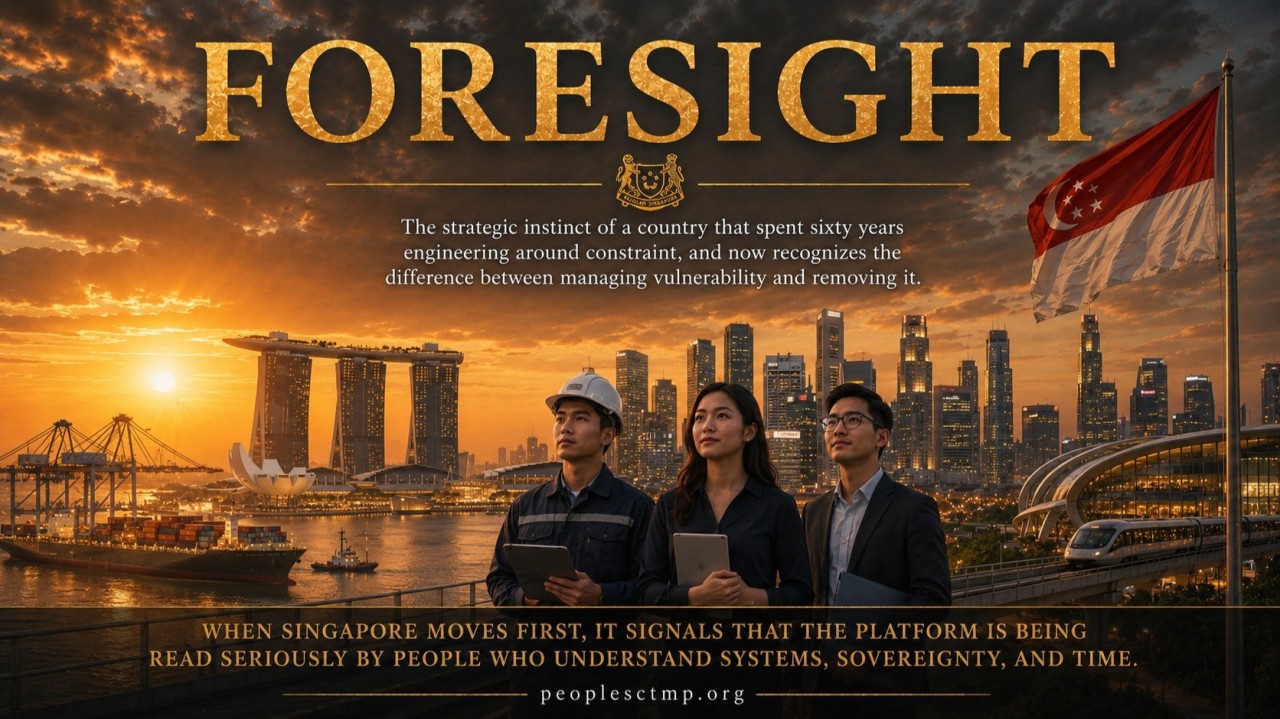
May 16, 2026
Singapore has moved into first place on the global verification race.
This is the most strategically meaningful country lead the platform has seen, and I want to explain why directly, because Singapore is unlike every previous country that has held the top position.
Singapore is not poor. Singapore is not at war. Singapore is not bleeding population. Singapore is not running a failing grid or an unreliable water system. Singapore has GDP per capita among the highest in the world. Its sovereign wealth funds collectively manage more than a trillion dollars in assets. Its public service consistently ranks among the most effective on the planet. Its port is one of the busiest in the world. Its financial centre is consistently ranked among the world’s leading financial centres. Its airline is consistently rated among the best. Its civil aviation authority, its monetary authority, its public housing authority, its national water agency, and its energy market authority are all considered benchmark institutions internationally.
By every conventional measure, Singapore should not need a CTMP module.
And yet Singapore is leading the public verification race for the deployment of the first one.
That is the story worth absorbing.
The Country That Was Supposed to Fail
In 1965, Singapore was expelled from the Federation of Malaysia. The country had no natural resources, no agricultural base, no domestic water supply sufficient to support its population, no significant manufacturing sector, and a population of roughly 1.9 million people on an island of roughly five hundred and eighty square kilometres. The conventional view in international development circles at the time was that the country would not survive the decade as an independent entity.
Sixty years later, Singapore is one of the wealthiest countries on Earth.
The conventional view was wrong.
What Singapore demonstrated, year by year for six decades, is that constraint is not the same thing as destiny. The country had no fresh water, so it built one of the most sophisticated water management systems in human history. The Four National Taps: catchment, imported water from Johor, reclaimed water through NEWater, and desalinated water. The country has no hydrocarbons, no rivers suitable for conventional hydroelectric generation, no wind speeds high enough for commercial wind power, and limited land for solar deployment. So the country built a natural-gas-fired grid, made the country into a global LNG trading hub, and began constructing one of the world’s most ambitious cross-border clean-electricity import strategies.
The country had no agricultural land worth speaking of. So Singapore became one of the most efficient food-importing systems on Earth, with strategic reserves, supplier diversification, and now vertical farming pilots at scale.
The country had no domestic defence industry. So Singapore built one through ST Engineering and a deeply considered network of foreign partnerships.
The country had no large internal market. So Singapore became one of the most open trading economies in the world, with free trade agreements covering most of its export and import volume.
Every constraint Singapore faced over six decades was met with engineering. Not with denial of the constraint. Not with the assumption that someone else would solve it. With sustained, expensive, technically sophisticated engineering, governed by an unusually disciplined civil service.
That is the historical record.
That is the record I want the reader to hold in mind when considering what it means that Singapore is now publicly registering for the deployment of the People’s CTMP.
What Singapore Has Solved, and What It Has Not
Singapore has solved water at the engineering level. The country produces enough water from desalination, reclamation, catchment, and imports to meet its current and projected demand reliably. But the country has not solved water at the economic or strategic level. Desalination remains energy-intensive. NEWater requires substantial electricity input. The Johor agreement that supplies imported water expires in 2061 and has been a source of recurring bilateral diplomatic tension for decades. Climate change is projected to make rainfall patterns more erratic, with longer dry spells and more intense storms, putting pressure on catchment water and on the reliability of imported water from Malaysia. The PUB, Singapore’s national water agency, has stated publicly that Singapore’s growing reliance on NEWater and desalinated water will make the energy intensity of water production a long-term strategic issue.
Singapore has solved electricity at the supply level. The country generates more than ninety percent of its electricity from natural gas, with a small but growing share from solar and the planned import of clean electricity from Indonesia, Vietnam, Cambodia, and other ASEAN neighbours. Singapore has a target to import around six gigawatts of low-carbon electricity by 2035, and has already issued conditional approvals for import projects above that amount. But the country has not solved electricity at the strategic or sovereignty level. Natural gas is imported. The pipelines run through territory the country does not control. The LNG cargoes pass through shipping lanes vulnerable to disruption from regional conflicts. The 2022 invasion of Ukraine and the 2026 Iran war both demonstrated how quickly global gas prices can rise when distant conflicts disrupt supply. A commentary first published by CNA on April 9, 2026, and later republished by RSIS under the title “Singapore Cannot Import its Way to Energy Security,” stated the constraint plainly: a country that depends on imported fuel for its baseload electricity is structurally exposed to disruptions it cannot control.
Singapore has solved industrial competitiveness at the policy level. The country has one of the most favourable business environments in the world, with low corporate tax, strong intellectual property protection, world-class logistics, and a workforce that consistently ranks among the most productive globally. But the country has not solved industrial sovereignty. Almost every input that flows into Singaporean manufacturing comes from somewhere else. Many advanced chips, semiconductor tools, substrates, and critical materials remain tied to foreign fabs and global supply chains. The steel and concrete that build the city are largely imported. Many pharmaceutical inputs and finished products remain tied to global supply chains, even as Singapore itself is a major biomedical manufacturing hub. The renewable hardware required for the country’s solar deployment is sourced from regional and global manufacturers.
Singapore has, in other words, engineered around every constraint it has faced. But the country has not eliminated the constraints. The constraints have been managed, mitigated, distributed across diverse suppliers, hedged through strategic reserves, and softened by diplomatic relationships. They have not been removed.
The CTMP platform offers something Singapore has not previously been able to access: the possibility of removing several of the underlying constraints rather than continuing to manage them.
What a CTMP Module Would Mean for Singapore
A People’s CTMP module, if cleared through a Singapore-specific bathymetric, geotechnical, land-use, and maritime-corridor review, would produce approximately three hundred gigawatts of firm clean baseload power, year-round, at an internal cost of less than one tenth of one cent per kilowatt-hour, with an external posted price of two and a half cents fixed by public charter.
Singapore’s total annual electricity consumption is approximately fifty-eight terawatt-hours. A single CTMP module produces approximately two thousand five hundred terawatt-hours per year. The module produces in a single year more than forty times the entire annual electricity consumption of the country.
The strategic implication is direct. Singapore’s natural gas dependency, which currently covers more than ninety percent of generation, would no longer be necessary at the strategic level. The country would retain its existing gas-fired plants for diversification and reserve capacity, but the baseload would be supplied by a subsurface architecture that does not depend on imported fuel, that is not tied to LNG cargoes vulnerable to maritime disruption in distant straits, that does not require pipeline diplomacy with neighbours, and that is priced at constitutional tariff rather than at the daily spot price of LNG.
The Energy Market Authority’s plan to import six gigawatts of clean electricity from regional neighbours by 2035 would no longer be the country’s primary clean-energy pathway. The imports could continue as supplementary capacity, but the bulk of clean baseload would be produced on Singaporean territory rather than depending on cross-border transmission through Indonesia, Malaysia, Cambodia, and Vietnam, each of which carries its own political and regulatory uncertainties.
The water situation is similarly transformed.
A CTMP module produces approximately two and a half billion cubic metres of fresh water annually, of which two billion are allocated free of charge to the host country at the WHO basic-needs threshold of fifty litres per person per day. For a population of approximately 6.1 million, that allocation supports the basic domestic water needs of the entire Singaporean population nearly eighteen times over.
The Johor water import agreement, which has been a recurring point of bilateral tension since 1962, becomes optional rather than necessary. The country’s existing investment in NEWater and desalination retains its strategic value as a diversified supply system, but the underlying constraint that drove the cost of NEWater and desalination upward, namely the high energy intensity of water production, is structurally removed. Water becomes substantially cheaper to produce because energy becomes substantially cheaper to consume.
The industrial verticals attached to the platform: green steel, green concrete, green hydrogen, green ammonia, green methanol, sovereign chip foundries, data centres, refined materials, and the additional verticals that come online as the platform compounds, change the input cost structure of every manufacturing sector in Singapore. The country’s existing strengths in semiconductor packaging, biopharmaceutical production, financial services, and logistics retain their advantages while the underlying physical inputs that those sectors consume become available at internal cost.
The strategic positioning is straightforward. Singapore becomes a regional hub not only for finance and logistics but for the supply of CTMP-produced power, water, and industrial outputs to the wider ASEAN region. The country’s existing infrastructure as a port, a financial centre, and a logistics nexus integrates directly with the platform’s outputs. The country’s existing role as a clean energy import customer is supplemented, and in some scenarios potentially replaced, by a role as a clean energy export source.
Why Singapore Is Reading This Faster Than Most
Singapore has a particular institutional culture that distinguishes it from almost every other country in the verification race. The country’s public service is structured around long-term scenario planning. The Centre for Strategic Futures, established under the Prime Minister’s Office, exists specifically to identify and analyze risks and opportunities that lie beyond the typical political cycle. The country’s planning horizons routinely extend twenty to fifty years. The water system was designed around a hundred-year horizon. The Marina East Desalination Plant was conceived to meet long-term needs measured in generations.
This institutional culture means that Singapore reads architectural opportunities differently than countries whose planning horizons are constrained by electoral cycles, by quarterly market pressures, or by donor-coordination requirements. A country that has spent six decades engineering around constraints recognizes, when it sees the engineering, the difference between a project that will not survive contact with reality and a project that has been designed to survive precisely the kinds of pressures that have absorbed every previous attempt at structural change.
The CTMP architecture has been engineered for the same kind of long-horizon survival that Singapore has historically demanded of its own infrastructure. The Charter is published. The capital structure forbids debt. The governance forbids political capture. The compounding is constitutional. The mechanism for deployment priority is public and transparent. The math is checkable.
A country that takes its planning seriously, when presented with that combination of architectural features, recognizes what is in front of it.
Singapore’s emergence at the top of the verification race is the public layer of that recognition becoming visible.
What This Lead Means for the Rest of the Region
Singapore is the financial centre, logistics hub, and strategic anchor of Southeast Asia. The country’s decisions are watched closely by Indonesia, Malaysia, Thailand, Vietnam, the Philippines, Cambodia, Laos, Brunei, Myanmar, and East Timor. When Singapore moves on a strategic issue, the rest of the region pays attention.
Singapore taking the top position on the verification race signals to the rest of ASEAN that the platform is being read seriously by the most strategically forward-looking small state in the region. That signal alone may produce verification-race movement in neighbouring countries over the coming weeks and months.
It also signals to the wider regional financial community. Singapore is the headquarters of major regional banks, insurance companies, sovereign wealth fund offices, family offices, and asset managers. The same institutions that finance the existing configuration are headquartered or substantially present in Singapore. A platform that has just attracted the visible support of a Singaporean civic mobilisation effort is a platform that those institutions will be asked to assess.
The architectural details that the wider financial community will see when they look closely include the no-debt constraint, the no-IPO restriction, the thirty-five percent equity cap, the three to six percent real return corridor, and the fifty percent reinvestment mandate. None of those terms permit the kinds of returns that those institutions are currently optimized to produce. But the same terms produce the structural stability that long-horizon capital, family offices, generational trusts, and conservative sovereign-fund mandates are designed to value.
What Singapore’s lead does, in part, is announce to that capital that the architecture is being taken seriously by an unimpeachable counterparty.
What This Project Cannot Do for Singapore
A CTMP module sited in Singapore would not resolve the country’s tensions with Malaysia over the 1962 water agreement. It would not eliminate the geopolitical pressures Singapore faces as a small state navigating between the United States and China. It would not address the country’s demographic challenges, including a fertility rate below replacement and an aging population. It would not eliminate the regional security concerns of operating in a major maritime trade corridor. It would not change the underlying constraint of physical land area. It would not solve the political and social tensions that come with high levels of foreign labour reliance.
What it would do is remove several of the underlying constraints that have made those broader challenges harder to manage. A country whose energy and water are not exposed to imported supply disruption has more strategic latitude to manage its other constraints. A country whose industrial input costs have dropped substantially can absorb more of the cost of demographic transition. A country whose sovereign electricity production can be exported to neighbours has additional tools in regional diplomacy.
These are not solutions. They are improvements in the underlying conditions on which the country’s broader strategic position rests.
What Comes Next
The threshold for Singapore, calculated against a population of approximately 6.1 million at the standard rule of five percent of population with a floor of two hundred and fifty thousand signatures, is roughly three hundred and five thousand signatures. The current count is small but the completion ratio places Singapore at the top of the global leaderboard.
The Singaporean diaspora is meaningful in absolute terms, with substantial communities in Australia, the United Kingdom, the United States, Canada, and the wider ASEAN region. Singapore also hosts a substantial population of permanent residents and long-term foreign workers whose signatures, under the platform’s country-attribution logic, would count toward Singapore’s total. The path to threshold is not trivial, but it is also not extraordinary by the standards of a country that has demonstrated, repeatedly, the capacity to organize itself around long-term strategic objectives.
If Singapore crosses its threshold, the country triggers Phase 1 verification. The geographic suitability is assessed publicly. The bathymetry of the Singapore Strait and the Southern Islands is analyzed. The land-use and corridor implications are reviewed. The government’s response is recorded. The country moves to the front of the deployment queue if the review clears.
The mechanism continues to function as designed. The first country to cross its threshold goes first. No closed room overrides the count.
The Pattern
The verification race has now been led, at various points over the past several weeks, by Bulgaria, Ireland, the United Arab Emirates, Peru, and now Singapore. Each lead has lasted a day or two. The leaderboard updates in real time.
What is emerging from the pattern is not a single narrative authored by anyone. It is a global cross-section of populations who have read the architecture, considered the implications, and decided to register a public position.
Singapore is the latest case. The country has spent sixty years proving that constraint is not destiny. The Wall is the next constraint the country is choosing to outgrow.
That is what the lead means.
That is what the rest of the world is watching, whether it understands it yet or not.
The Wall is live.
peoplesctmp.org
Christopher M. Coode Founder and CEO, Hutchison Lea ConneXions Inc. Architect and Steward, People’s CTMP