Position (Why Malaysia Is Leading The Wall)
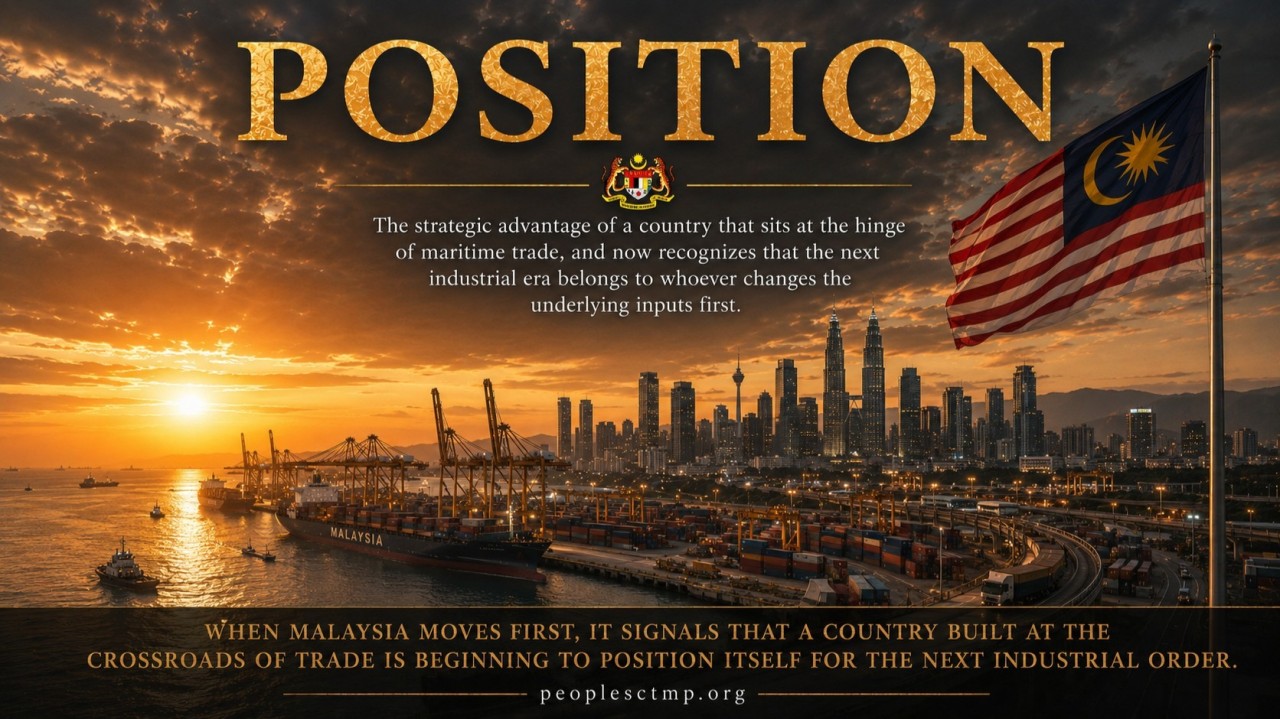
May 17, 2026
Malaysia has moved into first place on the global verification race.
Before I get to why, I want to walk through what the platform actually is, in plain terms, because the country posts have been arriving faster than the architecture has been explained, and the people of Malaysia who are looking at The Wall right now deserve to understand what they are signing for in the same terms I would use to explain it to my own family.
The platform that the verification race is for is called the People’s CTMP.
It is a piece of infrastructure that does not yet exist anywhere on Earth.
The engineering model is complete enough for the math to be checked, the assumptions to be challenged, and the deployment logic to be tested. The Stewardship Charter that governs it is published, currently at version 3.2. The math is checkable. What is missing is the physical deployment, and the deployment is what the verification race determines the order of.
The simplest way to describe what the platform produces is this.
It takes seawater and gravity, moves the water through protected subsurface channels, and uses engineered head pressure to turn turbines. Those turbines produce electricity.
Not a small amount.
A single platform module is designed to produce three hundred gigawatts of continuous, firm, twenty-four-hour baseload power. At full annual output, that is about 2.63 petawatt-hours per year. Malaysia’s official 2023 electricity consumption was 154,705 GWh, which means one module would produce roughly seventeen times Malaysia’s current annual electricity consumption from one platform. [1]
No fuel input.
No operating carbon emissions from the generation process.
No imported fuel dependency.
No external fuel-supply vulnerability.
The internal modelled cost of producing that power is between six and eight hundredths of one cent per kilowatt-hour. To put that in context, Lazard’s 2025 U.S.-focused benchmark places utility-scale solar in the cents-per-kilowatt-hour range before the deeper system issue of firming intermittent supply is even addressed. [2]
The platform sells that power externally at two and a half cents per kilowatt-hour, fixed by published Charter, with an end-user ceiling of five cents for the output to qualify as CTMP-Verified.
That is the foundation.
Everything else in the platform sits on top of it.
Around the power core, the platform runs sixteen additional industrial verticals.
Desalinated water at industrial scale. Green steel. Green concrete. Green hydrogen, ammonia, methanol, and synthetic natural gas. Sovereign chip foundries. Sovereign data centres. Refined materials recovered from the brine left over after desalination. Tunnel boring machines. Hydraulic turbines. High-voltage direct current transmission. Canal construction and excavated materials. Port operations and transshipment. Workforce housing. Research and development. Additive manufacturing. Carbon capture.
Each of those verticals is built by the platform, owned by the platform, and supplies the other verticals at internal cost with zero markup. The internal transfers happen at cost. External sales are intended, on average, to sit about twenty percent below incumbent market prices, depending on the vertical, the local delivery cost, taxes, regulated charges, logistics, quality specification, incumbent benchmark, and market conditions in the host jurisdiction.
That caveat matters because energy and industrial prices are not clean single numbers. Lazard’s own benchmark ranges vary by technology, cost of capital, fuel sensitivity, storage requirements, and operating assumptions. [2] A twenty percent average discount against incumbents is not a slogan. It is a pricing discipline applied against real-world delivered cost, not a blind number pasted across every market.
The remaining margin is reinvested into more capacity at a minimum of fifty percent of net operating surplus, by Charter mandate, every year.
This is what allows the platform to do something the existing industrial configuration cannot do.
It produces master commodities at a price that reflects the actual cost of physics rather than the spread between cost and what the market will bear.
Why does that matter for Malaysia?
Malaysia is one of the most strategically positioned middle-income economies in the world.
The country sits beside the Strait of Malacca, one of the most important maritime chokepoints on Earth. Reuters recently described the Strait of Malacca as the world’s busiest maritime trade route, carrying nearly twenty-two percent of global trade and more than one hundred thousand ships in 2025. [3]
Malaysia’s economy has been built around several major pillars: hydrocarbons through Petronas, manufacturing and electronics, palm oil, maritime trade, services, and an increasingly important digital and data-centre economy.
The country is also openly working toward its next industrial configuration.
The New Industrial Master Plan 2030 describes manufacturing as a key engine of Malaysia’s growth, with manufacturing contributing roughly twenty-four percent of GDP and roughly eighty percent of total exports. [4] That matters because Malaysia is not trying to remain a low-margin assembly economy. It is trying to move up the value chain.
Malaysia’s energy transition architecture is moving in the same direction. SEDA Malaysia’s 2023 Annual Report states that Malaysia is targeting a forty percent renewable energy capacity mix by 2035 and seventy percent installed renewable energy capacity by 2050 under the updated National Energy Transition Roadmap framework. [5] Malaysia has also launched a Hydrogen Economy and Technology Roadmap, with the IEA summarizing its aim as positioning Malaysia as a leading hydrogen economy country by 2050. [6]
These are not vague aspirations.
They are national industrial signals.
Malaysia is looking for the next configuration.
That is the context in which Malaysians are signing The Wall.
A People’s CTMP module sited on the Malaysian coast would produce, in a single year, far more clean firm baseload power than the country could consume domestically in any plausible near-term scenario.
The country’s existing dependence on gas and coal for baseload would no longer define the outer boundary of its industrial future. Malaysia would still be free to use solar, hydro, batteries, interconnection, and the ASEAN Power Grid. But those would become parts of a stronger system rather than substitutes for a missing baseload foundation.
Malaysia would become, structurally, the largest clean electricity producer in Southeast Asia and the primary clean power backbone of the region.
The water produced by the module’s desalination plant, two billion cubic metres per year given free to the host country, would also change the country’s long-term water arithmetic.
At fifty litres per person per day, which the WHO drinking-water guidance treats as an intermediate access quantity, two billion cubic metres per year is enough to support the basic domestic water needs of roughly one hundred and ten million people. [7] Malaysia’s working population figure inside The Wall threshold model is approximately thirty-four million. The free water allocation therefore supports basic domestic needs more than three times over, with substantial room for industrial, agricultural, resilience, and regional-use planning.
The brine left over after the desalination process is not treated as waste.
The platform refines it into recovered minerals: sodium chloride, potash, magnesium metal, gypsum, sodium sulfate, bromine, lithium carbonate, and other recoverable streams depending on concentration, process design, purity, recovery rate, and market conditions.
The indicative gross value of those recovered minerals is approximately thirty billion dollars per year per module in the platform model.
Those numbers are not promises.
They are calculations from the platform’s engineering model, published in the platform’s public materials, derived from established mineral concentrations in seawater and established processing chemistry.
The math is checkable.
The numbers come from physics and chemistry that have been understood for generations.
What is new is not the physics.
What is new is the configuration.
I want to spend a moment on why the configuration matters, because the question I get most often from people who look at the platform for the first time is whether anyone has built anything like this before.
The answer is no, and the reason is structural rather than technical.
The technical components of the platform, the turbines, the desalination plants, the chip foundries, the green molecule production, the port operations, the HVDC systems, the steel plants, the concrete plants, have all been built before, individually, by different companies, in different countries, under different ownership structures.
What no previous attempt has done is integrate all seventeen verticals under a single Stewardship Charter that forbids debt at the Core, forbids public stock listing at the Core, caps any single owner at thirty-five percent, charges zero margin between verticals, mandates a fifty percent minimum reinvestment of operating surplus, and posts external prices publicly under published verification rules.
The reason no previous attempt has done this is not that nobody was smart enough to imagine abundance.
The reason is that the existing financial system has no natural place for an integrated infrastructure project that explicitly refuses to extract scarcity rents.
Every previous attempt at large-scale clean infrastructure has eventually had to pass through debt, public equity, concession logic, political discretion, monopoly pricing, or investor exit structures.
Each of those creates an extraction surface.
The Charter forbids those extraction surfaces at the constitutional level.
That single design choice, that the platform cannot be financed in a way that turns essential outputs into capture points, is what makes the platform’s cost structure possible.
It is also what makes deployment dependent on a different kind of capital than the kind that currently dominates global infrastructure finance.
This brings me to how the platform is funded, because the question is reasonable, and Malaysians who are signing The Wall deserve a clear answer.
The full integrated CAPEX for the first People’s CTMP platform, across the Core and the surrounding industrial verticals, is approximately two hundred and seventy billion dollars.
That is the number.
Not seventy-five billion.
Not a single isolated plant.
Not a stripped-down power asset standing alone without the factories, water system, materials recovery, turbine manufacturing, HVDC, green molecules, housing, ports, logistics, and industrial base that make the whole structure work.
Approximately two hundred and seventy billion dollars for the full platform.
That capital requirement is substantial, but it is not unprecedented in the world of sovereign-scale infrastructure, industrial transformation, energy systems, or national development programmes.
The platform has, over the past several years, reviewed and refused over four hundred billion dollars in capital that did not conform to the Charter’s constraints.
A one hundred billion dollar rated bond proposal in November 2024 was rejected because the architecture forbids debt.
Sovereign-fund proposals that came with strategic conditionalities were rejected because the architecture forbids political conditionality.
Private equity proposals demanding board control or exit liquidity were rejected because the architecture forbids both.
The single largest equity Letter of Intent in good standing at this writing is for fifty billion dollars, dated July 7, 2025, signed in Dubai under the jurisdiction of the Dubai International Financial Centre, structured for thirty percent equity across the individual outputs of the seventeen verticals.
The party who issued the LOI is an individual acting in private capacity, not a sovereign entity.
The capital structure of the LOI accepts the Charter’s constraints: real return corridor of three to six percent, no controlling position, no debt, no exit through public listing.
That fifty billion dollars is part of the first platform’s capital stack.
It is not the whole stack.
The remainder will come from additional conforming equity participation, from host-country alignment where appropriate, from strategic in-kind participation where appropriate, and from operating revenue once the first platform comes online.
The funding model, in plain terms, is that the platform is designed to pay for its own expansion as it grows.
The first platform is the hardest one to capitalize.
Every subsequent platform becomes easier, because the first platform’s operating revenue, internal manufacturing base, recovered materials, industrial supply chain, and vertical capacity contribute to the next build.
This is what allows the platform to scale globally without waiting for the existing global financial system to authorize abundance.
The Charter cannot prevent the system from being slow.
The Charter only prevents the system from being captured.
I want to be honest about what a CTMP module in Malaysia would not solve.
It would not resolve Malaysia’s political tensions.
It would not erase the complexity of governing one of the world’s most plural societies.
It would not undo every governance controversy in the country’s recent history.
It would not restore watersheds and forests already damaged by land-use decisions.
It would not automatically bring back every Malaysian who left for Singapore, Australia, Canada, the United Kingdom, the Gulf, or elsewhere because wages and opportunities were stronger abroad.
What it would do is change the material conditions underneath those conversations.
That matters.
The argument over energy security stops requiring the country to choose between continued fossil dependence and an underbuilt intermittent grid.
A CTMP module produces more clean firm baseload power than the country could consume domestically.
The argument over industrial competitiveness stops requiring Malaysia to compete mainly on cost against neighbours with lower wages.
A CTMP module produces the inputs to higher-value manufacturing at internal cost.
The argument over outward migration stops requiring the country to accept that skilled Malaysians will keep leaving because the wage ladder is higher somewhere else.
A CTMP module creates an industrial wage floor capable of competing with the markets Malaysian workers have historically moved toward.
For a country that has lost too much of its skilled human capital to other labour markets, that arithmetic is not symbolic.
It is structural.
The diaspora that left because the opportunity was higher elsewhere has, for the first time, a way to register that the opportunity at home should change.
The World Bank estimated Malaysia’s diaspora at roughly one million people in 2010, with about one-third classified as skilled or tertiary educated, and with uncertainty around the estimates ranging from roughly 800,000 to 1.4 million people. [8]
That does not mean the diaspora alone carries the whole country.
It means the diaspora is large enough to matter.
The threshold for Malaysia, calculated against The Wall’s working population figure of approximately thirty-four million at the platform’s standard rule of five percent of population, is approximately one point seven million signatures.
The current count is still small in absolute terms, but it produces the highest completion ratio on the verification race leaderboard.
That is the point people keep missing.
The Wall is not ranked by raw signature count.
It is ranked by threshold progress.
A country with fewer total signatures can lead if it is moving faster toward its own population-adjusted threshold.
Malaysia is leading because Malaysians moved.
If Malaysia crosses its threshold, the country triggers Phase 1 verification.
The platform’s engineering team begins the public review of geographic suitability, coastal access, bathymetry, subsurface integrity, corridor and land-use compatibility, grid interconnection, port integration, and host-government engagement.
The findings are published.
The government’s response is recorded in the reporting record.
If the verification clears, the country moves to the front of the deployment queue.
The mechanism was designed so that no political negotiation in any closed room can override the public count.
The first country to cross its threshold goes first.
That is the rule.
The verification race is country-agnostic, configuration-agnostic, and political-spectrum-agnostic.
It counts signatures and ranks by completion ratio against population-adjusted thresholds.
It does not weight countries by their alignment with any preferred narrative.
It does not exclude countries because their politics are complicated.
It does not privilege the morally sympathetic.
It does the same arithmetic for every country on Earth, and it updates in real time.
Malaysia leading this week is the latest data point in a pattern that has, over the past several weeks, also placed Bulgaria, Ireland, the United Arab Emirates, Peru, Singapore, and Malaysia at the top, in different orders, at different times.
Each lead has lasted days or weeks.
The leaderboard updates continuously.
The pattern that is emerging is not a campaign authored by anyone.
It is the diffuse, distributed, anonymous registration of public position across populations that have made independent decisions.
The Stewardship Charter that governs the platform, the Sovereign Logic Engine that enforces its constraints automatically, the verification labelling system that distinguishes CTMP-Verified outputs from outputs that originate from the platform but cannot be verified, and the four locks that govern the system, Price Lock, Governance Lock, Allocation Lock, and Audit Lock, are all published.
They are not proprietary.
They are not concealed.
They are not the subject of negotiations behind closed doors.
They are the constitution of the platform, written down, available for any Malaysian, any Singaporean, any Emirati, any Bulgarian, any Irish, any Peruvian, any citizen of any country on Earth to read and to scrutinize.
The Charter cannot prevent a government from taxing.
It does not claim authority over taxation.
But it can prevent outputs from being claimed as CTMP-Verified if the end-user price exceeds the published ceiling.
That is the boundary.
The Charter operates within applicable law in every jurisdiction.
It does not claim sovereignty over governments.
It claims authority only over what can be represented as CTMP-Verified, and that authority is enforced by the Sovereign Logic Engine deterministically, without human discretion to override it.
The platform is, in other words, exactly what it says it is.
A piece of infrastructure governed by a published Charter, owned by no single person, operated under constitutional constraints that forbid the extraction surfaces that have absorbed every previous attempt at large-scale structural change in the global industrial order.
Malaysia leading this week is the country’s people registering, in public, anonymously, in numbers sufficient to lead the global race, that they want Malaysia considered for the first deployment of the platform.
That registration does not require Malaysians to take a personal risk.
It does not collect their identities.
It does not enroll them in any campaign.
It does not commit them to anything.
It records one public fact: that they want their country to be considered.
The count is the decision.
For now, in this hour, that decision favours Malaysia.
The Wall is live.
peoplesctmp.org
Christopher M. Coode Founder and CEO, Hutchison Lea ConneXions Inc. Architect and Steward, People’s CTMP
References for copy-paste
[1] Energy Commission of Malaysia, Malaysia Energy Statistics Handbook 2023. Electricity consumption listed at 154,705 GWh. URL: https://www.st.gov.my/sites/default/files/2026-02/Malaysia_Energy_Statistics_Handbook_2023.pdf Source check:
[2] Lazard, LCOE+ June 2025, Version 18.0. Utility-scale solar and other generation benchmarks, plus fuel and cost-of-capital sensitivities. URL: https://www.lazard.com/media/eijnqja3/lazards-lcoeplus-june-2025.pdf Source check:
[3] Reuters, Hormuz crisis throws spotlight on world's largest chokepoint, the Malacca Strait, April 23, 2026. URL: https://www.reuters.com/world/asia-pacific/hormuz-crisis-throws-spotlight-worlds-largest-chokepoint-malacca-strait-2026-04-23/ Source check:
[4] Malaysia Ministry of Investment, Trade and Industry, New Industrial Master Plan 2030. Manufacturing contribution to GDP and exports. URL: https://www.nimp2030.gov.my/ Source check:
[5] SEDA Malaysia, SEDA Malaysia Annual Report 2023. Renewable energy capacity mix targets of 40% by 2035 and 70% by 2050. URL: https://www.seda.gov.my/wp-content/uploads/2025/04/SEDA-AR2023_ENG_FINAL_S.pdf Source check:
[6] International Energy Agency, Hydrogen Economy and Technology Roadmap, Malaysia. URL: https://www.iea.org/policies/28661-hydrogen-economy-and-technology-roadmap Source check:
[7] World Health Organization, Guidelines for Drinking-water Quality, Table 5.1, via NCBI Bookshelf. Intermediate access listed as approximately 50 litres per person per day. URL: https://www.ncbi.nlm.nih.gov/books/NBK579449/table/ch5.tab1/ Source check:
[8] World Bank, Malaysia Economic Monitor: Brain Drain, 2011. Diaspora estimate around one million in 2010, with roughly one-third skilled. URL: https://documents1.worldbank.org/curated/en/282391468050059744/pdf/614830WP0malay10Box358348B01PUBLIC1.pdf Source check: