May 22, 2026
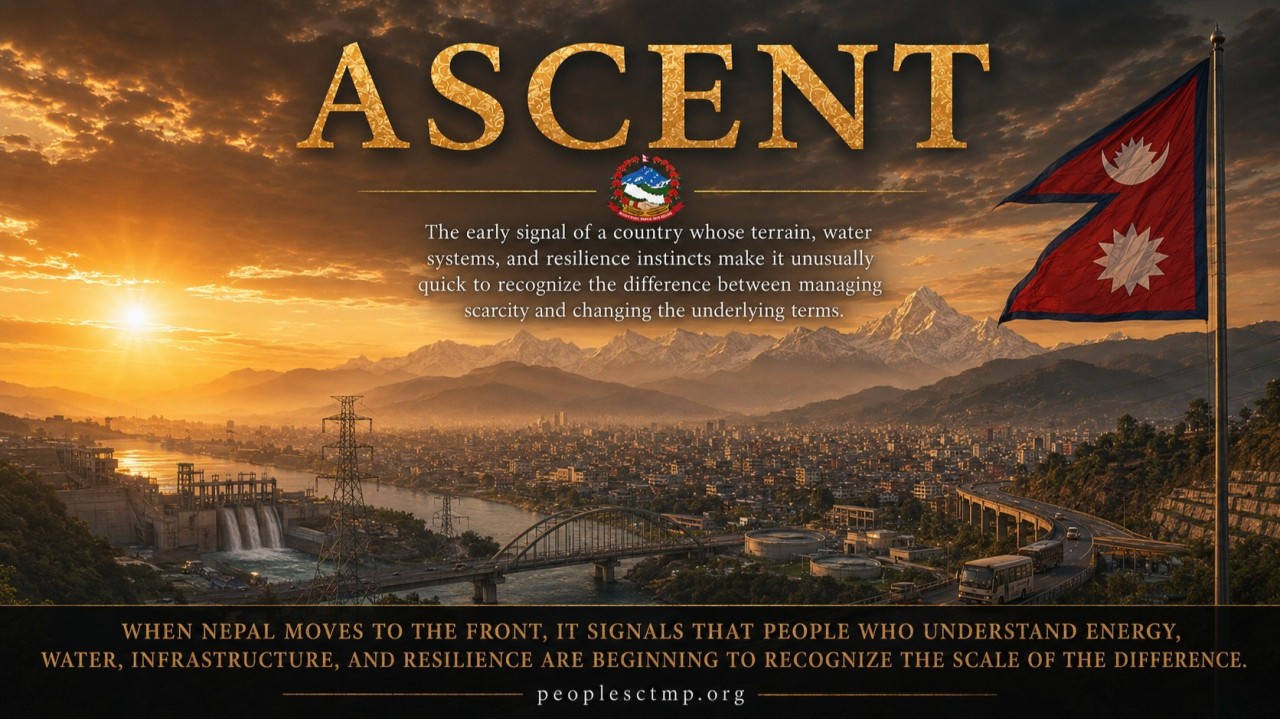
128 signatures from a country of thirty-one million, and the reasons behind them
Nepal is at the top of the Verification Wall today. One hundred and twenty-eight Nepali citizens have signed. Against the country’s Wall threshold of one and a half million signatures, that is 0.0083 percent. It is not a large number in absolute terms. It is the leading number on the leaderboard right now, ahead of South Africa, ahead of the UAE, ahead of Malaysia, Singapore, Peru, Ireland, and Israel.
I want to walk through why. Not with marketing language. With the actual conditions Nepalis live inside, the actual reasons a person in Kathmandu or Pokhara or a village in the middle hills would read about this project and decide to add their name to a public ledger.
Before I start, one disclosure. I have been in conversation with a number of people in Nepal over recent weeks. Engineers, civil society figures, people working in energy and water and rural development. The conversations are part of how the project becomes real in any country. I name this so the reader knows the country is not appearing on the leaderboard by accident, and also so the reader knows that the 128 signatures are still 128 individual decisions by 128 individual Nepalis, none of whom I have asked to sign and none of whom I have any way to compel.
The signatures are the signatures. The conversations are the conversations. The two are connected by the fact that the country has reasons to be paying attention. The reasons are what I want to walk through.
The country, briefly
Nepal sits between India and China, in the high Himalaya and the lower hill country and the plains along the Indian border. The Wall currently uses a thirty-one million population basis for Nepal. The country’s per capita income is among the lowest in Asia. A large number of Nepalis work outside the country, many of them in the Gulf states, sending money home that represents a major share of the national economy, often reported in the high-teens to mid-twenties depending on the source and period. The World Bank’s April 2026 Nepal update, for example, reported remittances at 16.6 percent of GDP in H1FY26.
The country has substantial natural assets. Hydroelectric potential measured in the tens of gigawatts. Mountain water systems that feed major rivers across South Asia. Agricultural land. A young population. A democratic constitution, finalized in 2015 after decades of political conflict.
The country also has significant constraints. Limited fiscal capacity. A geography that makes physical infrastructure expensive to build. Vulnerability to earthquakes, including the major one in 2015. Vulnerability to climate change that affects water systems, agriculture, and mountain stability simultaneously. A history of large international development projects that have produced mixed results, in some cases generating substantial debt without producing the promised outcomes.
This is the country we are talking about. These are the conditions that shape what Nepalis read when they read about the CTMP.
The electricity question
Nepal’s electricity story is paradoxical in a way that matters for what comes next.
The country has enormous hydroelectric potential. Studies commonly estimate Nepal’s theoretical hydropower potential at roughly 83 gigawatts, with about 43 gigawatts considered technically and economically achievable. The country currently uses a small fraction of that. Domestic demand has historically been met by a combination of domestic hydro generation and electricity imports from India.
For most of the last two decades, Nepalis lived with regular load-shedding. Power cuts of eight, ten, twelve, sometimes sixteen hours a day were normal. Households planned their lives around the schedule. Businesses ran on diesel generators when they could afford them.
In recent years, the situation has improved substantially. New domestic generation has come online. The cross-border transmission with India has expanded. Load-shedding in major urban areas is now far less severe than it was a decade ago.
But the improvement masks a structural fact. Nepal exports electricity in the wet season, when its rivers run high, and imports electricity in the dry season, when its rivers run low. The country’s energy security is therefore tied to the politics of cross-border power trading with a much larger neighbor, and to seasonal hydrology that is increasingly affected by glacier melt and changing precipitation patterns.
A Nepali reading about a CTMP module that produces 2,500 terawatt-hours per year, available year-round, with a posted power tariff of 2.5 US cents per kilowatt-hour and public rules limiting extraction above that in downstream resale structures, is reading about something that does not fit the existing pattern at all. The scale would not just close the country’s electricity gap. It would reposition the country from a marginal participant in regional power markets to a structural surplus participant, with the surplus going to the country rather than to external owners.
This is the first reason a Nepali reads the architecture and pays attention.
The water question
Nepal’s water situation is the inverse of what most outside observers assume.
The country has more freshwater per capita than most countries. The Himalayan rivers carry enormous volumes. The monsoon delivers substantial rainfall to most of the country for several months a year.
The country also has serious water stress in many places. The reason is not the absence of water. The reason is the absence of the infrastructure to deliver clean water reliably to the population.
In Kathmandu Valley, where roughly three million people live, piped water is delivered to most households only intermittently. Many neighborhoods receive water for a few hours every several days. The shortfall is filled by tanker delivery, by private bore wells of variable quality, by jar water purchased at retail prices, and by the time-consuming labor of household water collection that falls primarily on women.
The Melamchi Water Supply Project, designed to bring water from the Melamchi River to Kathmandu, was first proposed in the 1980s. Construction took nearly two decades. The system became partially operational in 2021. Flooding damaged the intake infrastructure shortly thereafter. The system has operated intermittently since.
A Nepali reading about a CTMP module’s water output is reading numbers that look strange against this background. Two billion cubic meters per year of mineral-balanced potable water, given to the host country at no charge under the Charter. At the WHO basic-needs threshold of fifty liters per person per day, that volume covers 109.6 million people. Nepal’s Wall population basis is thirty-one million. The module produces, as a free allocation, more than three times the country’s basic-needs water requirement.
The bottleneck is not the water itself. The bottleneck is delivery infrastructure, which is a solvable problem at a scale that a country with abundant skilled labor and engineering capacity can address, once the underlying supply is no longer the constraint.
I want to be honest about a complication here. Nepal is landlocked. A CTMP module is sea-sited. Module placement for Nepal would either require regional delivery infrastructure from a coast in India or Bangladesh, with all the political complexity that implies, or would require a regional arrangement under which a module sited elsewhere serves Nepal alongside its primary host country. Neither arrangement is impossible. Both require coordination beyond what a single host country alone can provide. This is in the published architecture and is not hidden from the reader.
This is the second reason a Nepali might sign. The country has been delivering water poorly for a long time, despite having more water than most places on Earth. A module deployment in the region changes the underlying supply position even with the landlocked complication factored in.
The earthquake question
In April 2015, an earthquake measuring 7.8 struck Nepal. Nearly nine thousand people died, more than twenty-two thousand were injured, and approximately one million structures were damaged. Reconstruction has taken years and is still part of Nepal’s public memory.
International donors pledged substantial assistance. Not all of it materialized. The portion that did was channeled through a mix of government agencies, international organizations, and private contractors whose work has been audited with results ranging from satisfactory to documented diversion.
A Nepali reading about the CTMP architecture’s no-debt, Charter-bound, externally-audited structure is reading something that addresses a pattern the country has experienced directly. The Charter’s provisions are responses to specific failure modes that countries like Nepal have observed in standard international financing. The capital is committed under terms that do not allow the standard extraction. The audit is continuous and public. The host country does not assume debt.
This is the third reason a Nepali might sign. Institutional memory is a significant factor in how citizens evaluate new proposals. Nepal’s institutional memory includes both the value of international assistance and the costs of the way that assistance has historically been structured.
The site weight question
I want to draw a parallel here that may seem technical but is actually about access.
A few weeks ago, the project’s website was approximately thirteen megabytes. That is the size of the page that loaded when someone visited peoplesctmp.org. It loaded fine on a desktop computer with a fast home connection. It loaded slowly on a mobile phone on a metered data plan. In a country where most people access the internet through a phone, and where data is charged by the megabyte, a thirteen-megabyte page is an expensive page to visit.
The site is now approximately three hundred kilobytes. A reduction of about ninety-eight percent. It loads quickly on any connection that supports basic web browsing. It can be opened on a phone in a rural area on a 3G connection without using up the visitor’s data allowance.
This matters for Nepal specifically because mobile internet is widespread, data is metered, and rural connections are slower than urban ones. A site that takes thirty seconds to load and uses substantial data is a site rural Nepalis do not load. A site that loads in two seconds and uses minimal data is a site they will load.
Some of the early Nepali signatures came in after the site became light. The timing is suggestive. The country has a digitally-engaged population, particularly among the under-thirty-five demographic, but it is a population that has been priced out of heavy international web infrastructure for years. Once the access barrier came down, the country started showing up on the leaderboard.
The diaspora question
A large number of Nepalis work outside the country. The remittances they send home are one of the largest single contributors to the national economy. The work they do is often in conditions that the international labor literature has documented extensively.
A CTMP module’s labor requirements are substantial. Construction phase generates millions of job-years. Sustained operations require hundreds of thousands of permanent technical workers. The Charter requires that wages be set against a dignity floor in the country where the work is being done, not against the lowest wage the market will tolerate, and that the work be done primarily by people from the host country and the surrounding region.
For Nepal, this matters in a specific way. The country’s workforce is already deployed internationally at scale. A module deployment in the region creates the possibility, for the first time in the modern era, of large numbers of Nepali workers being employed at scale at dignity-floor wages without leaving home. The remittance flows would not disappear. They would be supplemented by domestic earning at a level the country has not previously seen.
This is the fourth reason a Nepali might sign.
The geopolitical question
Nepal sits between two of the world’s largest economies and two of the world’s most populous states. The country has spent decades navigating the political space between Indian and Chinese interests. Major infrastructure projects in Nepal have historically been subject to that geopolitical context, with funding sources and contractor selection sometimes carrying implications beyond the project itself.
The CTMP Charter is jurisdiction-agnostic and designed so no single state, fund, company, or founder can capture it. No single foreign government, sovereign fund, or private actor can control the platform. It is not owned by India, by China, by the United States, by any Gulf state, or by any other geopolitical actor. The structure is designed to prevent capture at the architectural level.
For a country like Nepal, which has had to weigh the implications of accepting infrastructure from any single major power, an offer that is structurally non-aligned at the architectural level is a different kind of offer. The Charter’s ownership caps were not designed specifically for Nepal’s geopolitical situation, but they happen to address it in a way that few other infrastructure proposals have been able to.
A Nepali signing the Wall is making a calculation that includes this dimension.
What CTMP cannot do for Nepal
I want to be explicit about the limits.
The CTMP cannot resolve the political contests that shape Nepali governance. It cannot reform the parties, end the cycles of coalition government, or change the patterns of patronage and contestation that have characterized post-2015 Nepali politics. These are matters of Nepali political work.
The CTMP cannot prevent future earthquakes or other natural disasters. The modules themselves are not sited in Nepal, since Nepal is landlocked, and the question of how a module sited regionally serves Nepal involves negotiation with coastal neighbors that the platform cannot conduct on Nepal’s behalf.
The CTMP cannot guarantee that Nepali workers will benefit in proportion to the country’s contribution. The Charter sets the wage floor. It does not guarantee that the country’s political and economic institutions will distribute the resulting prosperity equitably across regions, ethnicities, castes, and genders.
The CTMP cannot end the diaspora. Many Nepalis who work abroad do so for reasons that include family histories, established networks, and preferences that go beyond pure economic calculation. A domestic alternative at scale changes the choice set. It does not erase the existing choices.
These limits are real. The arithmetic on the favorable side is also real. The two should be weighed together.
Why 128 signatures matters
So why is Nepal at the top of the leaderboard with 128 signatures?
The leaderboard ranks countries by progress toward their own thresholds. Nepal’s threshold is 1.55 million signatures, calculated as five percent of the Wall’s population basis. 128 signatures is 0.0083 percent of that threshold. South Africa, in second place, has 231 signatures against a threshold of 3.1 million, which is 0.0075 percent. The arithmetic favors Nepal at the moment by a small margin.
This is the fairness mechanism. A country does not lead by having a large population or by having loud social media. It leads by having a higher percentage of its own population engaged relative to the threshold the population’s size produces.
What 128 signatures shows, for Nepal, is the early stage of a population beginning to engage with the architecture. The country is far from verification. But the rate at which Nepalis are signing, against the country’s threshold, is currently higher than the rate at which any other country’s citizens are signing against theirs.
This may not last. Other countries may surge. The leaderboard has shifted many times over the recent weeks and will shift again. What it demonstrates today is that, given the conditions in Nepal that I have laid out above, enough Nepalis have read the architecture and decided to act on it that the country has moved to the front of the line.
The reasons are not mysterious. They are visible in the country’s electricity history, its water delivery patterns, its earthquake reconstruction experience, its diaspora economy, its geopolitical position, and the recently-improved accessibility of the site itself. Each reason on its own would not necessarily produce a leaderboard position. Cumulatively, they produce one.
128 Nepalis have done the arithmetic and signed.
The threshold ahead
Nepal needs roughly 1,549,872 more signatures to reach verification. That is a significant number. It is also a knowable number. The country has reached 128 organically, with the site newly accessible and the architecture published in plain language. What happens between now and a million and a half is a question of whether the early signal becomes sustained motion.
The Wall is open. The architecture is at peoplesctmp.org. Verification is free, name-only, and does not require a donation, purchase, account, or follow-up of any kind. A Nepali signing today adds their name to a public ledger that is currently in front. A Nepali signing tomorrow does the same.
The country is leading. The work is ahead.
Christopher M. Coode Founder and CEO, Hutchison Lea ConneXions Inc. Architect and Steward, People’s CTMP peoplesctmp.org