Transition, Why Azerbaijan Has Moved to the Front of the Wall
May 26, 2026
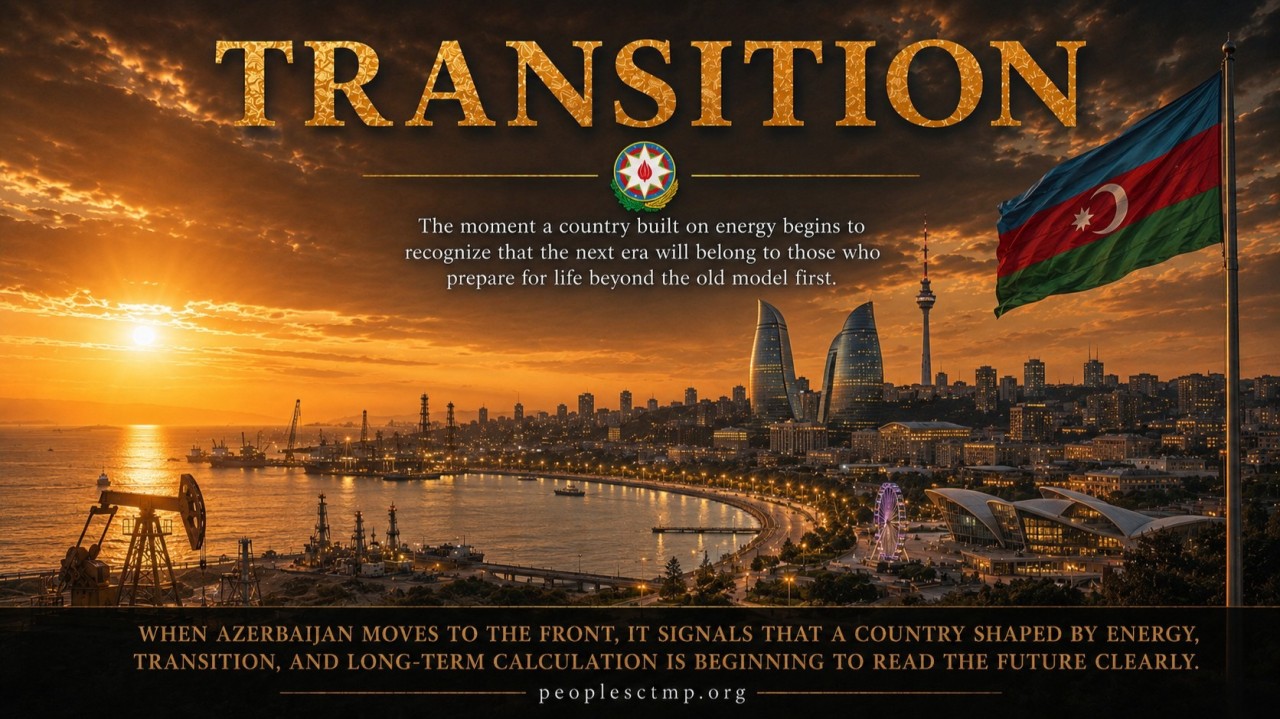
A country of ten million has just moved to the top of a global public ledger. Here is what that means.
Azerbaijan moved to the top of The Wall this week. Forty-seven citizens have signed against the country’s Wall target count of 520,000, which puts the country at 0.92 percent of the count needed for early review. That is the highest completion rate of any country on the leaderboard at this moment, ahead of Nepal, South Africa, the United Arab Emirates, Malaysia, Singapore, Israel, and Iraq, in that order.
I want to walk through what this means, why it matters, and what is actually being measured here. The audience for this piece includes officials and observers in many countries, so I will be careful with the language. Plain, accurate, no exaggeration.
What the leaderboard actually measures
The Wall is a public signal layer. Citizens of any country can add their name to indicate that they want their country to be considered for early buildout of a People’s CTMP deployment. A deployment is a major energy, water, and industrial infrastructure platform with seventeen associated verticals. The first deployments will be considered in countries whose populations reach their required counts first, subject to engineering, regulatory, siting, and government acceptance conditions.
Each country has its own target count, calculated as five percent of the Wall population basis, with a minimum floor of 250,000 signatures. The mechanism is designed to be fair across countries of very different sizes. A smaller country needs fewer absolute signatures to reach its target count. A larger country needs more. Countries are ranked by progress toward their own target counts, not by raw signature count.
This last point matters. When the leaderboard shows Azerbaijan ahead of South Africa, it is not saying Azerbaijan has more signatures in total. South Africa has 231 signatures. Azerbaijan has 47. South Africa is leading on absolute volume. Azerbaijan is leading on progress toward its own target count. The ranking favors the country whose citizens are engaging at a higher rate relative to that country’s own size.
This is the fairness engine of the system. It prevents large countries from dominating by default. It allows a country of roughly ten million people to lead a country of roughly sixty million if the smaller country’s population is moving more quickly relative to its own target count. That is what is happening right now.
Where Azerbaijan sits
Azerbaijan is a country of approximately ten million people on the western shore of the Caspian Sea, between the Caucasus Mountains and the Iranian border. The Wall currently uses a 10.4 million population basis for Azerbaijan, which produces a 520,000-signature target count. Current UN-based estimates place Azerbaijan’s 2026 population at roughly 10.45 million, so the Wall basis is a rounded operating figure rather than a census claim.
The country has substantial energy resources, particularly hydrocarbons, and has been a net exporter of oil and natural gas for over a century. Baku, its capital, sits on the Caspian coast and has been one of the historic centers of the global energy industry.
Azerbaijan’s economic profile remains strongly tied to oil and gas. The IMF reported that in 2024 the oil and gas sector accounted for 32.2 percent of Azerbaijan’s nominal GDP and 52.0 percent of total consolidated government revenues. U.S. trade reporting also states that energy products accounted for approximately 87 percent of Azerbaijan’s total exports in 2024.
Like every country with this profile, Azerbaijan faces a structural question that will define the coming decades. The hydrocarbon economy that helped build modern Azerbaijan will not continue under the same global assumptions indefinitely. Demand patterns, investment rules, carbon exposure, and reserve economics are changing. Carbon Tracker has warned that fossil fuel companies risk wasting up to $2.2 trillion on projects that could become uneconomic under climate policy and clean-technology transition pressure.
This is the context in which Azerbaijani citizens are reading the People’s CTMP architecture.
Why a person in Baku might sign
I want to do something I do not always do in these country pieces. I want to imagine a specific person, because the leaderboard is moved by specific people, not abstractions.
Imagine a young woman in Baku, late twenties, an engineer or a teacher, perhaps with a young child. Her household runs on electricity from a grid still deeply shaped by natural gas. The IEA has described Azerbaijan’s domestic energy supply as heavily reliant on natural gas and oil, with natural gas generating most of the country’s electricity and heat in 2020.
Her parents and grandparents lived through the late Soviet period and the early independence years. She has lived through a different period, one in which the country has been wealthier than it was, but in which the future of that wealth has begun to feel less certain.
She reads about the People’s CTMP. The architecture is published. The Stewardship Charter is published. She sees that one CTMP buildout is designed to produce roughly 2,500 terawatt-hours of electricity per year. She sees that one CTMP buildout is designed to produce approximately two billion cubic meters of mineral-balanced potable water per year for the host country. She sees that the buildout is financed without government debt being assumed by the host country. She sees that the Core power price is posted at 2.5 US cents per kilowatt-hour, with public rules limiting extraction above that in downstream resale structures. She sees that the architecture is designed so no single state, fund, company, or founder can capture it.
She does the arithmetic. The household electricity she currently pays for. The water security questions that affect different parts of the country. The economic transition her country will have to make in the coming decades. The fact that her child will grow up in a different energy economy than the one she inherited.
She signs.
She does not need to understand the entire architecture to sign. She needs to understand that the architecture exists, is published, is checkable, and is designed so that it cannot be quietly captured. The mechanism then takes her signature and adds it to her country’s progress.
Forty-seven Azerbaijanis have done some version of this calculation in the past several days. Forty-seven is a small number in absolute terms. It is enough, against Azerbaijan’s Wall target count of 520,000, to move the country to the top of the leaderboard. That is what the fairness engine is for.
What Azerbaijan leading the leaderboard does not mean
I want to be careful here, because the audience for this piece includes officials who will read between the lines, and I do not want anything to be misunderstood.
Azerbaijan leading the leaderboard does not mean Azerbaijan has been selected. It does not mean a CTMP deployment will be sited there. It does not mean the Azerbaijani government has agreed to anything. The Wall measures civic signal. It is not a binding agreement with any state, and it does not commit the platform to any specific siting decision.
It does not mean Azerbaijan has reached its target count. The country needs 519,953 more signatures to cross the required count. That is a significant number. Forty-seven signatures is a starting position, not a result.
It does not mean Azerbaijan will hold the lead. The leaderboard has changed many times over the past several months. Bulgaria led at one point. Ireland led. The United Arab Emirates led. Peru reached triple digits first. South Africa pushed the absolute count up. Nepal led until today. Azerbaijan leads today. Tomorrow may be different.
It does not mean other countries are behind in any final sense. Nepal, South Africa, the UAE, Malaysia, Singapore, Israel, and Iraq are all close enough that a surge in any of these countries could change the order within hours. The leaderboard is alive and competitive, which is the property that distinguishes a working mechanism from a static display.
What Azerbaijan’s lead does mean is that, at this moment, the country’s citizens are demonstrating the highest rate of engagement with the architecture relative to the country’s own Wall target count. That is the signal the leaderboard is designed to capture.
What this looks like from a government office
Most readers of this piece who hold positions of responsibility will be asking a specific question. What does this leaderboard mean for the country I work in?
The Wall is not a political mechanism. It does not endorse parties. It does not advocate for or against any government. It does not interfere in elections. It does not lobby legislatures. It is a public measurement instrument that records civic interest in a particular infrastructure architecture being considered for that country.
For an official reading the leaderboard, the relevant question is whether citizens are engaging with the architecture, and at what rate. If a government finds the architecture worth understanding, the Stewardship Charter is published, the public materials are available, and direct contact with the project is straightforward. No government has been asked to commit to anything, and no government will be asked to commit to anything until the country’s citizens have reached the required count and the engineering, regulatory, siting, and government acceptance work has been completed under Charter terms.
The architecture is structurally non-aligned. It is not designed to be owned or controlled by India, China, the United States, a Gulf state, a national investment fund, a public market, a lender group, or the founder. The external equity architecture is capped. The Core carries no debt, no liens, and no public stock listing. The structure is built to prevent capture before capture appears.
For Azerbaijan specifically, this means that the question of CTMP siting, if it ever reaches that stage, would be a state-level matter for the Azerbaijani government to consider on its own terms, with no obligation created by the leaderboard ranking. The leaderboard is a measurement. The siting is a decision. The two are connected, but they are not the same thing.
What the architecture offers a host country
Precision matters when officials are reading, so I want to be clear about what is on the table.
A CTMP deployment in a host country is designed to produce approximately 2,500 terawatt-hours of electricity per year under a posted Core power price of 2.5 US cents per kilowatt-hour. It is also designed to produce approximately two billion cubic meters of mineral-balanced potable water per year, given free, to the host country. Using a fifty-liter-per-person-per-day basic-needs benchmark, that water volume covers the basic daily water requirement of more than 109 million people.
The CTMP deployment is not just an energy and water facility. It sits inside a wider industrial platform: seventeen verticals covering energy, water, green materials, molecules, logistics, data, manufacturing, carbon, R&D, and associated infrastructure. The point is not only to produce cheap electricity. The point is to change the underlying input structure that determines what a country can build, manufacture, finance, move, grow, cool, desalinate, and repair.
The labor implications are substantial. Construction creates millions of job-years. Sustained operations require large numbers of permanent technical positions. Charter-governed wage rules are designed around a dignity floor in the host country, not the lowest wage the market can tolerate.
The financing structure does not require the host country to assume government debt, issue bonds, or guarantee unbounded returns. The platform carries no Core debt. It has no public stock listing and cannot be subjected to a hostile takeover. External equity is capped, with bounded returns. Capital that accepts Charter limits can participate. Capital that requires capture cannot.
These are the terms. They are documented. They are checkable. They are the same in every country.
What the architecture cannot offer
I am required, by my own commitment to honesty, to name what the architecture cannot offer. This is the section officials should read carefully.
The Stewardship Charter cannot resolve any country’s internal political contests. Whatever a country’s politics are, the architecture operates inside them, not around them. It does not endorse, oppose, or interfere with governance.
The Charter cannot guarantee that any specific country will be selected for early buildout, regardless of leaderboard position. Other factors, including site engineering, regional considerations, supply chain readiness, security, and government acceptance, shape the actual sequence. The leaderboard establishes civic signal and preference. It does not establish certainty.
The Charter cannot operate without host government acceptance of its terms. If a government decides not to engage, the platform cannot be sited there. The Wall measures population intent. It does not bind the state.
The Charter cannot replace any government’s national decision-making on energy, water, or industrial policy. It offers a specific instrument with specific terms. The choice to engage with that instrument remains with the country.
The Charter cannot prevent any country from changing its mind. If a host country, after engagement, decides to discontinue, the platform has procedures for that. The architecture is designed to be robust against political change in host countries, but it does not override national choice.
These limits are real. I name them so there is no confusion downstream.
Why I think Azerbaijan being at the top tonight matters
I want to close with something larger than tonight’s number.
Every country that has led the leaderboard since The Wall opened has come from a different part of the world and has carried a different set of conditions into its lead. Bulgaria. Ireland. The United Arab Emirates. Peru. South Africa. Nepal. Azerbaijan. Each lead has demonstrated something specific about who is reading the architecture and acting on it.
Azerbaijan’s lead tonight demonstrates something worth naming. A hydrocarbon-producing country, sitting at the seam between Europe and Asia, with a long history in the energy industry and a clear reason to think hard about the structural transition ahead, now has citizens engaging with an architecture built for the world that comes after the hydrocarbon economy. That is not nothing. That is a signal about how the future is being read in places where the present was built on the past.
I am not going to predict what happens next. The leaderboard will move. Other countries will surge. Azerbaijan may hold the lead, or it may be passed. What matters is that the mechanism is doing what it was designed to do. Citizens of countries weighing their long-term futures are finding the architecture, reading it, and acting on it. The Wall is recording their actions. The leaderboard is reflecting the result.
For officials reading this from anywhere in the world, the architecture is available at peoplesctmp.org. The Stewardship Charter is published. The public materials are available. The Wall is open. Signing is free, name-only, and does not require a donation, purchase, account, or follow-up of any kind.
For Azerbaijanis who have signed already, thank you for moving your country into a position where the rest of the world is now paying attention. The work ahead is large. The number of signatures needed is significant. The position you hold tonight is a starting line, not a finish.
For Azerbaijanis who have not signed and are considering it, signing is at peoplesctmp.org. You will find your country at the top of the leaderboard right now. Your signature is the next one that adds to the count.
The mechanism is working. The architecture is real. The choice belongs to citizens.
Christopher M. Coode Founder and CEO, Hutchison Lea ConneXions Inc.
Architect and Steward, People’s CTMP