Motion, Serbia Is Now in First Place on the Wall
May 27, 2026
A small country in the Balkans just moved to the top of a public worldwide list. Here is what that means in plain words.
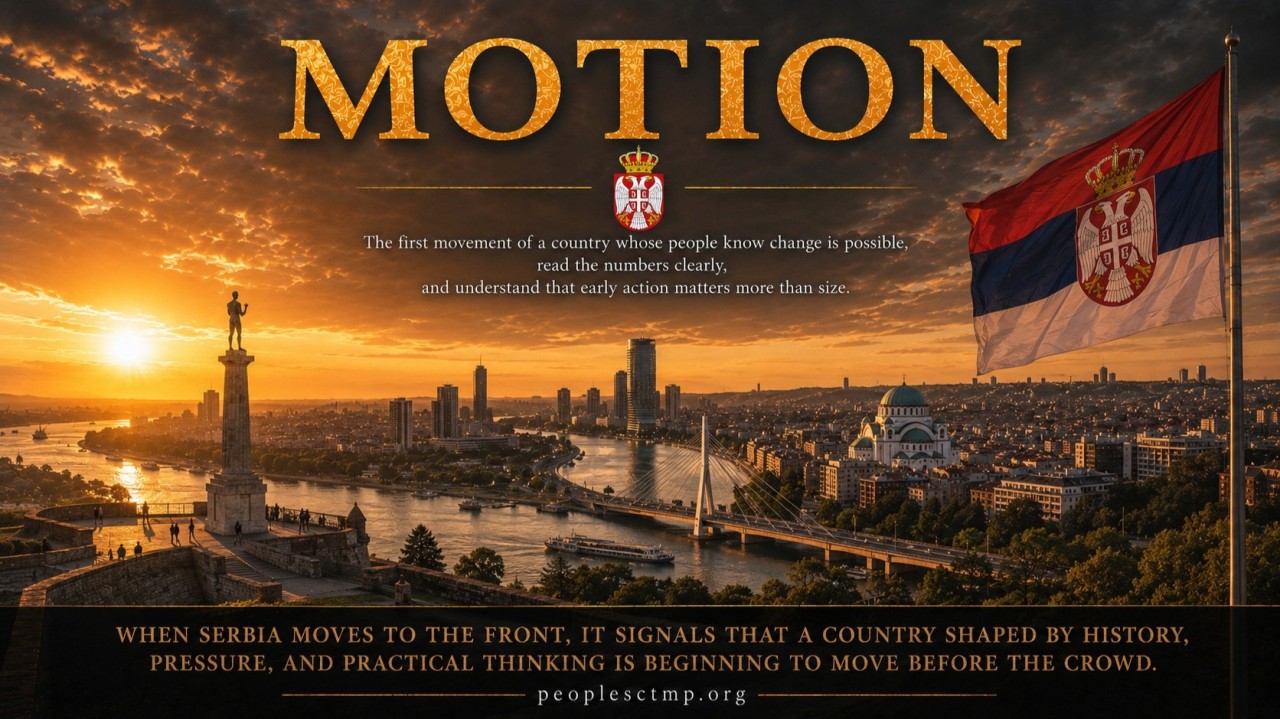
Serbia moved into first place on the public worldwide list this week. Thirty-one people in Serbia have added their names. The country sits at the top of the rankings, ahead of Azerbaijan, Nepal, South Africa, the United Arab Emirates, Malaysia, Singapore, and Israel.
I want to walk through what just happened, what it does not mean, and why a country with about six and a half million people has moved ahead of larger countries. The piece is written so anyone in the world can follow it. If you are reading in a second or third language, the words I use should be ones you already know.
What the public list is
Before going further, I want to be clear about what is being counted, because the words I use elsewhere in this project sometimes assume background you may not have.
The public list, which we call the Wall, is a website. People go to the website and add their name to it. The name is anonymous. No follow-up. No money asked for. No identity collected. Just one signal that the person would like their country to be considered for a new piece of infrastructure that we are planning to build.
The infrastructure produces two things that every country needs. A lot of clean electricity. A lot of clean water. We are planning to build eighty of these around the world over the coming years. The first ones will be built in the countries whose people show, on the public list, that they want them.
The list ranks countries by how close each country is to its own target. Each country has a different target, because every country has a different number of people. A small country needs fewer names than a large country to reach its target. A country with seven million people needs about 335,000 names. A country with sixty million people needs about three million names. This is fair, because it asks the same share of the population from each country, not the same total number.
When a country is at the top of the list, it does not mean that country has the most names. It means that country has moved the furthest toward its own target, relative to its size.
That is what Serbia has done.
Where Serbia is
Serbia is a country in the middle of southeastern Europe, often called the Balkans. It does not have a coast. It is surrounded by other countries: Hungary to the north, Romania and Bulgaria to the east, North Macedonia and Kosovo to the south, Montenegro to the southwest, and Bosnia and Herzegovina and Croatia to the west.
The capital is Belgrade, which sits where two large rivers, the Sava and the Danube, meet. The country has about six and a half million people. The population is somewhat older than the world average, and the country has been losing young people for years to work opportunities in the European Union, particularly in Germany and Austria. This is a quiet pressure that shapes how people in Serbia think about the future.
The Serbian economy includes farming, manufacturing, and a growing technology sector. The country has a long history. It was part of the Yugoslav federation in the second half of the twentieth century. It went through difficult years in the 1990s during the wars that broke that federation apart. Since then, it has rebuilt, joined some European institutions, and continued to work toward closer ties with the European Union, while also keeping relationships with countries to the east.
I am being careful with this section. The audience for this piece includes people in Serbia and people in countries that have complicated histories with Serbia. The history is what it is. The country today is what it is. The thirty-one Serbians who have signed this week are doing so as residents of the country they live in now, with the future they are looking at now.
Why thirty-one names moved the country to first place
The arithmetic is what matters here.
Serbia's target on the list is 335,000 names. Thirty-one names is 0.0093 percent of that target. That is a very small share. But it happens to be the highest share among the countries on the leaderboard right now. Azerbaijan is at 0.0092 percent. Nepal is at 0.0083 percent. South Africa is at 0.0075 percent. The numbers are all close together. The country at the top is the one whose people are signing fastest relative to their country's own target.
Thirty-one is small. I want to be honest about that. Serbia needs 334,969 more names to reach the target. The country is not close to that target. What thirty-one demonstrates is the start of motion, not the result of motion. The country has moved to first place because the rate of signing in Serbia, over the past few days, has been higher than the rate in any other country on the leaderboard, relative to size.
Tomorrow may be different. Other countries may have a surge of signatures and pass Serbia. The leaderboard has changed many times over the past several months, with different countries holding first place at different points. What Serbia leading today shows is that, at this moment, the people of Serbia are paying attention and acting.
Why people in Serbia might be paying attention
I want to think out loud about why Serbians, in particular, would be among the people most willing to read about and sign for a project like this. I am not Serbian. I am speaking as an outside observer who has watched the leaderboard move and is trying to understand what the move suggests.
Serbia is a country that has lived through several major transitions in living memory. Most adults in Serbia remember a different political system, a different economic system, and in some cases a different country. People who have lived through change know that change is possible. They are not as easily told that things must remain as they are.
Serbia is also a country whose energy and water systems are real and visible parts of daily life. The country still uses a lot of coal for electricity. The air in some Serbian cities, particularly in winter, is among the most polluted in Europe. People can see it. They can feel it in their throats. The cost of energy is a topic that affects how families budget their month. The state of the water and sewage systems in some smaller towns is something residents talk about openly.
A project that proposes to deliver a very large amount of clean electricity at a price the country has not seen before, and to deliver clean water at no charge as part of the same arrangement, is the kind of project Serbians will read carefully. The country has been promised many things by foreign investors over the years, and the country knows how to evaluate whether a promise is serious. The architecture we have built is checkable, the rules are published, and the financing does not require the country to take on any debt. These are the kinds of details Serbians who have seen many proposals will look at first.
Thirty-one of them have looked at those details and decided to sign. That is not a wave. It is a starting point.
What Serbia leading does not mean
I need to say this clearly, because the audience for this piece includes officials and observers who will read carefully and who deserve precision.
Serbia leading the public list does not mean Serbia has been chosen.
It does not mean a piece of the infrastructure will be built in Serbia.
It does not mean the Serbian government has agreed to anything.
It does not mean Serbia will hold the lead through tomorrow.
It does not mean other countries are losing in any final sense. The countries on the leaderboard right now, Azerbaijan, Nepal, South Africa, the United Arab Emirates, Malaysia, Singapore, Israel, are all within a narrow band. Any of them could move ahead of Serbia within hours if their people sign more.
What it does mean is that, at this moment, the share of Serbians acting is higher than the share of any other country's people acting. That is the signal the list is designed to measure, and Serbia is sending the strongest version of it tonight.
A note for people in any country reading this
If you are reading this from somewhere other than Serbia, I want to take a moment to address you directly.
The same list is open to your country. Every country on Earth is on the list. The target for your country is calculated the same way: five percent of the country's population, with a minimum of 250,000 names. If your country has not started moving on the list yet, the reason is simply that not enough people in your country have signed. There is no political requirement, no fee, no follow-up, no commitment beyond the single signature.
The signing takes a few seconds. You go to peoplesctmp.org. You find your country. You sign. That is the whole process.
Different countries are at different stages. Some are leading. Some have a few names. Some have none. None of this is final. The list moves every day. The country that is at the top of the list when it reaches its target is the country that will be first in line for serious buildout consideration, subject to engineering, location, legal, and government acceptance work.
If you live in a country that is not yet on the leaderboard, your country could be the next to move. The mechanism does not favor large countries. It does not favor wealthy countries. It does not favor any region. It favors the country whose people show up.
What the project would mean for Serbia
I want to walk through what it would mean if Serbia ever reaches its target and the infrastructure is built somewhere in the region for Serbia's benefit. The country does not have a coast, which is a real engineering question, because the infrastructure sits on the sea. But the region around Serbia includes coastlines, and arrangements with neighboring countries are part of the published architecture.
If a piece of this infrastructure is built and serves Serbia, here is what would happen for the country:
The country would receive a large quantity of clean water every year, free, delivered through pipelines from the regional source. The amount is far more than Serbia would need for basic household use, which means surplus water would be available for agriculture and industry as well.
The country would have access to a large amount of clean electricity at a price set by published rules. The published structure is designed to keep household and business power pricing from being pushed above five US cents per kilowatt-hour before normal taxes or regulated delivery charges. Serbia's current electricity prices are higher than that, depending on how you measure, and the price has been under upward pressure for years. The new arrangement would bring the ceiling down and hold it down.
The country would have a major employer for the next several decades. Building and running the infrastructure requires a lot of workers. The published rules require that the workers be paid against the cost of a basic life in the country where the work is done, not against the lowest wage the market will accept. For Serbia, this would be a meaningful number of permanent jobs in a country that has been losing young workers for years.
The country would not take on any debt to make any of this happen. The project is financed by its own capital structure. No government has to issue bonds. No bank has any claim on any of the assets. This is unusual and worth noting, because it is the opposite of how most large infrastructure projects have been arranged in the region over the past thirty years.
I am not promising any of this will happen for Serbia. The country has just started moving on the list. There is a long way between thirty-one names and 335,000 names. What I am describing is what the architecture offers a country that does reach its target.
What the project cannot do for Serbia
I am required by honesty to name this part too.
The project cannot fix Serbia's political differences with its neighbors. Those are matters for Serbia and its neighbors.
The project cannot reverse the loss of young people to work in Germany and Austria all by itself. It can offer a counter-pull, with serious employment at decent wages, but the choice to stay or leave will still be a personal choice for each Serbian.
The project cannot clean Serbia's air on its own. The energy that the infrastructure provides will displace coal generation over time, which will help, but the country has other pollution sources that the project does not touch.
The project cannot replace the work of Serbian institutions. It does not write laws. It does not run schools. It does not run hospitals. It does not vote in elections. It is one piece of physical infrastructure with a published rule book, sitting alongside everything else a country does for itself.
I name these limits so that no one reads this piece and thinks I am promising something that is not on the table.
The closing thought
Thirty-one Serbians have added their names to a public worldwide list this week. The list is open. The architecture is published. The numbers are checkable. The country has moved to first place because the share of its people acting is higher than the share in any other country at this moment.
The project will respect whatever choices Serbia and its citizens make. If the country continues to move on the list and reaches its target, the published architecture will be applied. If the country does not, the list will keep moving among other countries, and the project will continue.
What I find worth noting, as someone watching the list from outside Serbia, is the kind of country that has moved into first place. Not a wealthy country. Not a large country. Not a country that is widely featured in the global press. A country of six and a half million people, in the Balkans, with a complicated history and a clear-eyed view of what it has to work with. Thirty-one of its people have started something.
If you are Serbian and you have not yet signed, the list is at peoplesctmp.org. Find your country. Add your name. The signing is free, anonymous, and takes a few seconds. You are not committing to anything beyond that single signal.
If you are not Serbian and you are reading this from anywhere else, the same list is open to your country. The mechanism does not favor any country. It records what people do. The country whose people move it the most goes first.
The list is alive. The architecture is real. The choice belongs to citizens, in every country, including yours.
Christopher M. Coode Founder and CEO, Hutchison Lea ConneXions Inc. Architect and Steward, People's CTMP peoplesctmp.org