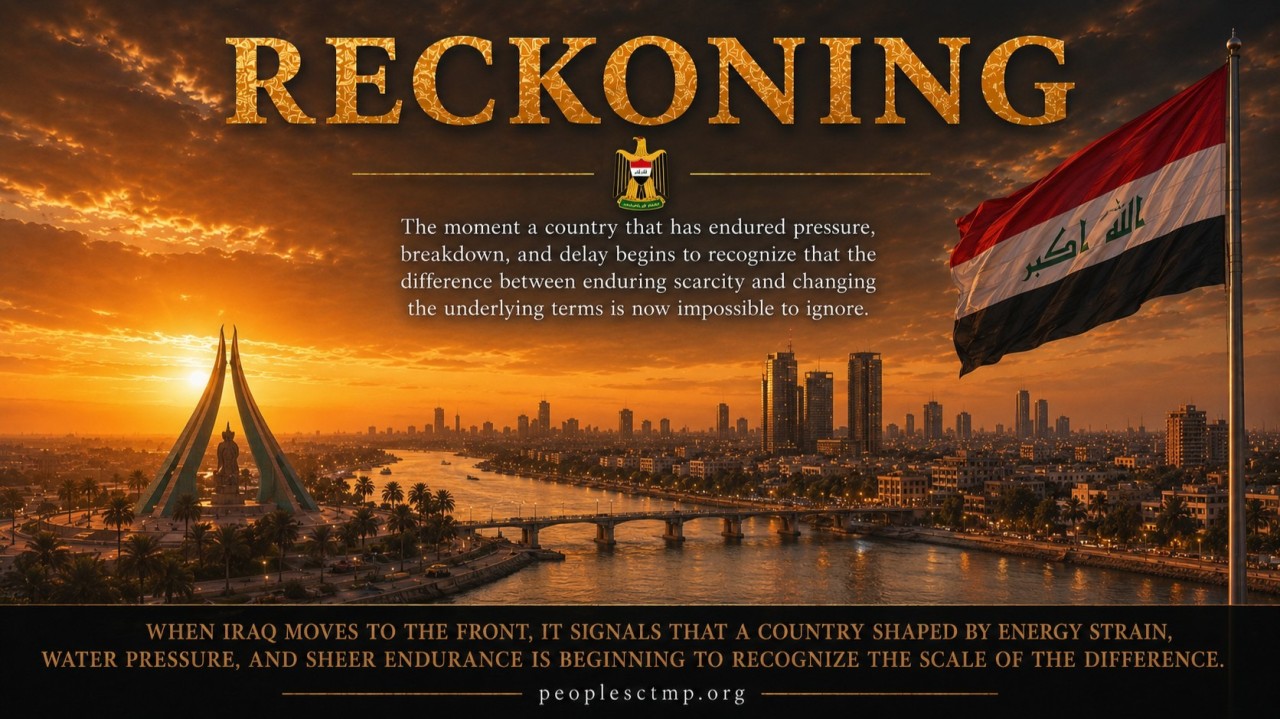
Reckoning, Iraq Has Moved Into First Place
May 28, 2026
Two hundred and ten people in Iraq have added their names to a worldwide public list. Their country is now leading it.
Iraq moved to the top of the worldwide public list this week. Two hundred and ten people in Iraq have added their names. That works out to 0.0094 percent of the country’s target, which is the highest share of any country on the list right now, ahead of Serbia, Azerbaijan, Nepal, South Africa, the United Arab Emirates, Malaysia, and Singapore.
I want to walk through what this means in plain words. The audience for this piece includes Iraqis, people in countries near Iraq, and people anywhere in the world who follow these things. I will be careful with the language. Direct, accurate, no exaggeration.
What is being counted
Before going further, I want to make sure the reader understands what the list is, because I do not want to assume background that you may not have.
The list is a website. The website is called The Wall. People go to the website and add their name to it. It is a name-only public signal, not a donation, not an application, and not an identity check. There is no money asked for. The signing takes a few seconds.
What people are signing for is to put their country in line to receive a large piece of infrastructure that produces two things every country needs: a great deal of clean electricity, and a great deal of clean water. We are planning to build eighty of these around the world over the coming years. The first builds will go to the countries whose people show, on the public list, that they want them.
Every country has a different target on the list, because every country has a different population. The target is calculated the same way for everyone: five percent of the population, with a minimum required count of 250,000 names. A small country needs fewer names. A large country needs more. The ranking on the list is by progress toward each country’s own target, not by total number of names. This is the part that lets a country with fewer people lead a country with more people, fairly.
That is what has happened with Iraq.
How 210 names moved Iraq to first place
Iraq’s current target on The Wall is 2,225,000 names. Two hundred and ten is a small share of that. It works out to 0.0094 percent.
But across the leaderboard right now, the numbers are very close together. Serbia sits at 0.0093 percent. Azerbaijan is at 0.0092 percent. Nepal is at 0.0083 percent. South Africa is at 0.0075 percent. The countries are all in a narrow band, with the rate of new signing in each country deciding who is ahead at any given hour.
Iraq’s lead comes from the fact that the rate of signing in Iraq has been higher than the rate in any of the other countries, relative to size. That is what put 210 names into first place.
I want to say this carefully: 210 is small. Iraq needs 2,224,790 more names to reach its target. That is a large gap. The country has not completed the job. What 210 demonstrates is the start of motion, not the end of it.
But starts matter.
Especially this start.
Where Iraq is, and what its conditions are
I am going to describe Iraq the way I have described every country in this series, with care, without flattery, without condemnation, and without dwelling on any single chapter of its history.
Iraq is a country of roughly forty-five to forty-six million people in the Middle East. Iraq’s own 2024 national census put the population at about 45.4 million, while the World Bank’s 2024 data series reports about 46 million. It borders Iran, Turkey, Syria, Jordan, Saudi Arabia, and Kuwait. The capital is Baghdad, which sits on the Tigris River. The country also has the Euphrates River running through it. These two rivers are among the oldest continuously used water systems for civilization on Earth.
Iraq has substantial oil resources and remains heavily tied to oil and gas. The International Energy Agency describes Iraq as holding abundant oil and gas resources, with production expected to remain globally significant through 2030. Outside the oil sector, the country still faces the long work of building a more diversified economy.
I am not going to walk through Iraq’s difficulty in detail. The reader knows the broad shape of it. Iraq has lived through a long stretch of years that I would not wish on any country on Earth. Most readers will have their own memory of headlines from one period or another. I will note only this: the country today is not just the country of the headlines. It is a country with a young population, universities, engineers, doctors, writers, farmers, tradespeople, families, and communities doing what people in every country do, which is build their lives.
What the country does not yet have, reliably, is the basic infrastructure that supports those lives at the scale the population needs.
The electricity problem
I want to walk through the specific reasons an Iraqi might be paying attention to a piece of infrastructure that produces electricity and water. The electricity reason comes first, because it is the most visible.
Iraq has been short of electricity for as long as most people alive in the country can remember. The grid has been damaged, repaired, expanded, stressed, and repaired again. It has still not reached the point where it consistently meets the country’s demand.
In the summer, when temperatures in Baghdad and other cities can climb to around 50 degrees Celsius or higher, the demand for electricity to run air conditioning is enormous. Iraq experienced a nationwide outage in August 2025 during extreme heat, with reporting citing temperatures over 50 degrees Celsius and a major loss from the grid. Families who can afford it run private generators. The cost of running those generators is a real burden on household budgets. Families who cannot afford generators simply sit in the heat.
This is not a small problem. In a country where summer temperatures can move beyond what the human body can safely endure for long without cooling, electricity is a question of public health. Older people are at risk. Children are at risk. Workers are at risk. The economic cost is large. The human cost is larger.
An Iraqi reading about a piece of infrastructure that can produce approximately 2,500 terawatt-hours of electricity per year, available year-round, is reading about something that does not fit the existing pattern at all. For comparison, federal Iraq generated an estimated 150 terawatt-hours of electricity in 2023. The numbers describe a country that could move from shortage to surplus.
That is the first reason 210 Iraqis have signed.
The water problem
The water problem is older than the electricity problem and in some ways harder.
Iraq has the Tigris and the Euphrates, which sounds like abundance. The reality is more complicated. Both rivers begin outside Iraq. Water flows are affected by upstream use, dams, drought, pollution, and climate stress. UNICEF has reported that Iraq’s 2020-2021 rainfall season was the second driest in forty years, with major reductions in Tigris and Euphrates flows and worsening freshwater quality pressures.
Inside Iraq, the river water that does arrive is often under stress by the time it reaches the southern cities. Salt levels and pollution are serious concerns. The marshlands in the south, which were among the largest freshwater wetlands in the Middle East, have been damaged by drought, drainage, and reduced river flow. Fishing communities that have lived in those marshes for generations have lost much of the water system that sustained them.
Beyond the rivers, Iraq is dry. Much of the country is desert. Groundwater is being depleted in many areas faster than it is being replenished. Climate change is making all of this worse. Summers are getting hotter. Rainfall is less reliable.
A piece of infrastructure that can produce two billion cubic meters of clean potable water per year, delivered to the host country under published public rules, is the kind of arrangement that addresses Iraq’s water problem at the scale the country needs. The amount produced is enough to cover basic-needs water for far more than Iraq’s current population. The surplus could support households, agriculture, industry, or regional cooperation, depending on what Iraq chose to do with it.
That is the second reason 210 Iraqis have signed.
The employment problem
Iraq has a very young population. UNICEF’s 2024 Iraq reporting says the population grew to approximately 45 million in 2024 and that 60 percent of the population is under 25. Youth unemployment is also severe. World Bank-linked data reports youth unemployment in Iraq at roughly 32 percent in 2024. Many young people who do have work are in or around the public sector, because the private economy outside oil has not grown large enough to employ everyone.
This is not sustainable. The government cannot absorb every young person forever. Oil revenue is volatile. Iraq has to develop a private economy that can employ people at scale, inside the country, or it will lose too much talent to migration, frustration, and underuse.
A build of the kind we are proposing creates large amounts of work during construction. Once operating, it supports permanent technical, industrial, logistics, water, power, maintenance, and manufacturing jobs. The published rules are designed so that the work is done primarily by people from the host country and the region, and that wages are measured against the cost of a basic life in the country where the work is done, not against the lowest wage the market can force someone to accept.
For Iraq, this means a major long-term employer in a country where major employers outside oil are rare. The skills required are exactly the kinds of skills Iraqi universities and technical schools can produce: engineering, materials science, construction, project management, metallurgy, logistics, electrical systems, water systems, and operations.
The country has the people. What it has not had is the work for them to do at scale, inside the country.
That is the third reason.
The structural offer
I want to address the part that matters most for an Iraqi reader, because the country has a long history of foreign proposals that did not turn out the way they were promised.
The infrastructure I am describing is financed by capital that does not come with debt attached to the host country. The Iraqi government would not have to issue bonds for it. Iraq would not have to assume national liability for it. No bank or foreign lender would have a claim on Iraqi public assets because of it. The capital structure was designed specifically to avoid the standard pattern in which host countries end up paying for decades for infrastructure that was supposed to benefit them.
The published power-price rules are designed to prevent the project from becoming another machine for extreme markup. The point is not to produce power and then sell it at whatever price desperation will bear. The point is to put low-cost, constant power underneath water, industry, food systems, housing materials, and jobs, then keep that structure governed by public rules that can be read and checked.
The free water allocation is also part of the public rules. No single foreign party can own more than thirty-five percent of the related business lines. The architecture is built to prevent capture, not invite it.
These provisions are not marketing language. They are written into the project’s operating structure, financing structure, allocation rules, and public commitments. The Iraqi government does not have to trust a foreign founder or a foreign investor. It would only have to read the rules, test them, and confirm that they are what they say they are.
For a country that has been on the receiving end of many proposals that did not deliver, this distinction matters. The 210 Iraqis who have signed have looked at the architecture and decided that it is worth their country’s consideration.
That is what the signing means.
What Iraq leading the list does not mean
I need to be careful here, the same way I am careful in every country post.
Iraq leading the list does not mean Iraq has been chosen.
It does not mean a build will happen in Iraq.
It does not mean the Iraqi government has agreed to anything.
It does not mean Iraq will hold the lead through tomorrow.
It does not mean other countries are falling behind in any final sense. The leaderboard has changed many times. Serbia held the top spot until today. Azerbaijan held it before. Nepal held it before that. Other countries will hold it after Iraq, and Iraq may hold it again. The list is alive and shifting.
What Iraq’s lead does mean is that, at this moment, the people of Iraq are demonstrating the highest rate of engagement with this architecture, relative to the country’s own target. That is the signal the list is designed to capture.
Iraq is sending the strongest version of that signal in the world tonight.
What the project cannot do for Iraq
I am required to name this clearly, because I will not pretend any project of mine can do what it cannot.
The project cannot resolve Iraq’s internal political contests. Iraq’s politics are for Iraqis to navigate.
The project cannot end disputes over river water with upstream countries. Those are matters between countries.
The project cannot rebuild Iraq’s institutions. The country has been rebuilding its institutions for two decades and will continue to do so. The project does not replace that work.
The project cannot guarantee that what is produced in Iraq will be distributed fairly inside Iraq. That distribution is internal to the country.
The project cannot heal the wounds of any of the years Iraq has lived through. That work is not the kind of work infrastructure does. It belongs to Iraqis and to history.
These limits are real. I name them because honesty matters to me, and because I will not write a piece that ignores them.
What 210 means
I want to close on what 210 means.
Two hundred and ten people in a country of roughly forty-five million is, on any objective measure, a tiny share of the population. It is also two hundred and ten more than the number of people in many other countries who have signed. It is a starting point that has put Iraq, of all countries, at the top of a worldwide list this week.
I think about who those 210 people might be. Engineers in Baghdad. Doctors in Basra. Students in Erbil. Mothers in Najaf. Farmers in the south. Shopkeepers in Mosul. Two hundred and ten people, each one deciding, in some quiet moment, to add their name to a public list because they decided that what was written in the architecture was worth being counted for.
This is what civic action looks like when a country has been through what Iraq has been through and still chooses to look forward.
If you are Iraqi and you have not yet signed, the list is at The Wall. Find your country. Add your name. The process is free and takes a few seconds. You will find your country at the top.
If you are reading this from any other country in the world, the list is also open to your country, at the same web address. The mechanism does not favor any country. It records what people do.
The architecture is real.
The numbers are checkable.
The choice belongs to citizens.
Iraq leads tonight.
Christopher M. Coode Founder and CEO, Hutchison Lea ConneXions Inc. Architect and Steward, People’s CTMP