Momentum, Egypt Just Did Something Different
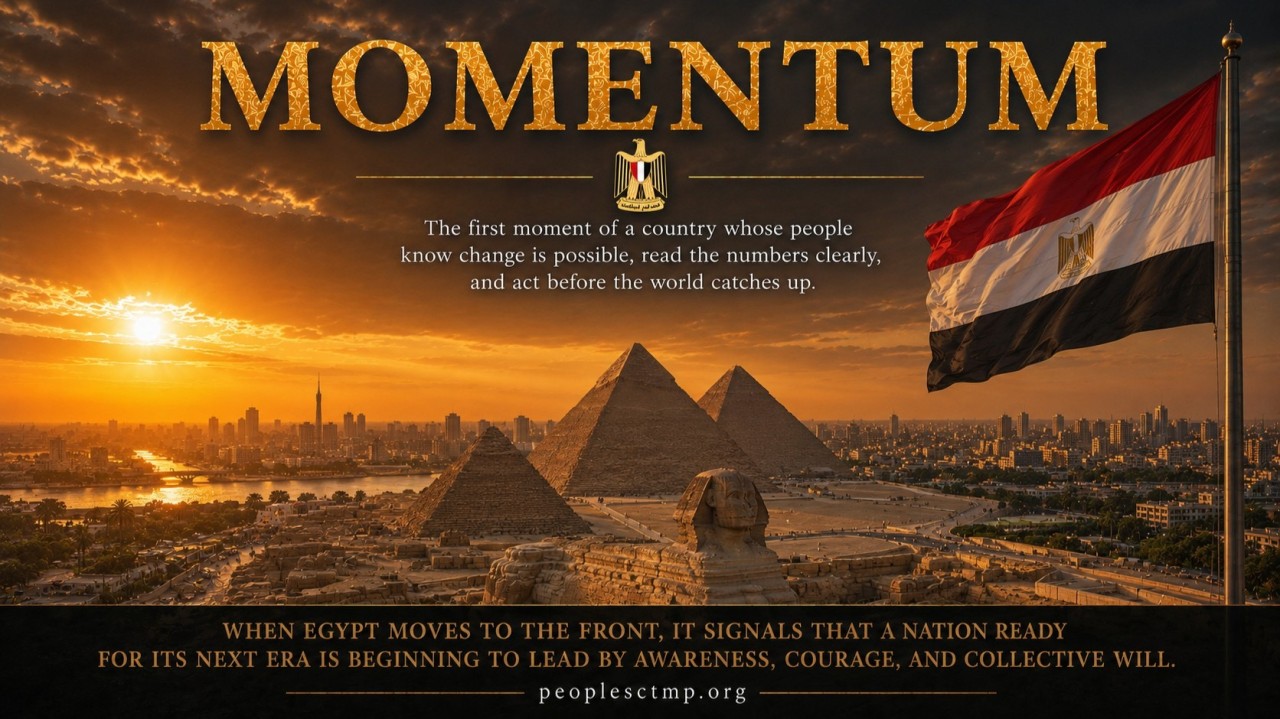
May 30, 2026
Over 500 Egyptians have signed the public list. That is roughly twice the number from any other single country so far. Here is what it means.
Egypt has taken first place on the worldwide public list, with over 500 Egyptians having added their names. That number is roughly twice the count from any other country that has led the list so far.
I want to walk through why that specific number matters, in plain words. The audience for this piece is everyone. Iraqis, Egyptians, South Africans, Serbians, Azerbaijanis, Nepalis, and anyone else following these things from any corner of the world. The language stays simple. The logic gets walked through step by step.
A reminder of what the list is
Before going further, let me make sure the reader understands what the public list is, in case this is your first time encountering it.
The list is a website called the Wall. Anyone in the world can go to the website and add their name. The name is anonymous. There is no follow-up. No money is asked for. No identity is collected. The signing takes a few seconds.
What people are signing for is to put their country in line to receive a large piece of infrastructure that produces two things every country needs: a very large amount of clean electricity, and a very large amount of clean water. We are planning to build eighty of these around the world over the coming years. The first ones will be built in the countries whose people show, on the public list, that they want them.
Every country has a different required count on the list, calculated as five percent of the country's population, with a minimum of 250,000 names. The ranking on the list is by progress toward each country's required count, not by total number of names. A small country can lead a large country, fairly, if its people are signing at a higher rate relative to its size.
That is the mechanism. Egypt has now done something on it that no country has done before.
The number that matters
Iraq held first place yesterday with 210 signatures. Before that, Serbia held it with 31. Before that, Azerbaijan with 48. Before that, Nepal with 128. Before that, South Africa with 231. The leaderboard has been competitive, and the leaders have come from all corners of the world, but the absolute numbers across all the leaders so far have been in roughly the same range. Most of the leading countries have moved into first place with somewhere between 30 and 230 signatures.
Egypt has now passed 500.
That is roughly twice the highest single-country count we have seen at any point so far in the leaderboard's life. It is not a small step. It is a different category of thing.
I want to be careful with that distinction because it matters. This is not a small improvement on what came before. Going from 30 signatures to 200 signatures is a small improvement, the kind of move that any well-connected single network in any country can produce. Going from 230 to 500-plus is not the same kind of move. It is the point at which the count starts to look less like one network of friends sharing a link, and more like a population beginning to engage.
That is what Egypt has done.
Why the difference between 200 and 500 matters
I want to spend a moment on this, because the distinction is the most important part of the piece.
When a count is small, the most likely explanation for the count is that one well-connected person shared the link with their immediate circle, and that circle shared it again, and within a week the count is somewhere between a few dozen and a few hundred. This is normal. It is how every project that has ever existed on the internet has gotten its first few hundred users. It does not yet prove that the underlying thing is reaching a population. It proves that one network has reached the limits of that network.
When a count crosses into the high hundreds and starts heading toward the first thousand, the underlying dynamic has to be different. Single networks do not reach that scale on their own. The link has to have left the original network and started traveling through second, third, and fourth networks. Different cities in the country. Different professional groups. Different age cohorts. Different language groups within the country, if the country has more than one. The count starts reflecting the country itself, not just one slice of it.
500-plus is the point at which that shift happens. Egypt is the first country to have crossed it.
Three implications follow from that. I will walk through each one.
Implication one: The Egyptian audience is genuinely engaging
The first implication is the most important. Egyptians, as a population, are reading the architecture and acting on it, not just one group of well-connected Egyptians in one city.
Egypt has roughly 110 million people, spread across a country whose population is concentrated along the Nile but also lives in cities, in towns, in the countryside, in the desert oases, in the canal cities, and along the Mediterranean and Red Sea coasts. The country has a young population. It has a long-established middle class in cities like Cairo and Alexandria. It has urban working-class neighborhoods. It has rural farming communities. It has Bedouin and Nubian and Coptic and Muslim communities of long standing.
A count of 500-plus, in a country of that size and complexity, is small in absolute terms. But it is the first count we have seen that begins to suggest reach across that complexity. The numbers do not prove this on their own. But they suggest it strongly enough that the project should be paying attention, and the rest of the world should be too.
Implication two: The architecture is translating across the Arab-speaking world
The second implication is regional. Egypt is the largest country in the Arabic-speaking world by population. It has long been a center for media, for thought, for film, for music, and for the production of ideas that move outward from Cairo to the rest of the region. When a project gets traction in Egypt, the project is much more likely to be discussed in the region than it was the day before.
Iraq, which held first place yesterday, is also an Arabic-speaking country. Iraq's count was 210. Iraq's lead today is being passed not by a small country, but by Egypt, which is roughly two and a half times Iraq's population and the cultural anchor of the broader region.
This means the architecture is reaching Arabic-speaking readers in a serious way. It also means the published documents are working as written, in translation or in the English originals that many regional readers can handle directly. People are reading. People are talking. People are deciding.
I am not going to overstate this. 500-plus signatures in a country of 110 million is still 0.0005 percent of the population. The country is at the start of a much longer climb. What I am saying is that the climb is starting at a different scale than any climb we have seen before, and that has implications for the region around Egypt.
Implication three: The mechanism itself just got validated
The third implication is about the worldwide public list itself.
A reasonable skeptic, watching the leaderboard over the past several months, could have said something like this: the leaders have been small countries, the absolute numbers have been small, and the mechanism may not be capable of reaching the scale it claims to be aiming for. That skeptic would have been reasonable to say it. The numbers up to yesterday did not yet refute that view.
Egypt crossing 500 does. It demonstrates that a large country, with a complex population, can produce the kind of count that suggests real engagement at the population level. The mechanism that put Egypt in first place is the same mechanism that put Serbia and Iraq and Nepal in first place. It is the same fair-share-of-population formula. Egypt's count of 500-plus is a higher share of Egypt's required count than Iraq's 210 was of Iraq's required count.
In other words, Egypt is not winning because it is a big country. Egypt is winning because its rate is higher. The fairness engine is doing exactly what it was built to do, and a large country has now moved through it at a scale that proves the mechanism scales.
I think this is important. The leaderboard is not a marketing display. It is a working system that decides where the first pieces of infrastructure get built. If the system cannot handle large countries, the whole project fails. Egypt is the first country to demonstrate that the system can handle a large country. The implications for every other large country in the world are obvious.
Why Egypt specifically might be moving
I want to think carefully about why Egyptians, in particular, might be the population most willing to engage at this scale right now.
I am not Egyptian. I am speaking as an outside observer who has watched the leaderboard move and is trying to understand what the move suggests.
Egypt depends on the Nile for almost all of its fresh water. About 95 percent of the country's population lives within a few kilometers of the river or its delta. The Nile is one of the most important freshwater systems in human history, and it has been the foundation of Egyptian civilization for more than five thousand years.
In the past decade, the construction of the Grand Ethiopian Renaissance Dam upstream in Ethiopia has raised serious questions for Egypt about long-term water security. The dam is a matter between Ethiopia, Sudan, and Egypt, and I will not take sides on it. What I will say is that for any Egyptian reading about a piece of infrastructure that produces two billion cubic meters of clean potable water per year, given to the host country for free under published rules, the relevance is immediate. The architecture is the kind of arrangement that addresses Egypt's water question at a scale and on terms that other arrangements have not.
Egypt also has chronic pressure on its electricity grid. The country has invested heavily in new generation capacity in recent years, but demand keeps growing, and the country has had blackouts during peak summer periods. Air conditioning is essential in Egyptian summers, particularly in the south. The cost of energy weighs on households. An arrangement that delivers electricity at a published ceiling of five US cents per kilowatt-hour, far below current Egyptian rates, would change the household math for tens of millions of families.
And Egypt has a very young population with a chronic shortage of well-paying private-sector jobs. Many young Egyptians have college degrees and cannot find work that uses their training. A piece of infrastructure of the kind we are building generates millions of job-years during construction and hundreds of thousands of permanent technical jobs in operation, with wages set by published rules against a dignity floor in the country where the work is done. For Egypt, this would be a major employer in a country that needs major employers.
These are real conditions. Any Egyptian who looks at the published architecture is going to recognize that the architecture is designed for the kinds of problems Egypt actually has. That recognition is what produces 500-plus signatures.
What this does not mean
I have to be careful here, the same way I am careful in every country post.
Egypt leading the list does not mean Egypt has been chosen.
It does not mean a piece of infrastructure will be built in Egypt.
It does not mean the Egyptian government has agreed to anything.
It does not mean Egypt will hold the lead through next week. Other countries will see Egypt's number and surge. Some will pass it. The list will keep moving.
It does not mean the count is close to Egypt's required count. Egypt needs about 5.5 million names to reach the required count. The country is at roughly one percent of one percent of that required count. There is a very long way to go.
What it does mean is that the mechanism just took its first step into the kind of scale it was designed to handle. Egypt was the country that did it. Other large countries can now see that the path is open.
What the project cannot do for Egypt
I name limits in every country post, and I will here.
The project cannot resolve any of Egypt's regional water disputes. Those are matters for the affected states to address among themselves.
The project cannot transform Egypt's economy on its own. It can be one major piece of a larger transformation that the country chooses to pursue.
The project cannot affect Egypt's political life. It does not endorse any party, government, or political figure.
The project cannot guarantee that what is produced will be distributed fairly inside Egypt. That distribution is internal to the country.
These limits are real. I name them out of respect for the reader.
The closing thought
Over 500 Egyptians have added their names to a worldwide public list. That number is roughly twice the count from any other country that has led the list so far. It is the first count we have seen that begins to look like population-level engagement rather than network-level engagement.
I want to honor this carefully. The 500 are individuals, each one of whom decided, in some quiet moment, to add their name to a ledger that they had read the rules of. Among them are likely engineers in Cairo, agronomists in the Delta, doctors in Alexandria, teachers in Aswan, tradespeople in the canal cities, students at universities across the country, mothers and fathers in apartment buildings and farming villages and Bedouin communities. Each of them made the same small civic decision, for their own reasons, in their own way. The list adds them up.
The result is that Egypt is at the top of a worldwide list tonight, and the mechanism that put it there has just demonstrated that it can handle a country of 110 million people. That is a different night than yesterday was.
If you are Egyptian and you have not yet signed, the list is at peoplesctmp.org. Find your country. Add your name. The process is free, anonymous, and takes a few seconds. You will find your country in first place.
If you are reading this from any other country in the world, the same list is open to your country at the same web address. The mechanism does not favor any country. The country whose people show up the most goes first.
The architecture is real. The numbers are checkable. The choice belongs to citizens, in every country on Earth.
Egypt leads tonight, with over 500 names, at a scale no other country has reached yet.
The rest of the world is watching.
Christopher M. Coode Founder and CEO, Hutchison Lea ConneXions Inc. Architect and Steward, People's CTMP peoplesctmp.org