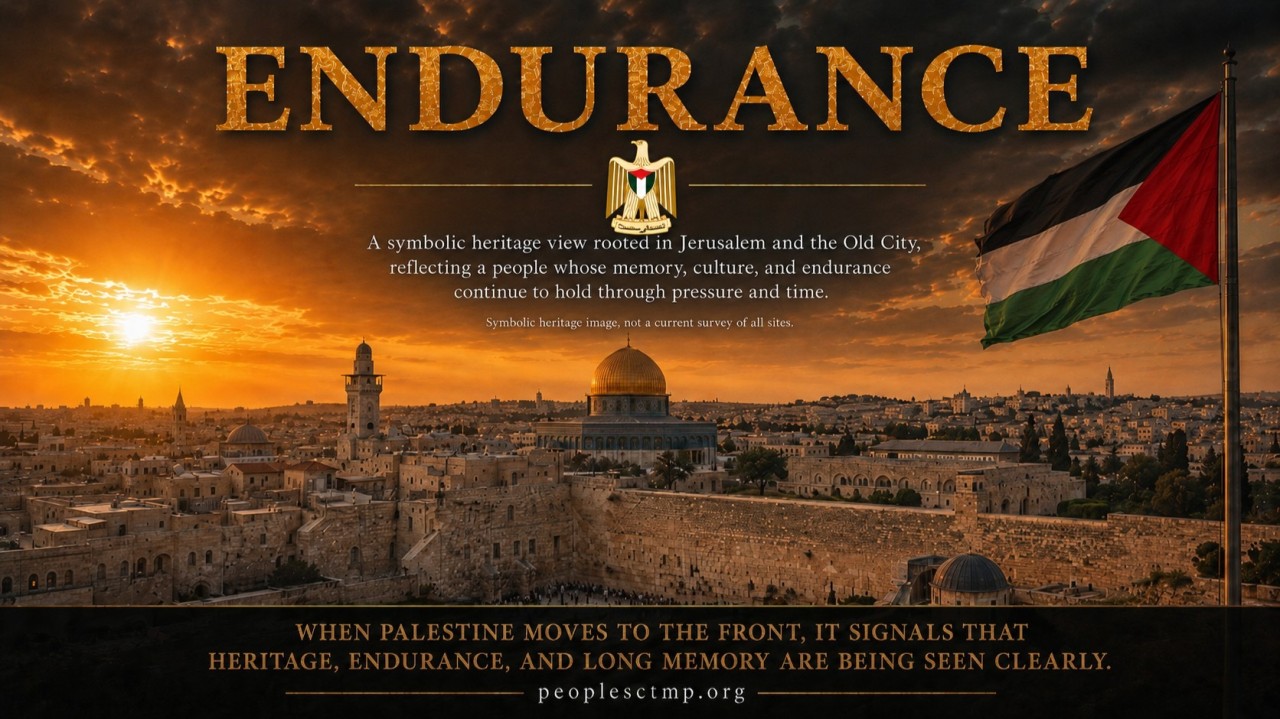
Endurance, Palestine Has Moved Into First Place
June 1, 2026
Twenty-nine people have put their territory at the top of a worldwide public list. Here is what happened, in plain words.
The Wall entry listed as Palestine, State of, moved to the top of the worldwide public list this week. Twenty-nine people have added their names. That works out to 0.011 percent of the required count for the territory, which is the highest share of any place on the list right now, ahead of Egypt, Iraq, Serbia, Azerbaijan, Nepal, Israel, and South Africa.
I want to walk through what this means, carefully, in plain language. This is the most sensitive entry in this series, and I am going to write it the way I have written every other one: about water, about electricity, about a list, and about the people who signed it. It is not about anything else. I will explain why I am drawing that line as I go.
What the list is
Let me make sure the reader understands what is being counted, because I never assume background.
The list is a website called the Wall. Anyone can go to it and add their name. The name is anonymous. There is no follow-up. No money is asked for. No identity is collected. The signing takes a few seconds.
What people are signing for is to put their country or territory in line to receive a large piece of infrastructure that produces two things every place on Earth needs: a very large amount of clean electricity, and a very large amount of clean water. We are planning to build eighty of these around the world over the coming years. The first ones will be built in the places whose people show, on the list, that they want them.
Every place on the list has a different required count, calculated as five percent of the population, with a minimum of 250,000 names. The ranking is by progress toward each place's own required count, not by total names. A small place can lead a large place, fairly, if its people are signing at a higher rate relative to its size.
That is the mechanism. It is the same for every place on the list, with no exceptions and no special cases for anyone.
How twenty-nine names reached first place
The arithmetic is the whole story here, and I want to walk it slowly.
The required count for the State of Palestine is 275,000 names, which is five percent of a population of about 5.5 million. Twenty-nine names is 0.011 percent of that required count.
That percentage, small as it is, is the highest on the list right now. Egypt has 520 names, but Egypt's population is 110 million, so its required count is 5.5 million, and 520 against 5.5 million works out to 0.0095 percent. Iraq is at 0.0094 percent. Serbia at 0.0093 percent. The numbers are all close together, and the place at the top is the one whose people are signing fastest relative to the size of the place.
Twenty-nine is a very small number. The territory needs 274,971 more names to reach the required count. There is a very long way to go. What twenty-nine demonstrates is the start of motion, not the result of it.
But the fact that twenty-nine names, from a population that faces the conditions this population faces, moved the territory to the top of a worldwide list, is worth stopping on. It tells you something about how much the people who signed want what is being offered.
What I am not going to do in this piece
I want to be direct about the line I am walking, because the reader deserves to know.
I am not going to write about the political situation of the territory. I am not going to take a position on statehood, on borders, on any party to any dispute, on who is right or wrong about anything. I am not going to assign blame to anyone for the conditions I describe. I am not going to use this piece as a statement about the conflict, because the moment I do that, this stops being a readout of a list moving and becomes a political act, and a political act would get the entire project dismissed by half the people who need to read it.
The project does not take sides. The list does not take sides. The architecture treats the State of Palestine exactly the way it treats Israel, which sits at number seven on the same list tonight, and exactly the way it treats every other place. Same formula. Same required count method. Same rules. Same infrastructure on the same terms.
I am writing about water and electricity and the people who signed for them. That is the whole of what I am writing about. Everything else belongs to other conversations that are not mine to have here.
The water reality
I am going to describe the conditions plainly, the way I describe conditions for every place in this series, and I am going to do it without saying whose fault any of it is, because that is not the point of this piece.
Water is scarce across the Palestinian territories. In Gaza, the coastal aquifer that most of the population has relied on has become heavily contaminated, with high levels of salt and pollutants, to the point where the great majority of the water drawn from it is not safe to drink without treatment. Most households buy drinking water from private vendors because the piped supply cannot be trusted. In the West Bank, water access varies widely from place to place, and many communities receive water intermittently, sometimes for only part of the week.
In many affected areas, available safe water is far below emergency and public-health benchmarks. This is not a matter of dispute. It is a measured fact, documented by humanitarian and health organizations over many years.
For a person living with that reality, a piece of infrastructure that produces two billion cubic meters of clean drinking water per year, given to the host place for free under published rules, is not an abstraction. The amount produced would be enough to cover the basic water needs of more than 109 million people, which is roughly twenty times the population of the territory. The relevance to someone who currently buys their drinking water by the jug, because the tap water is not safe, is immediate and obvious.
This is the first reason twenty-nine people signed.
The electricity reality
Electricity is also scarce. For many years before the current destruction, Gaza's electricity supply was already intermittent, often limited to only a few hours of grid power per day. Today the situation is worse, with much of civilian life dependent on damaged networks, generators, fuel access, and improvised systems. In the West Bank, supply is more consistent but still depends on arrangements that are outside the control of the communities that use the power.
For a population living with a few hours of electricity a day, the proposition of a piece of infrastructure that produces around 2,500 terawatt-hours of clean electricity per year, available continuously, at a published maximum price of five US cents per kilowatt-hour, is again not an abstraction. It is the difference between a refrigerator that works and one that does not. Between a hospital that can run its equipment around the clock and one that cannot. Between a child who can study after dark and one who cannot. Between a small business that can operate and one that cannot.
This is the second reason.
The structural reality
There is a third reason, and it is about how the infrastructure is paid for and owned.
The published rules require that the infrastructure be financed without the host place taking on any debt. No bonds. No loans. No foreign lender with a claim on any local asset. The published rules set a permanent ceiling on the price of electricity. The published rules require that the water be given free for the life of the operation. The published rules forbid any single foreign party from owning more than a third of any of the seventeen related business lines.
For a population that has seen a great deal of foreign involvement over a long period of time, much of it arriving with conditions attached, an arrangement whose conditions are published, fixed, and impossible to change by any single party, including the person who designed it, is a different kind of proposition. It does not ask the population to trust anyone. It asks them only to read the rules and check that the rules are what they say they are.
This is the third reason twenty-nine people signed.
Why the rate is so high
I want to address the thing that makes this entry different from the others, which is the rate.
Twenty-nine signatures, against a required count of 275,000, produced the highest completion rate on the entire list. The reason the rate is so high is not that twenty-nine is a large number. It is that the required count is relatively small, because the population is relatively small, and the people who signed are signing at a high rate relative to that small population.
But I think there is something underneath the arithmetic that is worth naming carefully. When a population lives with severe scarcity of the exact two things the infrastructure produces, water and electricity, the motivation to act on a proposal that addresses that scarcity is unusually strong. A person who has reliable water and reliable power may read about this project with mild interest. A person who buys drinking water by the jug and lives with a few hours of electricity a day reads about it differently. The proposition lands harder where the need is greater.
That is not unique to this territory. It is true of every place on the list where the need is acute. It happens to be especially visible here, because the need here is especially acute, and the small population means a relatively small number of motivated people can move the territory up the list quickly.
What this does not mean
I have to be precise here, the same way I am in every country post, and especially here.
The territory leading the list does not mean it has been chosen.
It does not mean a piece of infrastructure will be built there.
It does not mean any government or authority has agreed to anything.
It does not mean the territory will hold the lead. Egypt sits just behind with 520 names and a higher absolute count. Any place on the list could move ahead within hours.
It does not mean the count is anywhere near the required count. The territory needs more than 274,000 additional names. It is at the very beginning of a very long climb.
And it does not mean the project is making any statement about the political status of the territory, the conflict, or any party to it. The list records what people do. Twenty-nine people did this. The list reflects it. That is the entire meaning of the number, and I am not going to let it be read as anything more than that.
What the project cannot do here
I name limits in every country post, and the limits here are real and heavy.
The project cannot resolve the conflict. That is not the kind of work infrastructure does, and it is not mine to attempt.
The project cannot deliver infrastructure into a situation where the basic conditions for building and operating it safely do not exist. Building anything of this scale requires stability, access, and the cooperation of the relevant authorities. Where those conditions are absent, the infrastructure cannot be built, regardless of how many people sign. I am being honest about this because I will not offer false hope to a population that has had enough false hope.
The project cannot substitute for the political and humanitarian work that the situation requires. Water and electricity are necessary for a decent life. They are not sufficient by themselves. The rest of what this population needs is work that belongs to other people, other institutions, and processes far larger than any single piece of infrastructure.
The project cannot change the daily reality of anyone living there today. The list is about the future, and the future it points to is years away even in the best case. I will not pretend otherwise.
These limits are real. I name them out of respect, because the alternative is to mislead people who deserve better than to be misled.
The closing thought
Twenty-nine people, living in conditions that most readers of this piece have never had to endure, decided to add their names to a worldwide public list, and in doing so put their territory at the top of it.
I am not going to dramatize that. I am going to state it plainly. They read about a piece of infrastructure that produces the two things they most lack, clean water and reliable electricity, on terms that are published and cannot be quietly changed. They decided it was worth being counted for. They signed. The list added them up, applied the same fair formula it applies to every place on Earth, and the result is that their territory leads tonight.
That is the whole of it. No more and no less.
If you live there and you have not yet signed, the list is at peoplesctmp.org. The process is free, anonymous, and takes a few seconds. You will find your territory at the top.
If you are reading this from anywhere else in the world, including from places with their own histories and their own stakes in this region, the same list is open to your country, on the same terms, with the same formula. The mechanism does not take sides. It records what people do, everywhere, identically.
The architecture is real. The numbers are checkable. The rules apply the same way to everyone. The choice belongs to people, in every place on Earth, including this one.
Christopher M. Coode Founder and CEO, Hutchison Lea ConneXions Inc. Architect and Steward, People's CTMP peoplesctmp.org