Clarity: Why Paraguay Moved Into First Place
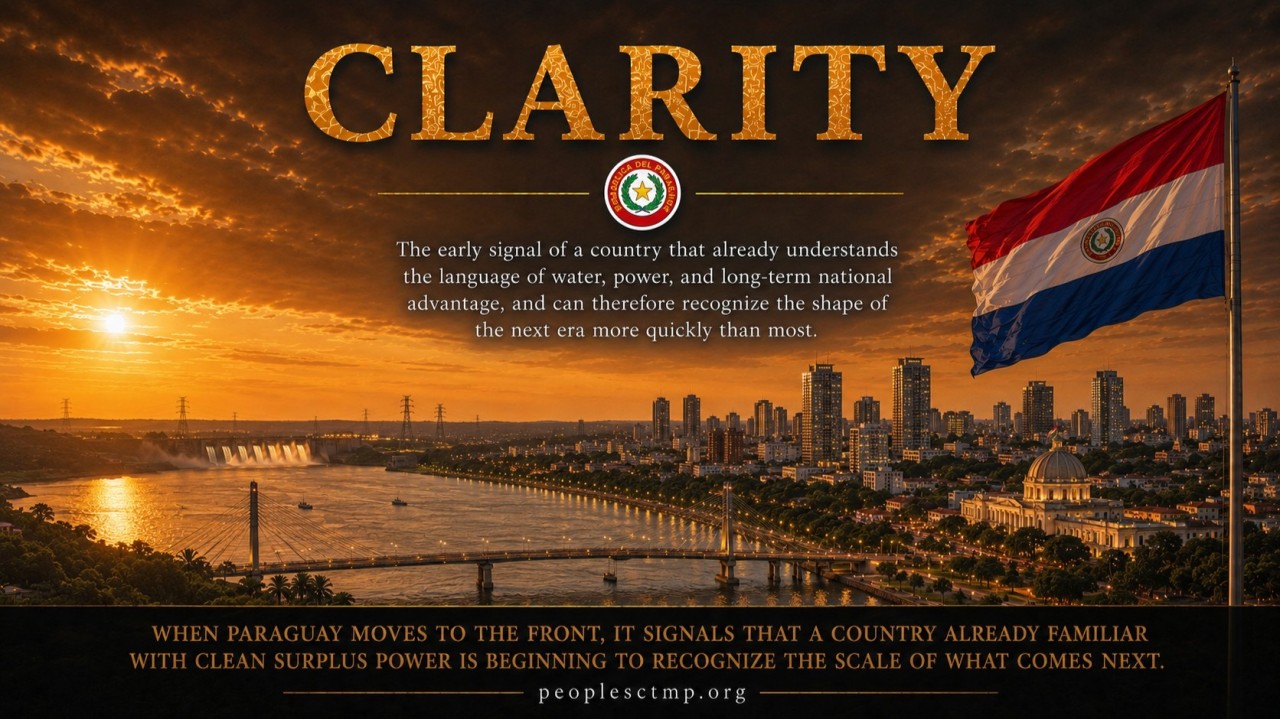
June 2, 2026
There are mornings I open The Wall and have no idea what I am going to find.
This was one of them.
Paraguay is in first place.
Not a coastal giant. Not an oil state. Not one of the big names everyone expects. A landlocked country of about 6.8 million people in the middle of South America, with no ocean coastline at all, sitting at the top of a global board that ranks countries by how strongly their people are asking for CTMP.
Forty-three people put it there. That is all it took to reach first place today. Forty-three people who decided to raise their hand and be counted.
And the more I sat with it, the more I realized Paraguay being first is not a fluke. It might be one of the most fitting things that could have happened. Because if you understand what Paraguay already is, and what CTMP is trying to become, the people who signed there may have understood something before almost anyone else did.
Let me explain it so that anyone, anywhere, can follow it. No jargon. No engineering degree required.
What the ranking actually measures
The Wall does not rank countries by population. It does not rank them by wealth, or power, or how famous they are. It ranks them by the share of their own people who have signed.
That is the whole point. A small country can lead the world, because what matters is not how big you are. What matters is how many of your people, as a fraction of the whole, have stood up and said: build here.
Paraguay reached first place with a higher share of its population signed than any other country on the board right now. Egypt has more total signatures. Nepal has more. But Paraguay has more relative to its size, and that is the measure that decides the order. The Wall was built that way on purpose, so that a small nation with determined people can stand ahead of a large nation where most people have not yet heard the message.
So the honest answer to "why is Paraguay first" is simple: a small group of Paraguayans understood the idea early and acted on it, and in a country their size, that was enough to lead the world.
But there is a deeper reason it fits, and it is worth understanding.
Paraguay already lives the idea
Here is something most people outside South America do not know.
Paraguay is one of the most remarkable energy stories on the planet, and it has been for decades. The country shares one of the largest hydroelectric dams in the world, Itaipú, on the river it shares with Brazil. Between that and another large shared dam, Paraguay generates far more clean electricity than it uses. It runs on almost entirely renewable power and still has enormous surplus left over.
Think about what that means. Paraguay is a country that already understood, long before most of the world, that water moving under the pull of gravity can power a nation. They have lived inside that truth for forty years. They did not have to be convinced that clean, water-driven baseload power is real, because they already wake up to it every morning.
So when a project comes along that says the future is firm, clean, water-driven power, produced at a fraction of today's cost, owned in a way that cannot be quietly captured, and paired with large-scale freshwater production on top of it, Paraguayans are not starting from zero. They are starting from experience. They already know the physics works because they already live on it.
That is why I think the people who signed in Paraguay saw it faster. They were not learning a new idea. They were recognizing an old friend, made far more powerful.
But the reason this matters is not electricity alone
Cheap, firm power is not just something that turns the lights on. It is the input underneath almost everything else a country tries to build. It changes the cost of clean water. It changes the cost of materials. It changes whether factories can run, whether food systems can become more secure, whether young people can find technical work at home instead of watching the next industrial era happen somewhere else.
That is what the rest of CTMP is for. The power is the heart, but the surrounding system is the body: water, materials, construction, manufacturing, logistics, food systems, data, and long-term employment. Not a handful of temporary jobs that vanish when a project ends. A national buildout that runs for decades.
I want to put real weight on that last point, because it is the part people underestimate.
A platform of this size is not built once and walked away from. It is built continuously, and then it is operated continuously, and both of those things take people. Across the full platform, the work is measured in millions of job-years. A job-year is simply one person working full time for one year. When I say a mature deployment supports millions of construction job-years every year and millions of permanent operating jobs across all its parts, I am describing a build-and-operate cycle that keeps renewing itself rather than a one-time boom.
For a country the size of Paraguay, sit with what that means. This is not a few hundred jobs at a single site. It is the kind of sustained technical employment that gives a generation of welders, electricians, operators, lab technicians, control-room staff, and engineers a reason to build their careers at home. It is the difference between exporting your young talent and importing your future, versus building both inside your own borders. That is a profound thing for any nation, and it is especially profound for one that has the clean-energy foundation but has watched the heavier industrial era largely happen elsewhere.
The scale almost does not sound real
Now let me show you the number that made me stop and check my own arithmetic.
A single CTMP build is rated at 300 GW. Run that continuously through a year and it produces well over 2,000 terawatt-hours of electricity annually, and roughly 2,500 terawatt-hours at high availability. I will keep that as an order-of-magnitude figure, because the exact output depends on real availability once built, and I am not going to pretend to a precision the platform has not yet earned.
Hold that number against reality.
Paraguay's share of Itaipú, and its hydro system overall, is large enough that the country already produces far more electricity than it uses and exports the surplus to its neighbours. That alone is remarkable. But it operates at a scale of tens of terawatt-hours.
A single 300 GW build operates at a scale of thousands of terawatt-hours.
Now widen the lens to the whole continent. The entire electricity consumption of South America, every country combined, Brazil included, sits in the rough order of 1,000 to 1,100 terawatt-hours per year. Brazil alone is around 725. Argentina around 125. Everyone else fills in the rest.
So here is the realization, stated plainly and carefully. One CTMP build, run at full output, would produce on the order of twice the entire electricity consumption of the South American continent as it stands today. Not Paraguay's consumption. The whole continent's. From one build.
I am not claiming a single build would or should be built to do that, or that you could distribute that power across a continent without enormous transmission work that does not exist yet. Those are real limits and I am not waving them away. I am simply pointing at the raw magnitude, because the magnitude is the thing people do not let themselves believe until they see the arithmetic. The capacity to power a continent twice over is not science fiction here. It is what the physics of the design implies at the rated figure.
And then there is the price inside the walls
There is one more piece, and for a country thinking about its own future, it may be the most important of all.
The posted price for CTMP power sold to the outside world is $0.025 per kilowatt-hour. That is already far below what most of the world pays. But that is the external price. Inside the platform, power moving between the verticals is valued at a small fraction of even that, on the order of a tenth of a cent per kilowatt-hour.
Let that sit for a moment.
Imagine being a business, a factory, a water system, a food producer, or a young industry that gets to operate on power priced at a fraction of a cent. Energy is the hidden cost buried inside almost everything a country makes. Crush that cost to nearly nothing for the activities built on the platform, and you change what is possible to build at all. Industries that could never survive on expensive imported power suddenly pencil out. The floor drops out from under the cost of starting something new.
That is the quiet revolution underneath the loud number. It is not only that the platform makes a lot of power. It is that the power inside the platform is so inexpensive that it rewrites the economics of every business that plugs into it. For a nation, that is not just cheaper electricity bills. It is a different starting line for an entire economy.
I keep the language calm on purpose, because the facts do not need decoration. A single build that could out-produce a continent. Power inside the walls at a fraction of a cent. Millions of job-years of work that renews itself for decades. You do not have to raise your voice when the arithmetic is already this loud.
The honest problem, and the honest answer
Now I have to be straight with you, because being straight is the only way any of this is worth anything.
CTMP was designed for the ocean.
The whole platform, as it stands today, is built around seawater. Seawater comes in, gravity and depth create the pressure that drives the turbines, and along the way the system also produces enormous amounts of fresh water through desalination, plus minerals, plus everything else. The ocean is the source and the sink. That is the design.
And Paraguay has no ocean.
So by the strict letter of the current design, Paraguay is exactly the kind of country that should not be able to host a build at all. Landlocked. No coast. No seawater.
Which makes it almost poetic that they are leading the board.
Here is the part I want every person on earth to hear clearly, and I want to be careful to say it honestly. We are currently exploring how the platform can be adapted to fresh water. The ocean version is the current engineered baseline. The freshwater version is something we are actively working through, not something I am telling you is finished or guaranteed. It has to be studied, engineered, and proven, the same as everything else.
But if it can be done, and that is the work in front of us, then the implications are staggering.
Because it would mean the platform is no longer limited to countries with a coastline.
It would mean a landlocked nation with rivers, lakes, or managed freshwater systems could, in principle, host a deployment of its own.
It would mean the door is no longer open only to coastal nations. It would mean that, in principle, any nation on earth has the potential to have one.
And of all the countries that could be sitting in first place at the exact moment this freshwater question is being explored, it is the landlocked one. The one that has lived on freshwater hydropower for two generations. The one that, more than almost anyone, would benefit from a version of CTMP that does not need the sea.
I did not plan that. The people of Paraguay did that. And it lands with a kind of rightness that I could not have scripted.
What this says to everyone else
If you are reading this from a country with a long coastline, the message is obvious. Your country is already suited to the platform as it exists today. The question is only whether your people raise their hands.
But if you are reading this from a landlocked country, or a country that always assumed a project like this could never reach you because you have no ocean, then Paraguay is your signal. Paraguay is the proof that the people who move first are not always the people with the obvious geography. They are the people who understand the idea and decide to be counted.
The freshwater work may open a door that has been closed. I cannot promise you the day it opens. I can only promise you that the work is real and that we are doing it. And I can tell you that when a country reaches the front of The Wall, it tells everyone, including us, where the determination is. The Wall shows where people are standing up. It is how demand becomes visible instead of guessed at.
Forty-three people in Paraguay made their country visible today.
That is how this works. Not money. Not power. Not connections. People, choosing to be counted, in numbers large enough relative to their nation to say something the whole world can see.
The thing I keep learning
I built The Wall, and it still surprises me almost every day. I genuinely do not know what I will find from one morning to the next. One day it is Palestine. The next it is Egypt, then Iraq, then Azerbaijan, and now a landlocked country in the heart of South America that, by the current design, should not even qualify, sitting in first place at the precise moment we are exploring the very thing that could one day let it qualify.
I cannot predict it. I have stopped trying.
What I can do is keep telling the truth about where things stand, keep doing the work, and keep showing the world what the people are saying through the only honest measure I know how to build: a public count that anyone can see and no one can buy.
Paraguay is first today.
Tomorrow it could be anywhere.
That is the whole point. The people decide where this goes. Not me. Not institutions. Not capital. The people who choose to stand up and be counted.
And right now, the people standing up are in Paraguay.
To everyone there who signed: I see you. The whole board sees you. And the work to build a version of this that your landlocked, freshwater nation could one day host is, as of right now, part of why I get up in the morning.
Chris Coode, Founder and CEO, HLX Inc. · peoplesctmp.org