The Country the Weather Keeps Betraying
June 4, 2026
Colombia has been climbing The Wall, and I think the people there may have understood something faster than almost anyone. So let me lay out the reasoning the way I see it, one step at a time, and let each step rest on the one before it. By the end you can decide for yourself whether it holds. I am not asking anyone to believe me. I am asking people to follow the logic and see where it lands.
It starts with a kind of heartbreak that only happens to people who did everything right.
Step one: Colombia made the correct choice decades early
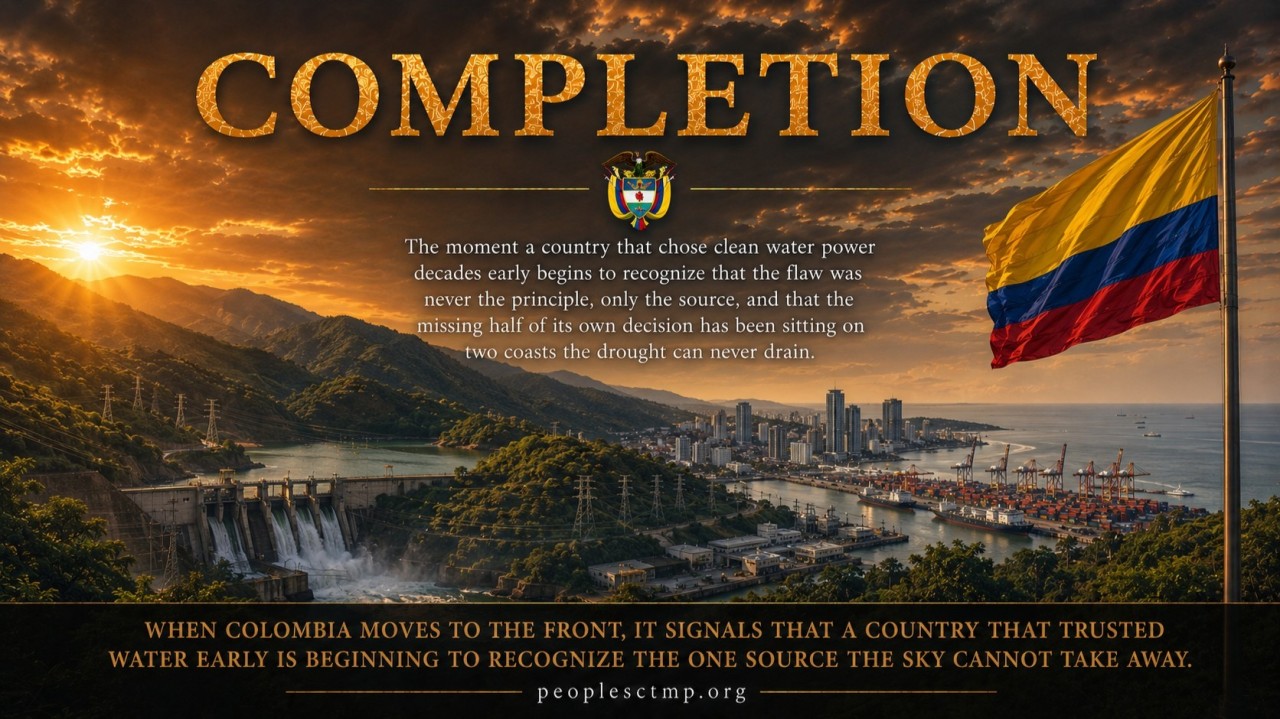
Long before most of the world took clean energy seriously, Colombia made a different decision. It looked at its mountains, its rivers, and its rainfall, and it built its electricity on water instead of on burning things. It dammed its rivers in the Andes and let gravity and rain do the work that other countries did with coal and gas. For a long time that looked like wisdom, because it was. To this day the large majority of Colombia's electricity comes from hydropower. The country runs, more than almost any nation its size, on the clean and ancient idea that falling water can light a city.
Hold onto that, because it is the foundation the whole argument stands on. Colombia is not a country that needs to be convinced that water can power a nation. It is a country that has lived inside that truth for two generations. Whatever comes next has to be understood against that fact: these are people who already know, in their daily lives, that the idea works.
Which is exactly what makes what happens next so cruel.
Step two: the choice has one flaw, and the flaw is the sky
Here is the thing about hydropower built on rivers and reservoirs. It does not depend on water in the abstract. It depends on rain. The reservoir behind the dam has to be refilled, and only the weather can refill it.
And every few years, the weather refuses.
A pattern forms out in the Pacific. The trade winds slacken, the surface of the sea warms, and the rain that Colombia's entire electrical system quietly depends on simply does not come. The pattern has a name that people who have never read a science paper know by heart, because they have watched what it does. El Niño. When it arrives, the reservoirs stop refilling. The water that spins the turbines drops lower and lower, and a country that built its strength on water starts to watch the level fall the way a family watches a bank balance shrink.
This is not a story from the distant past. In the most recent hard stretch, national reservoirs fell toward a third of their capacity, close to the edge where the system can no longer keep up. The grid operators were forced back onto the very thing the hydro system was built to avoid, burning gas and diesel as hard as they could. Prices climbed. The country imported expensive fuel to keep the lights on. The capital had to ration water for millions of people. Colombia had to cut off the electricity it normally sells its neighbors just to keep enough for itself. It has gotten serious enough that the country has begun, carefully, to discuss whether it might one day need nuclear power, simply to have something underneath the system that the weather cannot switch off.
So the flaw is precise and it is devastating. Colombia did not make the mistake other countries made. It did not build dirty. It built clean, early, on water. And its reward, every few years, is to be held by the throat by the sky, forced back onto the fuels it never wanted, made to ration the most basic things, and left wondering what it could possibly build that the weather is not allowed to take away.
That is the question the rest of this letter answers. And the answer turns out to have been sitting against the country's own coast the whole time.
Step three: Colombia is holding the answer and has been treating it as scenery
Now look at the second fact, the one almost nobody puts next to the first.
Run your eye down a map of South America. Brazil faces the Atlantic. Chile and Peru face the Pacific. Argentina faces the Atlantic. Every country on the continent, large or small, faces one ocean or none. Except one. Colombia is the only country in South America that touches two oceans, the Caribbean to the north and the Pacific to the west, more than three thousand kilometres of coastline split between two separate seas. No other nation on the continent has this.
For most of Colombia's history this has been treated as a fact about trade routes and beaches. It is much more than that, and here is why it connects directly to step two.
The ocean has the one property the rivers can never have. It does not have a dry season. El Niño can empty a reservoir in the mountains, but it cannot empty the Pacific. The sea does not wait for rain, does not fall to a third of capacity in a hard year, does not need the clouds to cooperate. It has been there, full, through every drought in human history and every drought before there were humans to suffer them. The water Colombia has spent decades praying for, watching the sky for, rationing because of, has been sitting against its own coast the entire time, on two oceans, completely indifferent to the weather that keeps betraying the rivers.
So put the two facts together, because the whole argument lives in the gap between them. Colombia learned to love water power, and then the rain taught it that water power built on rain is a promise the sky can break. And all the while, the country has been bordered by the one body of water that cannot break that promise. The answer was never missing. It was just facing the wrong way, treated as a view rather than a resource.
Step four: the fix is the same idea Colombia already trusts, with the flaw removed
This is where the platform enters, and the reason it fits Colombia so exactly is that it is not a new idea to them. It is the idea they already believe in, with its single weakness engineered out.
The platform takes the exact thing Colombia trusts, falling water turning turbines, and changes only the source of the water. Instead of waiting for rain to fill a reservoir in the mountains, it uses the weight of the ocean itself. Seawater is drawn in at the coast, falls through the rock to turbines set deep below, spins them, and returns to the sea. No fuel to burn, nothing to ship in or out, and no reservoir waiting on the clouds, because the reservoir is the ocean, and the ocean is never empty.
That is the entire move, and notice what it does not ask of Colombia. It does not ask the country to abandon what it knows and adopt some foreign technology. It asks it to complete the choice it already made. It is the same clean, quiet, ancient principle Colombia bet on decades ago, simply attached to the one source of water a drought cannot touch. For a nation that has spent decades being punished for choosing water, this is not a pivot. It is the missing half of its own decision, the version the weather is not allowed to veto.
And the same logic that fixes the power can also fix the water, because the energy system can support fresh water production at national scale, with the first large share given free to the host country. When El Niño comes, it does not only drain the reservoirs that make electricity. It drains the reservoirs that hold drinking water, which is why the capital has had to ration the tap for millions in the same dry years. A country can be rich in rivers and still find itself counting litres. For a country that has rationed both its power and its water in the same dry season, that is the difference between a future that depends on the rain and a future that depends on the sea, which is to say a future that does not depend on luck at all.
Step five: the place that fits best is the place Colombia forgot
There is one more turn in the logic, and it is the one I find hardest to look away from, because it takes the country's oldest neglect and turns it into its greatest advantage.
Colombia's two coasts have never been treated as equals. The Caribbean coast in the north has the famous cities, the trade, the tourism. The Pacific coast in the west has been, for most of the country's history, the forgotten side, one of the wettest places on earth, a wall of rainforest, and also one of the poorest and most neglected regions in the country. It has been spoken about mostly in the language of hardship.
But the Pacific coast may have the feature a platform like this needs most. The water goes deep, fast, close to shore. Steep, deep nearshore water is not easy to find, and stretches of that coast may have exactly it. The very geometry that made the region remote and hard to develop, a coast where the land drops quickly into deep ocean, is the geometry the design is looking for.
Follow what that means. The part of Colombia treated as the back door for two centuries, the wet and forgotten coast, could turn out to be one of the most valuable places in the country to build the thing that ends the dry-year fear for everyone. The region that received the least could become the region that gives the most, not through charity, but through the plain fact of where the deep water meets the land. For a country still doing the long work of healing its regional divides, that is not a small thing. It is the kind of reversal that changes how a nation reads its own map.
I will not pretend the engineering is settled, because the chain of reasoning would break if I did. The ground on any coast has to be studied honestly before anyone trusts it, and the Pacific coast carries real challenges that only fieldwork can answer. No Colombian site has been through that work yet. What I can say without reservation is that the fit between what Colombia needs and what this offers is not something I had to manufacture. It was already there, waiting in the gap between a country that runs on water and a country that touches two oceans the drought can never drain.
Step six: what it builds, and what it cannot
A country that no longer fears the dry year does not just keep its lights on. It changes what it is able to plan. When the cost of energy stops swinging with the weather, a factory can sign a contract that lasts a decade without writing a clause about drought. A hospital can run without a generator on standby for the year the reservoirs fall. A farmer can buy fertilizer at a price that does not double because a faraway gas market reacted to a faraway war. A young engineer who today watches the best industrial work happen elsewhere can find it at home, because the conditions that drive industry away, unstable power and unpredictable cost, are the exact conditions the platform removes.
And there is the work itself. A build of this kind is years of construction and then decades of operation, measured in the kind of skilled, lasting employment that gives a generation of welders, electricians, technicians, and engineers a reason to build their lives in their own country rather than leave it. For a nation that has lived through long decades of conflict and the long work of recovery, steady, dignified, long-term work in every region is not a line on a chart. It is a kind of peace that pays wages.
I owe you the boundary of the claim, the same way I owe it to every country, because an argument that claims too much breaks at the first overreach. This does not undo Colombia's history. It does not heal what the conflict cost. It does not settle the country's divisions. It was never built to. What it was built to do is narrower and, I think, still worth everything: to remove the recurring betrayal that turns every dry season into a national emergency, and to do it using the country's own coast and the country's own people.
The only question on the table
So the chain closes where it opened, with a country that did everything right and was punished anyway.
Colombia rising on The Wall does not mean a decision has been made or a deal struck. The Wall is not a petition to any government, not a vote, not an investment. It takes no money, no email, no personal name, and no public identity. It asks one thing: that a person register, once and anonymously, that their country should be considered, knowing the count is public and the order of consideration follows the count. Reaching the required count awards nothing. It moves a country into formal, public review, where the geography, the geology, and the coastline are examined in the open, precisely so that no arrangement in a closed room can override the count.
Of all the countries on earth that might look at a platform built on ocean water and steady power and reliable fresh water, Colombia is one of the few that does not need the idea explained. It chose water and was betrayed by the rain, over and over, for decades. And it happens to sit, alone on its continent, against two oceans that have never once gone dry. A country that did everything right, and was punished anyway by the weather, holding the one thing the weather cannot take.
The rivers can be emptied by the sky. The ocean cannot. Colombia, more than almost any nation on earth, already knows the difference, because it paid for the knowledge one dry year at a time.
So the only question The Wall asks is the simple one the whole letter has been building toward. Not a promise, not a deal, not a decision. One question: should this country be considered for the first People's CTMP buildout?
One signature. One country. One public, anonymous act. And right now, the people of Colombia are quietly answering it.
Chris Coode, Founder and CEO, HLX Inc. · peoplesctmp.org