Ukraine, The Debt Is the Second Occupation
June 4, 2026
There is a kitchen somewhere in Ukraine that has no wall on its north side anymore.
A family still uses it. They have hung a blanket where the wall was, and in the evening someone boils water on a single working ring, and the children do their homework at the table because the table is still there, and a table that is still there matters more than anyone who has never lost one could understand.
That kitchen is going to be rebuilt. Almost everyone agrees on that now. The wall will go back up. The ring will become a stove. The blanket will come down. This is the good part of the story, the part everyone is working toward, and I do not want to take a single thing away from it.
I only want to ask one question about it, and it is the question almost no one is asking while the work is this urgent and the grief is this fresh.
When that wall goes back up, who will the family owe for it?
That is what this letter is about. So let me be careful at the very start about what it is not.
It is not about the war. I take no side in it. I will not tell you who is right, who is to blame, or how it ends. That is not mine to touch, and nothing I have built could touch it anyway. I cannot give back one person this war has taken. I cannot return one hour of it. I would never insult anyone by pretending an industrial project could. The war is the war, and it belongs to the people living and dying inside it, not to me.
What I can speak to is the kitchen. The morning after. And I think there is a second catastrophe being quietly prepared for that kitchen, in plain sight, by people who mean nothing but good, and I cannot stay silent about it.
So let me walk it through one step at a time, and let each step rest on the one before.
Step one: the rebuilding is already priced, and the number does not feel real
You do not have to take my figure. Take the one the World Bank, the European Commission, the United Nations, and the Government of Ukraine published together at the end of 2025.
Rebuilding Ukraine is now estimated at roughly 588 billion dollars over the next ten years.
On its own that is just a big number, the kind that slides off the mind. So hold it against the comparison the World Bank itself puts right next to it. That 588 billion is nearly three times everything Ukraine produces in a year. Not three times its budget. Three times its entire economy. Every factory, every farm, every shop, every wage, for three full years, just to put the walls back.
That is the size of the hole this war is leaving in the ground. And it has to be filled. No one is arguing about whether. A country cannot be left as a kitchen with a blanket for a wall. The homes, the power, the water, the rail, the hospitals, the schools, all of it has to come back, and soon, because winters do not wait for reconstruction conferences.
So the only real question was never whether the kitchen gets rebuilt. It is how. And the how is where the second catastrophe is hiding.
Step two: the ordinary way to fill that hole is debt, and debt does not forget
When a country needs three times its own economy and does not have it, and no country on earth has it lying in a drawer, the money comes from outside. Loans. Aid with conditions. Reconstruction facilities. Donor conferences with a stage and a row of flags. Financing package after financing package, each one reasonable on its own, each one carrying terms written by people who do not live in that kitchen and never will.
This is not a villain's plan. It is just how rebuilding has always been paid for. Every single loan is defensible. Every condition has a good argument behind it. The people offering the money usually believe, sincerely, that they are helping. Most of them are.
But debt has a memory far longer than the war will have. The loan taken in 2027 to rebuild a power plant is still being paid in 2047. The conditions attached to the money quietly decide what the country is allowed to do with itself for a generation. A creditor never has to send a soldier. A creditor only has to hold the note, and wait, and be there at every table where the country tries to decide its own future.
Here is the part that should stop your breath for a second.
A country can survive the war and lose itself anyway, in the rebuilding. It can hold its borders, keep its people, endure the thing that was built to erase it, win the right to exist, and then spend the next thirty years slowly owned by the very act of putting itself back together. The shooting stops. The owing begins. And this new occupation does not arrive in tanks. It arrives in good news, in ribbon-cuttings, in press releases about partnership, wearing the friendly face of help. The child doing homework at that table tonight could spend her whole working life paying for the wall that went up behind her.
That is the future being laid down right now, with the best intentions in the world, while everyone is rightly looking at the war. The largest debt-financed reconstruction in modern history is being lined up, and almost no one is asking the obvious question: is debt really the only way to fill a hole this size?
It is not.
Step three: the same hole can be filled with a floor the family owns
Here is the turn, and it is the whole reason I am writing to you instead of staying quiet.
There is a difference between rebuilding a country and giving a country a floor it can stand on by itself. Rebuilding replaces the wall that was lost. A floor changes what the country can produce from that day forward, so it never has to go back to the table and ask for the next loan to fix the next thing.
The platform I have spent decades building is meant to be exactly that floor. Power at a scale that changes the price of everything built on top of it. Clean water at the scale of a whole nation. The steel and the concrete and the materials to rebuild the country out of what the platform itself makes, instead of importing all of it on credit. The kitchen wall, made from a country's own production, not borrowed against its grandchildren.
But the floor is not even the part that matters most. The rules are.
The platform is built, by its own charter, to carry no debt. Not low debt. None. There is no creditor. There is no refinancing cliff waiting five years out. There is no bond market through which someone hostile can buy up a country's rebuilding and call the loans at the worst possible moment. There is no outside owner allowed to take control of it. The host country does not end up owing anyone for the deployment, and the thing keeps running no matter who sits in which capital next year, because it does not run on anyone's goodwill. It runs on published rules that cannot be quietly rewritten after the cameras leave.
Set that beside the reconstruction trap and you see the whole choice in a single frame. The ordinary path rebuilds the wall and hands the family's future to whoever held the money. This path rebuilds the wall and leaves the family owing no one.
One puts the kitchen back, and quietly takes the country in payment.
The other puts the kitchen back, and lets the country keep itself.
Step four: what this is, and what it could never be
I have to mark the edge of the claim clearly, because an argument that reaches too far snaps at the first pull, and this is the last subject on earth where I would let mine snap.
This does not end the war. It does not shorten it by one day. It does not return anyone who is gone. It does not mend one family or undo one thing that has been done in these years. It holds no opinion on the war and no power over it. Anyone who tells you an industrial platform can heal what this war has cost is selling something, and I am not.
What it can do is smaller, and it is the one thing I am putting on the table. It is about that kitchen. It is about whether the family that survives gets to own the wall that goes back up, or spends a generation paying strangers for the privilege of having survived at all. That is a humbler promise than the headlines would want. I think it is also the one that will still matter long after the war is history, because the shape of the rebuilding will outlive every argument anyone is having about the war today. The guns will fall silent. The note will not.
The only question on the table
So we end where we began, in that kitchen, with the blanket where the wall should be.
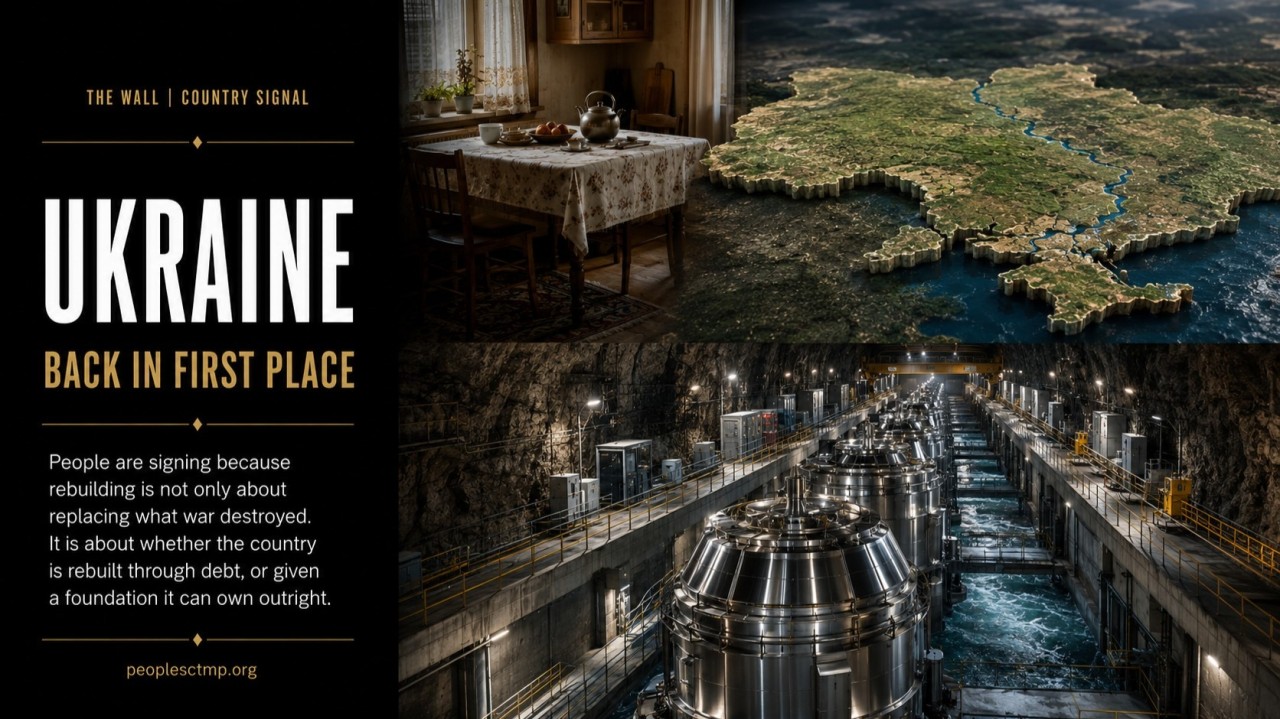
Ukraine reaching the front of The Wall does not mean anyone has been chosen, or any decision made, or any deal struck. The Wall is not a petition to any government, not a vote, not an investment. It takes no money, no name, no email, no identity. It asks one thing: that a person register, once and anonymously, that their country should be considered, knowing the count is public and the order of consideration follows the count.
It will not be moved by the loudest voice on any side. It moves on the quiet, private decisions of people who look at that kitchen and decide that when the wall goes back up, it should be a wall the family owns, not a wall they owe for.
That is the whole choice, said as plainly as I know how. A country can be rebuilt in a way that leaves it indebted to the world for a generation. Or it can be given a floor it owns outright, and owe no one.
The wall is going back up either way.
The only question is who holds the note when the children are grown, and whether, when they sit at that table years from now, the room around them belongs to them, or to someone they never met, who was kind enough to lend.
And right now, quietly, one signature at a time, the people of Ukraine are beginning to answer.
Chris Coode, Founder and CEO, HLX Inc. · peoplesctmp.org