Jordan: The Country Living on Borrowed Water
June 5, 2026
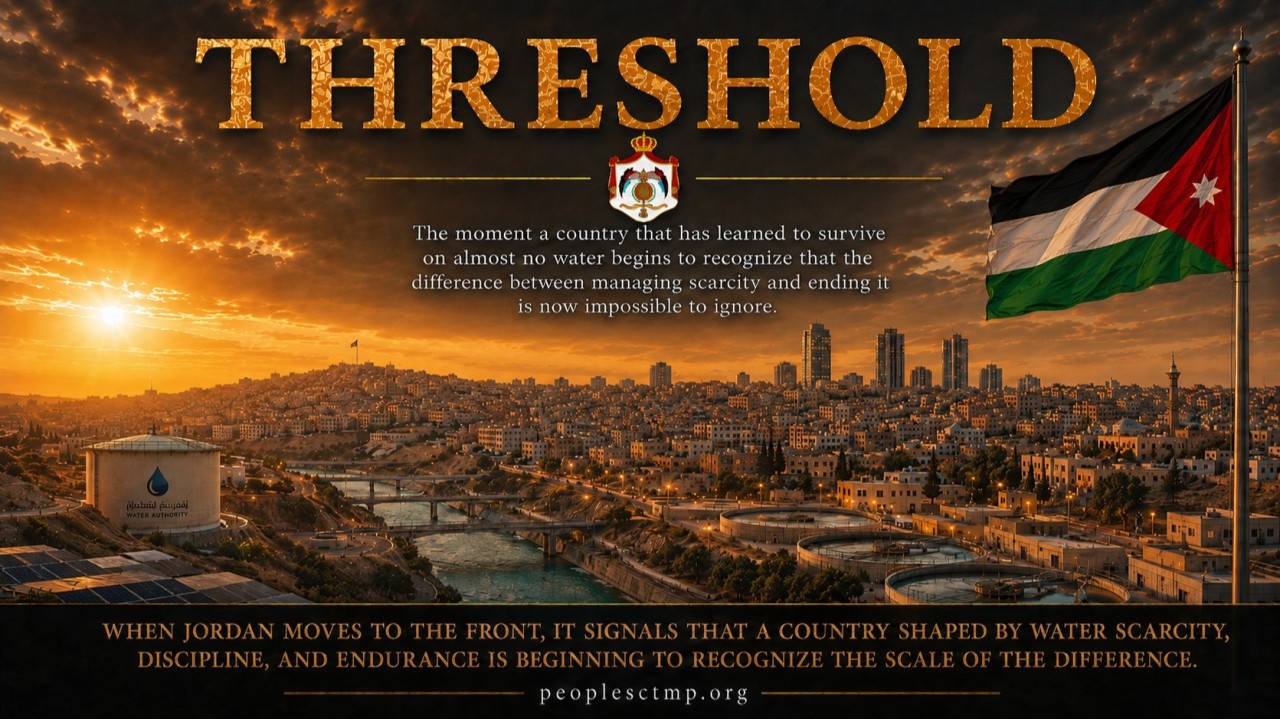
Jordan just moved into first place on The Wall, and I have no control over that. I never do. I do not know who signs, or why, or from where. I just do the work and watch what the people decide.
But this one stopped me, because once you understand what Jordan is actually living on, you cannot look away from it. So let me walk through it the way I see it, one step at a time, and let each step rest on the one before. You can decide for yourself whether it holds. I am not asking you to believe me. I am asking you to follow the logic.
It starts with a number that should not be possible for a functioning country.
Step one: Jordan is one of the driest nations on the face of the earth
The line the world uses for absolute water scarcity is 500 cubic metres of fresh water per person per year. Below that, a country is officially in crisis.
Jordan has under 100.
Not 100 below the line. 100 total. One fifth of the threshold for severe scarcity. Jordan is not near the edge of the world's water crisis. It is one of the few countries that lives at the very bottom of it, year after year, and has somehow kept a modern society running anyway.
And I want to be honest about how remarkable that "anyway" is, because it is the whole foundation of this story. Despite having almost no water, Jordan gets access to an improved water source to more than 98 percent of its people, even though supply is often intermittent. This is not a country that failed at water. This is a country that has performed something close to a miracle with almost nothing, for decades, through discipline and engineering and sheer will.
But a miracle performed on an empty tank has a cost. In Amman, families sometimes wait a week between water deliveries. People store water in tanks on their roofs because the supply does not run continuously. An entire society has organized its daily life around when the water comes. They have managed. They have adapted. They have done everything right with a hand almost no country on earth was dealt.
Which raises the only question that matters next. If you are already that disciplined, already that good at it, and you still have to ration, then what exactly is holding the whole thing up?
Step two: the country is drinking water that is thirty thousand years old, and it is running out
Here is the part that stopped me cold.
A huge share of the water keeping Amman alive is pumped from a place called the Disi aquifer, deep underground near the Saudi border. That water is fossil water. It has been sitting in the rock since wetter Pleistocene-era conditions, roughly 10,000 to 30,000 years ago, and it does not meaningfully refill. Every litre pulled up is a litre that is gone for good.
Jordan is, quite literally, drinking the deep past to survive the present. A 325 kilometre pipeline carries that ancient water to the capital, and the country leans on it because there is nothing else.
And the experts who study it have put a clock on it. The Disi system is not permanent. The project is often described around a finite 50-year lifeline, and estimates vary with extraction rates, Saudi withdrawals, and future demand.
Sit with what that means. A child born in Amman today is expected to watch the country's largest single lifeline of water empty out within their own lifetime. Not in some distant abstract future. Within the span of one ordinary human life. The tank that the entire miracle is balanced on has a visible bottom, and the country is moving toward it a little more every single day.
So that is the real ground Jordan stands on. Not scarcity it is failing to manage, the opposite, a scarcity it has managed brilliantly, but on a reserve that is finite, falling, and dated to expire. The discipline is real. The foundation underneath the discipline is disappearing.
Which leads straight to the next question. If the old water is running out, what is the plan to replace it?
Step three: the plan is real, and it arrives wrapped in debt and a thirty-year foreign concession
Jordan is not standing still. Far from it. The country is building the largest piece of infrastructure in its history to save itself: a roughly six billion dollar project to desalinate seawater at the Red Sea port of Aqaba and pipe it hundreds of kilometres uphill to Amman. When it comes online toward the end of this decade, it is meant to bring continuous water to more than three million people and finally end the rationing that defines daily life.
This is a genuine achievement, and I do not want to take anything away from it. It is the right instinct. Replace the vanishing fossil water with water from the sea, which never runs out.
But look closely at how it is being built, because this is the part that connects Jordan to something I have written about before.
The project was handed, on a thirty-year concession, to a consortium of foreign engineering firms. They will design it, build it, finance it, operate it, and only eventually transfer it back to the country. It carries billions in cost, layered with foreign investment grants and the financing structures that always come attached to a megaproject of this size.
So follow the thread. A country that has done everything right, that has managed the impossible for decades, that is now watching its ancient water run toward empty, secures its future water by signing a thirty-year arrangement in which outsiders own and operate the lifeline, and the country pays, and pays, and pays, until somewhere down the line it finally gets the keys.
The water problem gets solved. But the way it gets solved means the most basic input of life in Jordan, the water itself, runs through a structure owned by someone else for a generation. The thirst ends. The dependency begins. And this is not a criticism of Jordan, which is doing the only thing the current world offers a water-poor country to do. It is a description of the only menu that was ever put in front of them.
That is the trap. And it is worth asking, plainly, whether that menu is the only one that could exist.
Step four: there is a version where the water and the means to make it both belong to the people who drink it
Here is the turn, and it is the whole reason I am writing this.
The platform I have spent decades building makes fresh water at the scale of a nation, from the sea, as an ordinary part of how it works. The same cheap power that runs everything else runs the process that pulls the salt out of seawater. And for Jordan, I want to put the actual number on the table, because the number is the whole point.
A single module is designed to give two billion cubic metres of potable water every year, free, to the country that hosts it.
Now follow that through at the most basic human benchmark. The figure used for essential daily water is fifty litres per person per day. Divide two billion cubic metres a year across that benchmark, and it covers the basic daily water of roughly one hundred and ten million people. Jordan's entire population is about eleven and a half million.
Read those two numbers together, because for a country that rations the tap they are almost hard to believe. A single module's free allocation alone is enough to cover the essential daily water of nearly ten times every man, woman, and child in Jordan. Not barely enough. Not enough to scrape by. Enough to cover the whole nation many times over, with a surplus so large it could, on paper, underwrite the basic drinking water of more people than live in several of Jordan's neighbours combined. In a region where water has been one of the things wars are fought over, a single module turns the scarcest thing on the map into the most abundant. And it does it on the same terms for everyone, because the charter does not allow the host to turn the tap into a weapon.
And here is what the charter actually locks down, because this is the part that separates it from every concession and every loan. The water given to the host nation is free. Not subsidized, not financed, not leased back over thirty years. Free. The only thing the charter permits is a nominal charge to cover the physical cost of getting it to people, the pipes, the moving of it, and nothing beyond that. No one takes a margin on the water itself. It cannot be marked up, mortgaged, or sold back to the people who drink it, because the rules forbid it at the level of the system's own constitution.
That is where the governance matters more than the engineering. The platform is built, by its charter, to carry no debt. None. There is no thirty-year concession in which outsiders hold the lifeline. There is no creditor. There is no financing structure layered on top of the most basic substance a human being needs to live. The host country does not spend a generation paying strangers for its own water, because the rules forbid the water and the means of making it from being owned that way in the first place.
Set that beside the trap and you see the whole choice in one frame. The ordinary path ends the thirst and hands the tap to whoever financed it. This path ends the thirst and leaves the tap in the hands of the people who drink from it.
One way, Jordan stops rationing and starts owing.
The other way, Jordan stops rationing and owes no one.
Step five: the same project that ends the thirst rebuilds the country that drinks
There is a second number here, and for a nation of eleven and a half million people it may land just as hard as the water.
Building one of these platforms is not a ribbon-cutting. It is years of construction, and then decades of operation, and by the platform's own planning figures the labour involved is measured in the millions of job-years. A job-year is simply one person working full time for one year. Add up the construction phase and the permanent operating workforce across a full module buildout, and the work runs to a scale that, for a country Jordan's size, is on the order of the entire nation's working capacity. It is not a number you can fill from one year's idle hands. It is a number large enough that it reaches beyond the borders and pulls people back.
Think about what that does to a place. It is not a few hundred jobs at a single site. It is the kind of sustained, skilled work, welders, electricians, plant operators, engineers, lab technicians, the work a country normally watches its brightest young people leave to go find somewhere else. A buildout on this scale does the reverse. It gives a generation a reason to build their lives inside their own borders instead of exporting their talent and importing their future.
So the same project that ends the rationing also rebuilds the workforce that runs it. The water and the work arrive together, because they were always the same act.
I will keep the honesty flag on these figures, the way I do on everything. The water volume and the labour numbers are the platform's design and planning figures, derived from how a module is built to operate, not a promise stamped onto Jordan specifically. The real profile of any one deployment has to be worked out against the real site. But the shape of it is not in doubt. A project this size, in a country this size, is a national event, not a local one, in both the water it makes and the work it takes to make it.
Step six: what this is, and what it is not
I have to mark the edge of the claim clearly, the same way I do for every country, because an argument that reaches too far snaps at the first pull.
No Jordanian site has been studied yet. The geology of a coast and a conveyance route has to be proven honestly, with real fieldwork, before anyone should trust it. I am not going to pretend that work is done, because it is not. And nothing about this changes the politics of the region or the hard realities Jordan navigates every day. It does not solve everything. It was never built to.
What it can do is narrower, and on Jordan's particular fact it is almost everything. It is about whether the water that replaces the dying aquifer arrives as something the country owns outright, or as something it rents from the world for the next thirty years. That is a humbler promise than a headline would want. I think it is also, for a nation living this close to the bottom of the tank, the one that matters most.
The only question on the table
So the logic closes where it began, with a country performing a miracle on an empty tank.
Jordan reaching the front of The Wall does not mean a decision has been made, or a deal struck, or that anyone has been chosen. The Wall is not a petition to any government, not a vote, not an investment. It takes no money, no name, no email, no identity. It asks one thing: that a person register, once and anonymously, that their country should be considered, knowing the count is public and the order of consideration follows the count.
Of all the countries on earth that might look at a platform that makes endless fresh water from the sea and gives the first share away free, Jordan is one of the very few that does not need the idea explained. It has spent decades learning, the hard way, one rationed week at a time, exactly what water is worth, and exactly what it costs to have to borrow it. It is drinking the ice age to get through the year. It knows, better than almost anyone alive, the difference between water you own and water you owe for.
The aquifer can be emptied. The sea cannot.
Jordan, more than almost any nation on earth, already understands that, because it has been counting down to the bottom of the tank for years. And right now, quietly, one signature at a time, its people are saying so.
Chris Coode, Founder and CEO, HLX Inc. · peoplesctmp.org