Nicaragua: The Canal That History Kept Promising
June 7, 2026
Nicaragua is climbing The Wall, and of all the countries that have reached the front, this is the one where I had to sit back from the screen for a moment, because the longer you look at it, the more it stops feeling like coincidence and starts feeling like something closer to a circle finally closing.
I have no control over which countries rise. I never do. I do not know who signs, or why, or from where. I just do the work and watch what the people decide. But Nicaragua carries an irony so precise that I do not think I could have invented it if I tried. So let me walk through it the way I see it, one step at a time, and let each step rest on the one before. You can decide for yourself whether it holds. I am not asking you to believe me. I am asking you to follow the logic, because the logic here is almost unbelievably clean.
It begins with a project name.
Step one: the name on my work is the oldest dream in this country's history
The platform I have spent decades building is called the Canal and Transshipment Mega Project. CTMP. I did not choose that name with Nicaragua in mind. I chose it because the architecture includes a canal and corridor system, transshipment, ports, the movement of materials and goods through a body that does not depend on the world's chokepoints.
But say the word "canal" to a Nicaraguan and you have not said a piece of infrastructure. You have said the country's entire modern history in a single syllable.
Because Nicaragua is not a country that happens to have considered a canal. Nicaragua is the country defined, for two centuries, by a canal that was always promised and never came.
This is not an exaggeration. The dream of cutting a passage between the Atlantic and the Pacific through Nicaragua goes back to the colonial Spanish, who looked at the geography and saw what nobody could unsee once they saw it. Later the idea was studied, surveyed, and formally presented to the United States Congress in the 1820s. Through the 1800s, Nicaragua was the leading candidate, the favored route, the place the great powers fought over precisely because whoever controlled that passage controlled the movement of the world.
And then, at the last moment in history, the canal went to Panama instead. The United States chose the other route. Nicaragua, having been the chosen one for the better part of a century, watched the single thing that would have transformed it go to its neighbor.
That is where this country's heartbreak begins. Not with a disaster. With a promise withdrawn.
So when a project arrives at Nicaragua's door with the word "canal" in its very name, understand that for the people there it is not a neutral word. It is the word their whole history has circled. Hold that, because it is only the first turn of the screw.
Step two: the dream came back, again and again, and each time it took something instead of giving
Here is what makes the irony sharpen rather than soften.
The canal did not die when Panama won. It kept coming back, like a thing that could not rest. And every time it returned, it returned in a shape that asked Nicaragua to give, and give, and give, with the promise that someday it would receive.
In our own decade, the most dramatic version of all. In 2013, the Nicaraguan government granted a concession for a forty to fifty billion dollar interoceanic canal to a foreign-financed consortium. It was announced, in its backers' own words and with complete sincerity, as the project that would finally lift Nicaragua out of poverty, the biggest construction project in the history of humanity, the thing that would double the nation's growth. A route was unveiled. Ground was broken.
And then look at what it actually asked of the country. The plan would have carved a hundred-foot-deep trench straight through Lake Nicaragua, the largest freshwater lake in Central America, the country's single greatest natural treasure. It would have displaced tens of thousands of people, including indigenous communities whose land lay along the route. Scientists warned the damage to the lake, the very heart of the country's fresh water, could be catastrophic and irreversible.
So here was the bargain history kept offering Nicaragua. To finally get the canal it had been promised for two hundred years, the country would have to let a foreign consortium dredge through its freshwater heart, owe the financing, carry the risk, displace its own people, and hand over a thirty to one hundred year concession in which outsiders owned and operated the passage.
And then that project, like every version before it, collapsed. Financing problems. Environmental opposition. Political reality. The ground broke and the dream evaporated again, leaving behind only the cost of having believed in it.
Follow the pattern across the whole two centuries, because the pattern is the point. Every time the canal returned, it came wrapped in foreign money, foreign ownership, debt, displacement, and risk to the one thing Nicaragua could not afford to lose, its water. The canal was always something done to Nicaragua, financed by others, owned by others, threatening the country's own lake, in exchange for a someday that never arrived.
That is the trap this country has lived inside for two hundred years. The dream of connection that always demanded the surrender of sovereignty as the price of admission.
A short word about what was always on the table to be sacrificed
I want to slow down on the lake for a moment, because to understand why every canal scheme was a trap, you have to understand what the country was always being asked to risk.
Cocibolca is not a reservoir. It is a living thing, and a strange and wonderful one. It is the only freshwater lake on earth where sharks swim. Bull sharks make their way up the San Juan River from the Caribbean, navigating the rapids the way salmon do, until they reach an inland sea so vast the Spanish drank from it and thought they had found the ocean. Out of its waters rise the twin volcanoes of Ometepe, an island formed by fire standing in the middle of fresh water, ringed by four hundred smaller islands and the towns that have lived on its shores for centuries.
This is the heart the canal schemes proposed to dredge a hundred feet deep. This is what Nicaragua was told, over and over, it would have to put at risk in order to finally receive the prosperity it had been promised. Not an abstraction. The sweet sea itself, the largest body of fresh water in all of Central America, the thing the country's life is built around, offered up to the dredgers as the cost of admission.
A nation can be forgiven for hesitating two hundred years before paying a price like that. And it tells you something true that Nicaragua, poor as it has been kept, never did pay it. The lake is still whole. The sharks still climb the river. Whatever else was taken from this country, it held onto its sweet sea.
Which raises the question the whole history has been building toward, whether anyone ever stopped to ask it. What if the thing Nicaragua actually needed was never the trench between the oceans at all?
Step three: Nicaragua already has the thing the canal was always a substitute for
Step back and ask what the canal was ever really for.
Strip away two centuries of romance and the answer is simple. The canal was meant to be Nicaragua's way out of poverty. That is the only reason it was ever wanted. Not the trench for its own sake. The prosperity the trench was supposed to deliver. Every president who chased it, every survey commissioned, every concession signed, was chasing the same thing: a way to convert the country's extraordinary geography into a decent life for its people.
And here is where the irony becomes almost too perfect, because look at what Nicaragua is actually sitting on.
It touches two oceans. The Caribbean to the east, the Pacific to the west. It is one of the few nations on earth that faces two seas at once, the exact feature that made it the favored canal route for two hundred years.
It holds the largest freshwater lake in Central America, Cocibolca, the sweet sea, so vast that the first Spanish to reach it drank from it and believed they had found the ocean. More than forty rivers drain into it. It is, in the words of a survey written a hundred and fifty years ago, the great receptacle of the waters of Central America.
And it already runs, more than almost any country its size, on the power of its own land. Nicaragua sits on a spine of volcanoes. It draws energy from that volcanic heat, from its wind, from its water, and generates a remarkable share of its electricity from renewable sources. Like the other nations that have led this list, Nicaragua does not need to be convinced that nature can power a country. It already lives on it.
So assemble the picture. Two oceans. The largest body of fresh water in the region. Volcanic energy under its feet. A people who already understand power drawn from the land. By every measure of natural endowment, Nicaragua is one of the richest places on the planet.
And it remains one of the poorest countries in the entire Western Hemisphere.
That is the real Nicaraguan paradox, the one underneath the canal. Not a country lacking in resources. A country drowning in them, surrounded by water, sitting on energy, facing two oceans, and still poor. The wealth was always there. What was never there was a way to turn the endowment into a life without handing the endowment itself to someone else as the price.
The canal was always the wrong answer to the right question. The question was never "how do we cut a trench." The question was always "how do we finally convert what we are sitting on into prosperity that belongs to us." For two hundred years the only answer on offer was a trench owned by foreigners that threatened the lake. There was never another menu.
Until, perhaps, now.
Step four: the platform is the prosperity the canal always promised, without the surrender it always demanded
Here is the turn, and it is the reason the irony stopped me cold.
The platform I have built makes its power from the ocean. Seawater drawn in at the coast, dropped through depth and gravity to spin turbines, returned to the sea. Nicaragua faces two of them. The same cheap power runs desalination, so a country can have abundant fresh water at the scale of a nation without ever having to dredge or endanger the lake it already loves. The same power feeds an entire integrated industrial base, steel, concrete, materials, molecules, the things that build a country, produced on site, at a fraction of world cost.
And yes, the architecture includes exactly what the name says: a true canal, a navigable passage built for the largest ships on earth, the very thing Nicaragua was promised for two hundred years. I will come in a moment to how it gets built, and to the hard choices that come with cutting a passage across this particular country, because I am not going to wave my hand over the difficult part. But the essential point belongs here first. In this version, the canal is one vertical inside a platform that also hands the country its power, its water, and its industry. It is not the single fragile thing the entire national hope is made to hang on, the way it has been for two centuries. It is one organ in a whole body.
But here is the part that turns the whole history on its head. Look at what this version does not ask for.
It carries no debt. None. By its own charter, there is no creditor, no foreign consortium that owns the passage, no thirty to one hundred year concession in which outsiders hold the lifeline and the country pays and pays until someday it gets the keys. The water given to the host nation is free, given, not financed, not leased back. The platform cannot be owned in the way every canal scheme in Nicaragua's history was owned, because the rules forbid it at the level of the system's own constitution.
Set that against two hundred years of history and feel the size of it. Every version of the dream that was ever offered to Nicaragua demanded the same price: foreign money, foreign ownership, debt, displacement, and risk to the country's own water, in exchange for a someday. This asks for none of it. It delivers the prosperity the canal was always supposed to deliver, the connection, the industry, the way out of poverty, and it leaves the country owing no one, owning its own water, its own power, its own future.
The canal, for two centuries, was the thing Nicaragua had to surrender its sovereignty to obtain.
This is the same prosperity, arriving as the thing that builds its sovereignty instead.
One way, Nicaragua finally gets its canal and spends the next century paying foreigners for it, with its lake at risk.
The other way, Nicaragua gets everything the canal ever promised and owes no one, with its lake untouched.
Step five: the canal, built the hard way, because the lake is not for sale
Let me be specific about the canal itself, because vagueness is exactly how every earlier version of this dream got away with what it quietly intended.
The passage is built to one uncompromising standard. It must carry the largest vessels that will ever float, with margin to spare, for a century. Fifty metres deep. One kilometre wide. Those numbers are not for show. The biggest container ships on the planet today run about four hundred metres long, sixty metres across the beam, and draw sixteen to seventeen metres of water when fully laden. The deepest supertankers afloat draw around twenty-four. A channel fifty metres deep is more than double the draft of the deepest-laden ship on earth, and a kilometre of width lets the largest vessels ever built pass each other in both directions at the same time, with open water between them. Whatever the world launches next, larger than anything sailing now, this passage is sized to take it without a second thought. And the entire channel is lined in the platform's own green concrete, produced on site by the same integrated industry that builds everything else, so the canal is not poured from the dirtiest material in the world but from the cleanest version of it the platform makes itself.
That is the part I can state with confidence. Here is the hard part, and I am going to put it on the table in full, because hiding it is precisely what two centuries of canal schemes did.
The natural route across Nicaragua, the one that has tempted every empire since the Spanish, runs straight through Lake Nicaragua. It is the low path, the short path, the cheap path. And it is the one path I will not take. The lake is not for sale. Cocibolca, the sweet sea, the living lake with its sharks and its volcanoes and the towns that have stood on its shores for centuries, is the exact thing every prior plan was willing to dredge a hundred feet deep, and it is the exact thing this project treats as absolutely off-limits from the first line of the first page. You do not save a country by carving out its heart.
So the canal has to go the hard way. Around the lake, not through it. The honest, unglamorous siting work that runs in the background of this project every single day has already mapped what that choice costs, and I would rather show you the cost than pretend it away. Once you rule out the lake and the great reserves around it, the San Juan basin, Indio Maíz, Bosawás, the Caribbean wetland belts, the only corridor family left runs overland, north of the lake, up through the central highlands and back down to the Caribbean. That is not the easy lowland dredge the southern route would have been. It is a longer, deeper cut through rising ground, tens of millions of cubic metres of excavation for every kilometre of its length. It means confronting, plainly, what this country's geography actually holds: an active seismic zone down the Pacific side, a chain of living volcanoes along the western arc, soft and river-heavy ground toward the Caribbean, and belts of under-studied limestone that have to be drilled and proven before any honest engineer will trust them.
I am not going to stand here and tell you that is easy, because it is not, and you would be right to distrust me if I did. It is one of the most demanding excavation problems anyone has ever set down on paper. But demanding and impossible are not the same word, and I have never once let myself confuse them. The excavation that stops other people is the precise thing this platform was built to do. It owns its own tunnel-boring fleet, its own materials handling, its own heavy industry. And every cubic metre carved out of that corridor is not waste to be dumped. It is feedstock: the aggregate and the fill and the raw material that the platform turns into the very green concrete that lines the canal walls. The corridor carries more than ships, too. Alongside the navigable channel runs the platform's lifeblood, the water, the power, the green molecules, routed through the spine of the country rather than around it. The mountain that has to be moved becomes the canal that moves through it.
And notice what choosing the hard way actually means, because this is the whole moral of two hundred years. Every previous version of this dream chose the easy route and was willing to pay for it with the lake. This version chooses the harder route precisely so the lake never has to be paid at all. The difficulty is not a flaw in the plan. The difficulty is the proof that the promise is real. Anyone will build the cheap canal straight through the country's fresh water. It takes a flat refusal to do that to build the other one.
I will keep the honest flag on every word of this, the way I do on everything. No corridor has been certified. The siting work so far is desktop screening, not a committed route, and the real proof demands fieldwork, drilling, fault mapping, and a full accounting of the communities and wetlands along whatever band survives the exclusions. I am not handing anyone a finished line on a map. I am handing them the one thing that was never on offer in two hundred years of promises: that the lake is off the table, and any route would have to be proven around it, or it would not proceed.
Step six: how a country drowning in resources finally gets to keep the wealth
I have to go one level deeper here, because the question from step three is still hanging, and it is the question that has defined this country for two centuries. How does a nation this rich in what the earth gave it stay this poor? And what, precisely, would have to change for the wealth to finally stay home?
The answer is a single idea, and once you see it you cannot unsee it. Energy is the master commodity. It is not one cost among many. It is the cost hidden inside every other cost. The price of steel is mostly the price of the energy it took to make it. The price of clean water is mostly the energy it took to move and purify it. The price of fuel, fertilizer, concrete, food, transport, all of it, is in large part the price of the energy buried inside it. Master the price of energy and you have not lowered one cost. You have lowered the floor under every cost there is.
That is what the platform does. By producing firm, clean power at a fraction of what the rest of the world pays to generate it, the cost base of everything built on top of it collapses. And here is the consequence, stated plainly, because the arithmetic deserves to be loud while the voice stays quiet.
The platform can sell everything it produces, the steel, the concrete, the fuels, the molecules, at around twenty percent below what the rest of the world charges for the same thing, and still earn margins better than almost any corporation on earth. Both of those are true at the same time, and they are only able to be true together because the master commodity has been mastered. Take green steel as the one worked example. A tonne that costs the world around fifteen hundred dollars costs the platform, with its near-free power, on the order of two hundred and fifty. Sell it at twelve hundred, twenty percent under the world price, and the margin is still close to eighty percent. Undercut everyone, and out-earn everyone, with the same act.
Now hold that against Nicaragua's two-hundred-year paradox. The country was never poor for lack of resources. It was poor because there was never a way to convert what it sat on into wealth without handing the conversion, and the profit, to someone else. The master commodity was the missing key. A platform that masters it does not just produce things. It produces them so far below world cost that the prosperity stays inside the country instead of leaking out to whoever financed it. The wealth Nicaragua has been sitting on for two centuries finally has a way to become a life its own people keep.
And then there is the work, which for a nation of under seven million people may be the part that lands hardest of all.
Building one of these platforms is not a ribbon-cutting. It is years of construction and then decades of operation, and the labour involved is enormous, large enough that for a country of under seven million people it is the wrong instinct to picture a few thousand jobs at a single site. The honest way to say it, and I will hold to the honest way, is that the workforce required to build and then run a full module is being counted vertical by vertical right now and benchmarked against real industry standards before I will put a hard number on it in public. I am not going to hand you a figure I have not finished standing up. But the shape is not in doubt. A buildout of this kind, in a country this size, is a national event, not a local one. It is the kind of sustained, skilled work, the welders, electricians, plant operators, engineers, and technicians, that a country normally watches its brightest young people leave to find somewhere else. A project at this scale does the reverse. It reaches past the borders and pulls a country's scattered people home, and it keeps doing it for decades, because the platform is built to compound, every vertical growing year over year, so the work grows with it rather than ending when the ribbon is cut.
I will keep the honest flag on all of it, the way I do on everything. The cost figures and the margins are the platform's design and planning numbers, derived from how the system is built to operate. The workforce figures I am deliberately not pinning down in public yet, because I am still counting them vertical by vertical and benchmarking them against real industry standards, and I will not publish a hard number before that work is done. None of this is a promise stamped onto Nicaragua specifically, and the real profile of any one deployment has to be proven against the real site and the real ground. But the shape of it is not in doubt. A platform that has mastered the master commodity sells below everyone and earns above everyone, and the work it takes to build and run it, for a country Nicaragua's size, is a national event measured against the whole population, not a local one measured against a town.
So the prosperity Nicaragua chased through the canal for two hundred years turns out to have a real engine underneath it after all. Not a trench that foreigners own. The mastery of the one commodity that sits inside the price of everything, turned into goods sold below the world and wealth that stays at home, built by a workforce drawn from the country's own people and its own returning diaspora.
Step seven: the divine irony, said plainly
Now let me say the thing I have been circling, because you can feel it building and it deserves to be named.
For two hundred years, Nicaragua's entire national hope was attached to a single word. Canal. The country was the chosen route and then the rejected one. It was promised and abandoned, courted by empires and handed to its neighbor, offered the dream again and again only on terms that would have cost it its water, its land, and its independence. An entire nation's longing, compressed into one word that always arrived carrying a price it could not afford and a betrayal it could not avoid.
And now a project arrives carrying that exact word in its name, the Canal and Transshipment Mega Project, and it is the first version in two hundred years that asks Nicaragua to surrender nothing. No debt. No foreign ownership. No threat to the lake. No someday. The word that was the country's two-century heartbreak turns out to be the word on the one thing built so that it could never break a country's heart again.
That is the irony I felt before I could explain it. It is not that Nicaragua might get a canal. It is that the canal, the actual idea, the connection and prosperity it always stood for, finally arrives stripped of the one thing that made every previous version a trap. The dream comes back, for the hundredth time across two centuries, and this time it comes back without the chains.
And of all the countries on earth that might look at a platform with the word canal in its name and a promise of prosperity without debt, Nicaragua is the one nation alive that has spent two hundred years learning, in the hardest possible way, exactly what that word has always cost. They do not need the irony explained to them. They have been living inside it for two hundred years. They know, better than anyone on earth, the difference between a canal that owns you and a canal that frees you.
I genuinely did not arrange this. I could not have. I named the work for what it is, the people of Nicaragua found it on their own, and the circle closed itself.
What this is, and what it is not
I have to mark the edge of the claim clearly, the same as I do for every country, because an argument that reaches too far snaps at the first pull.
No Nicaraguan site has been studied yet. The geology of the coasts, the routing of any corridor, the protection of the lake above all, every bit of it would have to be proven honestly, with real fieldwork, before anyone should trust a single shovel. I am not going to pretend that work is done, because it is not. And the platform changes none of the country's politics or its present difficulties. It does not solve everything. It was never built to.
What it can do is narrower, and against this country's particular history it is almost everything. It is about whether the prosperity Nicaragua has chased for two centuries arrives, at last, as something the country owns outright, with its lake intact and its books clean, or whether it keeps arriving the only way it ever has, as a trench owned by someone else, paid for across a century, dug through the heart of the country's own fresh water. That is a humbler promise than two hundred years of canal dreams would want. I think it is also the one that finally answers them.
The only question on the table
So the logic closes where it began, with a single word and two hundred years of waiting.
Nicaragua reaching the front of The Wall does not mean a decision has been made, or a deal struck, or that anyone has been chosen. The Wall is not a petition to any government, not a vote, not an investment. It takes no money, no name, no email, no identity. It asks one thing: that a person register, once and anonymously, that their country should be considered, knowing the count is public and the order of consideration follows the count.
Of all the countries that might understand what it means to be offered connection and prosperity without surrender, Nicaragua is the one that has waited two centuries for exactly that offer and been handed a trap every single time. It sits between two oceans. It holds the sweet sea. It runs on the fire under its own mountains. It has every gift the earth can give a country and has been made to stay poor anyway, because the only path it was ever shown demanded it sign away the gifts to use them.
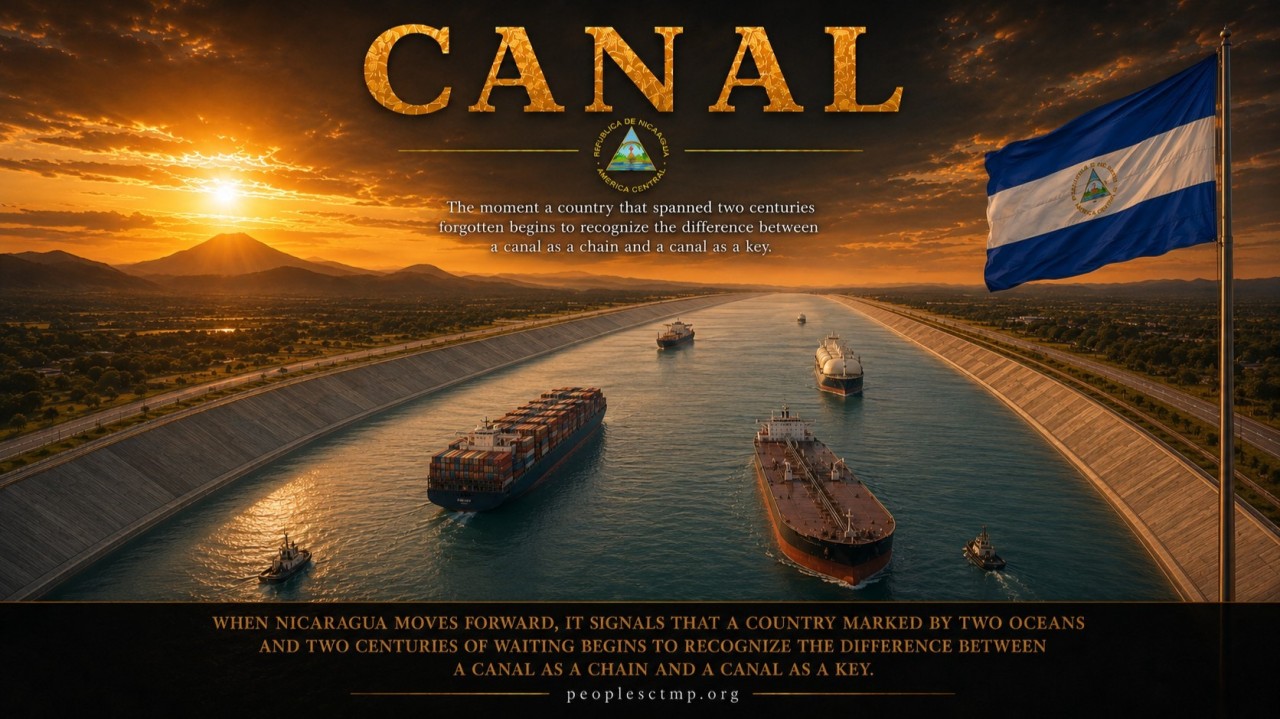
The canal can be a chain. The canal can be a key.
Nicaragua, more than any nation on earth, already knows the difference, because it has held the chain for two hundred years and never once been handed the key. And right now, quietly, one signature at a time, its people are reaching for it.
Chris Coode, Founder and CEO, HLX Inc. · peoplesctmp.org