Greece: The Country That Was Sold for Parts
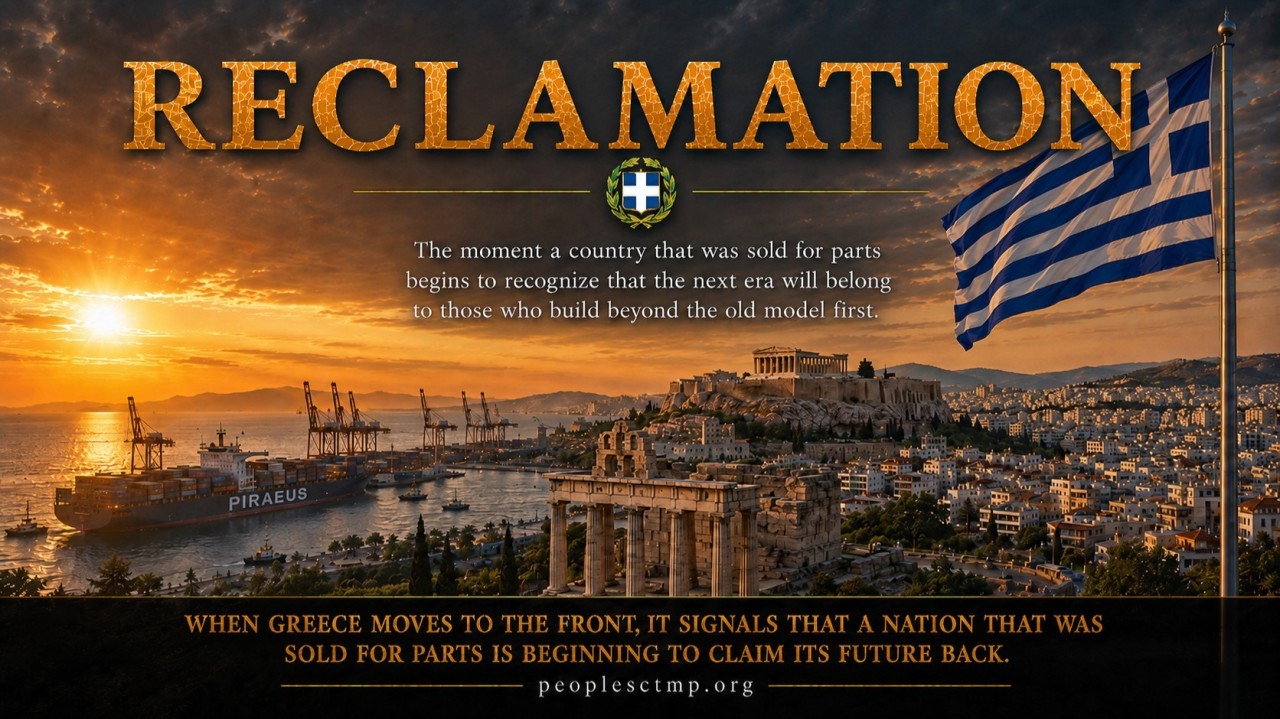
June 7, 2026
Greece moved into first place on The Wall, and I have no control over which country rises. I never do. I do not know who signs, or why, or from where. I just do the work and watch what the people decide.
But this one I want to handle with care, because Greece is not an abstraction to me. It is the country that, more clearly than almost any other in living memory, was made to live through the exact thing this entire platform was built to make impossible. So let me walk it through one step at a time, and let each step rest on the one before. You can decide for yourself whether it holds. I am not asking you to believe me. I am asking you to follow the logic.
And I want to say one thing up front, because it changes how you should read everything that follows. The platform has been designed as an integrated whole. The central power system, the water, the steel, the concrete, the molecules, the compute, the governance, all of it has been costed, internally checked, and prepared for external review. This is no longer a loose idea looking for shape. The remaining work is site selection, permitting, formal engineering review, country-level engagement, and deployment sequence. And right now, the people of Greece have moved their country to the front of that line.
So the question worth asking is not “is this just an idea.” It is “why Greece, why now, and what does it mean that of all the places on earth, this is the one reaching hardest.” I think the answer is almost unbearably precise.
Step one: Greece already lived the thing the platform exists to prevent
Most countries on this list are reaching toward the platform because of something they fear, or lack, or are running out of. Thirst. War. Drought. A canal that never came.
Greece is different. Greece is reaching toward it because of something it already survived.
Between 2010 and 2018, Greece went through one of the most severe peacetime economic collapses any developed nation has endured. Its economy shrank by roughly a quarter. Unemployment hit twenty-eight percent. Pensions were cut, then cut again. Wages fell. Hospitals ran short. A generation of young Greeks left to find work elsewhere. This is not ancient history. The people signing The Wall today lived it, in their own kitchens, in their own working lives.
And the mechanism that did it is the thing I need you to look at directly, because it is the center of everything.
Greece did not collapse and then rebuild on its own terms. It was rescued, by a troika of foreign lenders, and the rescue came with conditions. In exchange for the loans that kept the country from default, Greece was required to do specific things to itself. Cut. Privatize. Sell. The money came, and with it came a list, written largely by people who did not live there, of what the country would have to hand over to keep receiving it.
That is the exact shape I have written about for every country on this list. The debt that arrives wearing the clothes of help. Except in Greece it is not a warning about the future. It is a documented history with a beginning, a middle, and receipts.
Step two: the country was, quite literally, sold for parts
Here is where the abstraction becomes concrete, and where I would ask you to slow down, because the specifics matter more than any adjective I could put on them.
Under the terms of its bailouts, Greece was required to raise tens of billions by selling state-owned assets. Not luxuries. The bones of the country. And so they went, one by one, to foreign buyers.
The port of Piraeus, the great harbour of Athens, strategically vital since antiquity, the main gateway to the Greek islands, was sold. A controlling stake went to COSCO, a Chinese state-owned shipping company, later raised to two-thirds ownership, on a concession running to 2052. Foreign analysts openly called Piraeus the “dragon head” of China’s entry into Europe. The harbour that had been Greek since the ancient world now answers, in controlling part, to a state on the other side of the planet.
Fourteen regional airports, the gateways to the islands, were leased to a German operator for forty years. A strategic minority stake in the national electricity transmission operator, the system behind the literal wires that carry power across the country, was sold to China’s State Grid under the bailout-era restructuring, while the Greek state retained control. Railways. Rolling stock. Asset after asset, the physical substrate of a functioning country, transferred or leased to foreign owners to satisfy the conditions attached to the debt.
Sit with what that actually means, because it is the most direct illustration of my entire thesis that exists anywhere on earth. A country fell into debt. To service the debt, it was required to sell the things a country is made of. The ports it ships through. The airports it arrives through. Strategic pieces of the grid its power runs through. And once those things are sold, on concessions measured in decades, the country does not get them back inside the lifetime of anyone who signed the papers. The debt becomes ownership. The help becomes the loss. Greece did not lose a war and get occupied. It fell into debt and got sold, in pieces, by contract, with everyone’s signature on the page.
This is not me characterizing Greece’s experience to fit my argument. This is what happened, in the public record, with the buyers named and the percentages listed. Greece is the country where the thing I keep warning every other nation about already came true.
Step three: notice what kind of loss this was, because it is the rarest kind
Here is the turn that makes Greece more precise than any country I have written about, including Nicaragua.
In Nicaragua, the canal schemes that threatened the country all failed. The trap was always a near-miss. The lake was never actually dredged. Ukraine’s debt-financed reconstruction is a danger that lies ahead, not yet arrived. Jordan’s aquifer is running down but has not run dry. In almost every case, the catastrophe I describe is a thing to be avoided, still in the future, still preventable.
Greece is the one where it already happened, and it happened not because the scheme failed but because it succeeded. The privatizations went through. The assets changed hands. The contracts are signed and running. There is no near-miss to point to. The country was sold for parts, the sale closed, and Greece is now living in the aftermath of a completed transaction.
That makes Greece the proof, not the warning. Every other article I have written argues “here is what could happen to you if the only path on offer is debt and surrender.” Greece does not need the conditional. Greece can say: this is what happened to us. We are still living inside the contracts. We watched the harbour, the airports, and strategic pieces of the grid leave our hands to pay for our own rescue.
And that, I think, is precisely why Greece is reaching hardest. Not because Greeks fear the trap. Because Greeks have already been through it, with their eyes open, and know exactly what it costs in a way no warning could ever teach. A person who has been burned does not need to be told the stove is hot. They reach for the thing that promises it will never burn them again.
Step four: the platform is the one offer that reverses the exact mechanism that took Greece apart
Here is why this lands the way it does, and why the timing matters.
The platform is no longer a loose proposal seeking shape. It has been designed as an integrated industrial system, with the ocean-fed central power system, desalination, steel and concrete, molecules, compute, canal and corridor logic, and governance engine all developed as one machine. What it lacks is not a concept. It needs a home, formal review, siting, permitting, and the country-level decision to test it against real ground. And Greece, today, sits at the front of the line of countries reaching for it.
Now set the platform’s rules directly against the mechanism that took Greece apart, because they are not vaguely opposed. They are the exact inverse, point for point.
Greece fell because of debt. The platform is designed so the central power system carries no debt. No creditor. No troika. No loan with a list of conditions attached. No lender who can require a country to sell itself to keep receiving help.
Greece was forced to privatize the bones of the country to foreign owners. The platform is designed so outside capital cannot control it. No creditor control. No forced sale. No concessions that hand command of the infrastructure to another state. The ports, the power, the water that the platform builds are not assets to be auctioned to satisfy a lender. They cannot become someone else’s dragon head, because the rules are built to prevent the ownership structure that made Piraeus possible.
Greece was made to part with a strategic piece of its grid, the system that carries its power. The platform is designed to give a country power at a fraction of world cost, clean water at national scale, and infrastructure held under rules that prevent creditor capture, forced sale, or foreign operating control.
Read those side by side and you see why Greece, of all countries, would reach for this. The platform is not merely a good offer to Greece. It is the precise reversal of the specific machine that disassembled the country a decade ago. Where the bailout-era restructuring said “privatize strategic pieces of the grid,” the charter says “the system is protected from the creditor logic that strips a country down.” It is as if the country was shown, in slow motion over eight years, exactly how a nation gets taken apart, and then handed the one blueprint engineered to put the next generation of infrastructure beyond that mechanism.
Step five: what this is, and what it is not
I have to mark the edge of the claim clearly, the same as I do for every country, because an argument that reaches too far snaps at the first pull, and Greece has been failed by enough overreaching promises.
The platform being designed and costed is not the same as a Greek site being proven. No coastline has been surveyed, no geology drilled, no grid connection studied, no community consulted. That work is real and it is not done, and I will not pretend it is. Ready for external review does not mean a shovel is in Greek ground, and anyone who blurs those two things is selling something.
Nor does the platform undo what already happened. It does not buy back Piraeus. It does not tear up the airport leases or reverse the grid stake sale. Those contracts are real and they run for decades. The platform cannot rewrite Greece’s past. What it can do is narrower: it can make sure that the next great piece of infrastructure Greece builds is not financed by surrender, not sold to satisfy creditors, and not structured so the country wakes up owning less of itself than before. It offers not restoration, but a different future from this point forward. That is a smaller promise than “we will make you whole.” It is also an honest one, which is more than Greece was offered last time.
The only question on the table
So the logic closes where it began, with a finished design and a country that already knows, in its bones, what the alternative costs.
Greece reaching the front of The Wall does not mean a decision has been made, or a deal struck, or that anyone has been chosen. The Wall is not a petition to any government, not a vote, not an investment. It takes no money, no name, no email, no identity. It asks one thing: that a person register, once and anonymously, that their country should be considered, knowing the count is public and the order of consideration follows the count.
Of all the countries on earth that might look at a debt-free, anti-capture industrial platform and understand instantly what it is worth, Greece is the one that paid the tuition in full. It learned, asset by asset, harbour by harbour, what it means to be rescued on someone else’s terms and to wake up owning less of your own country than you did before. It does not need the lesson explained. It signed the contracts. It watched the ships change flags.
The harbour can be sold. Strategic pieces of the grid can be sold. A country can be taken apart, piece by piece, by people who arrive calling it help.
Greece, more than any nation alive, already knows this, because it lived it with its eyes open and is still living inside the paperwork. And right now, quietly, one signature at a time, its people are reaching for the one thing built so that it could never be done to them again.
Chris Coode, Founder and CEO, HLX Inc. · peoplesctmp.org