The United States: The Richest Country Where the Lights Still Feel Fragile
June 18, 2026
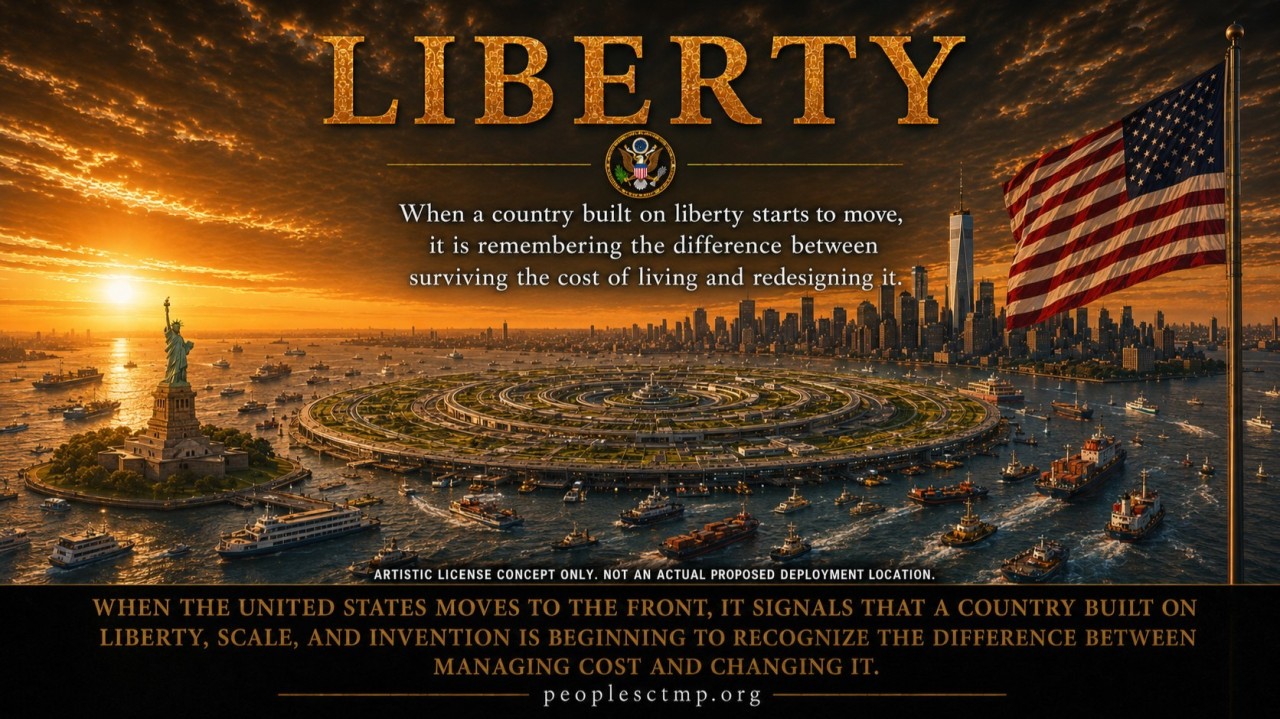
The United States moved to the front of The Wall, and this is the one country I cannot write about from a safe distance.
I lived there.
Eight years.
Long enough to stop being a visitor and start seeing the thing under the thing. Long enough to understand that America is not simple. It is power and exhaustion at the same time. It is brilliance and pressure. It is one of the most capable nations human beings have ever built, and still, somehow, ordinary people walk around inside it carrying a private fear that a country that rich should never have normalized.
I was back in New York not long ago, and I saw it again.
Sharper this time.
New York is one of the most extraordinary places on Earth. The density of talent, money, architecture, ambition, culture, finance, engineering, and raw human force is almost impossible to explain if you have not stood inside it. It feels like civilization running hot.
That is what makes the contrast so hard to take.
Because in the same glance, on the same street, you can see towers of capital and people sleeping on the concrete below them.
That does not look like a lack of wealth.
It looks like wealth failing to become security.
And that is the part that gets under my skin.
The United States is not short of money. It is not short of engineers. It is not short of universities, builders, capital, coastlines, resources, talent, ambition, or technology. This is a country that can build rockets, chips, aircraft, software empires, financial systems, military systems, ports, highways, hospitals, laboratories, and entire digital worlds.
And yet ordinary people still open ordinary bills with fear in their stomach.
That should bother everyone.
I saw it for eight years. People working hard, sometimes brutally hard, and still unable to feel safe. Parents doing math at the kitchen table. Workers coming home with nothing left in them. Families one medical event, one rent increase, one energy bill, one car repair, one bad month away from falling through the floor.
These were not people who failed.
They were people living inside a system where the basics had become too expensive to feel basic anymore.
That is the American contradiction.
A country with almost unlimited capacity, where millions of people still feel one bill away from the edge.
When you trace that fear down far enough, it keeps ending in the same place: the cost of the things people cannot live without.
Power. Water. Housing. Food. Heat. Cooling. Transport. The cost of being sick. The cost of keeping a home livable. The cost of simply getting through the month without being punished for existing.
And underneath almost all of it sits energy.
People are taught to think of energy as one bill. It is not.
Energy is buried inside almost every bill.
It is inside food because energy grows it, moves it, refrigerates it, and sells it. It is inside housing because steel, concrete, glass, lumber, heating, cooling, equipment, and transport all carry an energy cost. It is inside water because water has to be pumped, treated, moved, pressurized, and maintained. It is inside manufacturing, logistics, hospitals, data centers, schools, grocery stores, ports, farms, and factories.
When energy is expensive, life becomes expensive.
When energy is unstable, life becomes unstable.
That is why this matters.
The United States did not move to the front of The Wall because I picked it. I do not pick the country. I do not control who signs. I do not know who will move next. I just watch the public count like everyone else.
For days, Brazil held the lead. Brazil carried the pulse. Then the United States began moving. Brazil stayed ahead. Then the U.S. passed Brazil. Then Brazil answered. Then the U.S. answered back. Brazil retook the lead more than once because every new Brazilian signature moved the country visibly. Then the United States moved again and pulled clearly into first place.
That did not happen in theory.
It happened in public.
It happened in real time.
Ordinary people moved the order of the board.
And part of what propagated this movement came from something very real.
I sat with a university class of engineers for about an hour and a half.
They grilled me.
Properly.
That is what engineers are supposed to do. They are not there to applaud a vision statement. They are there to find the crack. They are there to ask where the energy comes from, how the water works, how the economics hold, how the system scales, how the governance survives contact with reality, how pricing is protected, how auditability works, where the failure modes are, how the chips get made, and whether the whole thing collapses when you stop speaking in headlines and start speaking in mechanisms.
That room did not treat the idea gently.
Good.
A project at this scale does not deserve gentle treatment.
It deserves pressure.
So I gave them the real thing.
Energy as the base layer. Water as a consequence of firm low-cost power. Industrial verticals built around that power. Materials, manufacturing, workforce, logistics, internal transfer discipline, verification, auditability, pricing constraints, sovereign compute, wafer fabrication, and governance all tied into one operating machine instead of scattered across disconnected systems where every interface can quietly become a tollbooth.
That is the part most people miss at first.
CTMP is not just an energy project.
Energy is the engine.
The platform is the point.
Low-cost energy by itself is powerful. Low-cost energy inside a structure that prevents the benefit from being captured before it reaches ordinary people is something else entirely.
That is where the engineers went straight to the right question.
If the platform can produce power cheaply, what stops the old system from buying it cheaply and selling it back expensively?
That is the question.
That is always the question.
Because that is how the public usually loses. A cheap input enters the system, an expensive output reaches the household, and the difference disappears into someone else’s margin. The public is told progress happened, but the kitchen table never feels it.
So the answer cannot be “trust us.”
The answer has to be structural.
The public power price is designed around 2.5 cents per kilowatt-hour at the metered delivery point.
That number is not decorative.
Against the current American electricity reality, it is violent.
In March 2026, California residential electricity was above 33 cents per kilowatt-hour. New York was above 28 cents. The U.S. residential average was above 18 cents. Even Washington industrial electricity, one of the strongest West Coast benchmarks for large buyers, was 6.85 cents per kilowatt-hour.
So when I say 2.5 cents, I am not talking about a small discount.
Against California or New York households, it is less than one-tenth of the price.
Against the U.S. residential average, it is about one-seventh.
Against one of the best industrial benchmarks on the West Coast, it is still far below half.
That gap between thirty-cent electricity and two-and-a-half-cent electricity is the whole American problem compressed into one number.
That is the size of the fear, measured in cents.
Inside the CTMP platform, the energy that feeds the verticals can be driven below one cent per kilowatt-hour. That is the number that changes the machine. It lets the platform manufacture, desalinate, process, compute, cool, fabricate, and expand from a cost base the ordinary grid cannot match.
But the public benefit only matters if the public receives it.
That is why the Stewardship Charter exists.
If CTMP-derived electricity is represented as CTMP Verified, the end user price must remain within the public ceiling. The test is what the final person actually pays. Not the press release. Not the legal structure. Not the name someone puts on a fee. What the person pays.
If the delivery chain pushes the price above the ceiling, it cannot honestly keep representing that output as CTMP Verified.
That is the lock.
The Charter does not pretend to govern people. It does not claim authority over taxation. It does not claim to override local law. It governs the infrastructure and the conditions under which outputs can carry the CTMP Verified designation. If someone captures the benefit on the way down, the capture becomes visible.
That is the moral difference.
A cheap input that becomes an expensive output is not a public breakthrough.
It is just another extraction surface.
And America knows extraction surfaces.
Americans live with them every day. The fee. The surcharge. The delivery charge. The demand charge. The adjustment. The financing cost. The mystery line item. The thing that was supposed to help but somehow became another way to pay more.
So the platform has to be designed around the reality of capture, not around the fantasy that capture will politely stay away.
That is why debt is kept out of the platform.
Debt is not just financing. Debt is leverage. A lender with a claim over essential infrastructure has influence. Influence becomes pressure. Pressure becomes price behavior. Anyone who has watched large infrastructure understands this. The public is told the asset is being built for them, and then the cost of financing rides on their bills for decades.
The Charter removes that control surface.
No platform debt.
No liens over the platform assets.
No creditor sitting in the room with a quiet claim on the future.
That is not an accounting preference.
It is a governance rule.
The same logic applies inside the platform. If the power vertical sells cheaply but the steel, concrete, water, logistics, manufacturing, compute, wafer, and construction verticals quietly mark each other up internally, the public still loses. The margin simply migrates inward where it is harder to see.
So internal profit tolls are prohibited.
Internal transfers have to stay clean.
This is what the engineers understood quickly. A low price only matters if the structure underneath it prevents the usual forces from eating it alive.
And this is where the scale becomes very hard to ignore.
A 300 GW baseload platform operating above 93% capacity factor produces roughly 2,444 terawatt-hours of electricity per year.
For context, the entire United States produced about 4,430 terawatt-hours of electricity in 2025.
So a single 300 GW CTMP platform is not a small energy project.
It is a second national backbone.
It is enough annual energy to change the structure of the grid conversation itself. It can support existing demand, industrial renewal, desalination, manufacturing, green materials, molecule production, and the new electrical hunger that is arriving from artificial intelligence and data centers.
That last part matters more every month.
The AI era is not being limited by software dreams. It is being limited by power delivery and heat rejection. Data centers are already becoming one of the major new loads on the U.S. grid. The Department of Energy and Lawrence Berkeley National Laboratory reported that U.S. data centers consumed 176 TWh in 2023, and projected that number could rise to between 325 and 580 TWh by 2028.
The AI race is becoming an energy race.
And the energy race is becoming a cooling race.
That is why CTMP’s Compute vertical is not a side business.
It is the nervous system of the platform.
The compute vertical uses ocean-cooled, high-density immersion data centers, thermally coupled to the sea rather than trapped inside the old logic of air-cooled buildings fighting heat with more electricity. The platform owns the power. It owns the cooling architecture. It owns the steel, concrete, tanks, foundations, and power conditioning. It owns the wafer pathway. The compute is not simply plugged into the grid as another hungry customer. It is grown out of the platform itself.
That is the difference.
A conventional data center arrives in a region and asks the grid for power.
CTMP compute arrives with its own power.
A conventional data center fights heat.
CTMP compute uses the ocean as the thermal sink.
A conventional data center depends on chips, firmware, and hardware supply chains it does not fully control.
CTMP’s wafer vertical is designed to produce 300-millimetre wafers from polysilicon sourced through the platform’s own mineral and processing chain, including silica-bearing materials recovered where excavation and regional geology support it, then processed through CTMP-owned fabrication lines powered by CTMP electrons.
That matters because compute sovereignty is not a marketing phrase.
If the chip is external, the sovereignty is conditional.
If the firmware is external, the trust is conditional.
If the power is external, the uptime is conditional.
If the cooling is external, the density is conditional.
If the capital stack is external, the price is conditional.
CTMP is designed to collapse those conditions into one platform.
The excavation that builds the physical infrastructure also becomes a material inventory. The silica-bearing streams can feed the wafer pathway where suitable. The wafer factory feeds the compute vertical. The compute vertical feeds the control systems, AI models, grid optimization, process control, desalination, steel, concrete, logistics, and verification layers. The waste heat from compute can become another useful thermal stream rather than just something thrown away.
The platform does not simply consume inputs.
It loops them.
That is the part people need to feel.
This is not a supply chain in the old sense.
It is an industrial organism.
Energy feeds water. Water feeds industry. Industry feeds materials. Materials feed compute. Compute feeds the intelligence layer that makes the whole platform tighter, safer, faster, and more predictable. And the whole thing is designed to grow, not sit still.
A platform like this cannot be built as a one-time plant that ages while the country grows around it. The verticals need room to expand by roughly 10% per year. Power, water, materials, manufacturing, logistics, workforce, wafer fabrication, data centers, and supporting industrial capacity all have to grow with demand rather than become the next bottleneck.
That is what scale means.
Not a ribbon-cutting.
Not a press conference.
A living industrial base layer.
And that is why the United States matters so much in this moment.
America understands scale.
America also understands capture.
It has lived both.
A CTMP platform on the East Coast or West Coast would not be symbolic. It would be a national-scale industrial base layer. The ocean becomes the feedstock for fresh water. Firm low-cost power becomes the engine for desalination. Desalination becomes water security. Low-cost energy becomes manufacturing capacity. Manufacturing capacity becomes work. Work becomes dignity. Dignity becomes stability.
That is the chain.
A single module is designed to take in about five billion cubic metres of seawater per year and convert roughly half of it into fresh water. Under the platform design, two billion cubic metres of that water is provided to the host nation at no charge. That is not a small side benefit. It is water security at national scale, coming from the sea a coastal nation already borders.
Think about that in America.
The West burns and dries. Reservoirs fall. Towns ration. Farmers watch the sky. The East floods and storms. Cities age. Pipes fail. Families pay more. And sitting on both sides of the country is the ocean.
The platform turns that ocean into firm power, fresh water, industrial work, and compute capacity.
Not as four separate promises.
As one machine.
That is why I think people are signing.
They may not have read every technical document. Most people never will. That is fine. They are signing because they recognize the shape of the problem. They know life has become too expensive. They know the basics are no longer basic. They know the richest country on Earth should not feel this fragile.
They know something is wrong when infrastructure always costs more, takes longer, delivers less, and still ends with another bill.
They know something is wrong when the public absorbs the pain and someone else captures the upside.
The Wall gives people a way to say that without waiting for permission.
That is why the live race matters.
A static page can be ignored. A live public count behaves differently. People see their country move. They see another country answer. They see Brazil lead, the United States surge, Brazil respond, the United States respond again. Suddenly the count is not a number buried on a website. It has motion in it.
Motion changes psychology.
When people see movement, they understand that their action can connect to something larger than themselves.
That is what happened today.
The United States did not merely add signatures.
It crossed into first place by progress toward its required count.
Brazil did not disappear. Brazil is still right there. Lebanon, Israel, Yemen, and others are still moving. The board can change again. That is the beauty of it. The Wall is alive now.
This is not about cheering for one country against another.
It is about visible public demand.
Every country that moves proves the same thing from a different angle: ordinary people are willing to be counted for a different future.
But the United States reaching first place carries a particular weight because the contradiction there is so large.
America is too capable to be this squeezed.
That is the sentence I cannot get away from.
A country that can build almost anything should not be asking ordinary families to accept unstable basics as the natural order of life.
A parent in the richest country on Earth should not be afraid of the power bill after a hot month.
A worker should not give the best hours of their life to the economy and still come home feeling like the month is winning.
A young person should not look at the future and see only rent, debt, exhaustion, and a narrower life than the generation before them.
A country with two great coastlines should not treat water security as though the sky is the only source worth waiting on.
A nation with that much engineering capacity should not be trapped inside infrastructure logic that everyone quietly knows is failing.
That is not destiny.
That is design.
And what has been designed can be redesigned.
CTMP does not solve every American problem. No serious person should claim one platform can do that. But energy is not just another sector. Water is not just another utility. Industrial capacity is not just another policy category. Compute is not just another technology market.
They are the floor under civilization now.
Change the floor, and the room above it changes.
That is why this hits home for me.
I saw the fear up close. I saw the wealth. I saw the contradiction. I saw New York again and felt the same thing even more strongly. America is powerful and hurting at the same time. It is extraordinary and exhausted at the same time. It contains some of the best human capability on the planet and still leaves too many people wondering how they are going to make it through the month.
That should not be normal.
And maybe that is why the United States moved.
Maybe it began with engineers who tried to break the idea and found something solid enough to carry. Maybe it moved because people are tired. Maybe it moved because the live race made the whole thing visible. Maybe it moved because, deep down, Americans know that a country built on scale should not be afraid to build at scale again.
Whatever the reason, the result is now public.
The United States moved into first place.
Brazil can answer.
Any country can move.
The race continues.
But underneath the race is the question that matters most: can public demand become visible enough that serious review becomes unavoidable?
That is what The Wall is for.
It lets ordinary people register that their country should be considered.
One signature is small.
A public count is not.
A country moving in daylight is not.
No American site has been studied. Not the Atlantic coast, not the Pacific, not the depth offshore, not the grid connections, none of it. That work is real and it is not done. The production numbers, the capacity, the water volumes, the prices, the work, the compute, and the verticals are platform design and planning figures, not a promise stamped onto the United States specifically. The real profile of any deployment has to be proven against the real coast, the real ground, the real interconnects, and the real operating conditions.
That honesty matters.
Because Americans have been sold too many things that reached too far and snapped.
This does not need to pretend to solve everything.
It is narrower than that.
It is about whether the most basic inputs of life, the energy and the water sitting underneath almost every other price, can be made cheap and kept cheap all the way down to the person who pays the last bill, with the chips, compute, industry, and real work built around them.
That is a humbler promise than the usual salesmanship.
For people who have been afraid of their own bills inside the richest country on Earth, I think it is the one that would actually mean something.
I lived in the United States for eight years, and I have thought a long time about why the richest place on Earth makes so many of its own people afraid.
It is not that America lacks anything.
It has the coasts, the engineers, the universities, the industrial memory, the capital, the people, the builders, the workers, the inventors, the stubbornness, and the scale.
It has every ingredient.
What it has never been handed is a base layer that does not quietly rob the person at the bottom. An energy and water foundation cheap enough, owned cleanly enough, and locked tight enough that the savings actually survive the trip down to the kitchen table.
That is the whole of it.
Not charity.
Not a miracle.
Just the most basic things, power, water, compute, chips, and work, priced like physics instead of like a tollbooth, and held there by rules that cannot be quietly bought off.
In thirty-cent country, this is two-and-a-half-cent country.
And the difference between those two numbers is not abstract.
It is the difference between a parent who dreads the August bill and a parent who does not.
It is somebody’s whole month.
It is whether the work leaves them anything to come home with.
It is whether the lights feel like a utility or a threat.
The grid can fail. The bill can frighten a parent in the richest country on Earth. The savings can vanish before they ever reach the table. That is the country as it is.
It is not the country as it has to stay.
And right now, quietly, one signature at a time, a room of engineers who could not break the idea, and then the people they told, and then the people those people told, are saying so out loud.
The world spent a long time teaching even the richest people on Earth to expect less.
Less security.
Less dignity.
Less future.
The Wall is where they stop agreeing to it.
Find your country.
See where it stands.
Move it.
Chris Coode Founder and CEO, HLX Inc. peoplesctmp.org