Oman: The Country That Already Chose This Future
June 24, 2026
Oman climbed into the top of The Wall in a single day, and of every country that has risen this fast, Oman is the one where I did not have to wonder why.
I have no control over which countries rise. I never do. I do not know who signs, or why, or from where. I just do the work and watch what the people decide.
But when Oman moved, the logic was already sitting there in plain view, because Oman is not a country that needs to be persuaded of what this platform does. Oman is a country that has already, officially, formally, staked its entire national future on exactly the thing the platform produces.
That is what makes Oman different.
I am not asking anyone to believe me. I am asking people to follow the logic, because in Oman’s case the logic is not mine. It is the country’s own stated plan, and the platform simply meets it.
Oman Has Already Chosen the Direction
Most countries reach for this platform because of a problem they have not yet solved.
Oman is different.
Oman has not only identified its problem, it has written the answer into national policy and begun building it.
The problem is honest and it is existential. Oman is an energy economy built on hydrocarbons, and the gas that has funded the modern state is finite. Credible assessments put the comfortable horizon for Oman’s natural gas at somewhere in the range of one to two decades. A nation cannot build a century on a resource with that kind of clock on it, and Oman, to its great credit, did not pretend otherwise.
It looked the clock in the face and made a plan.
That plan is Oman Vision 2040, and underneath it the National Energy Strategy. The decision at the center of it is clear and bold: diversify away from raw hydrocarbons, and become a global leader in clean fuels, specifically green hydrogen and its derivatives.
This is not aspiration on a slide.
Oman has committed on the order of fifty billion dollars across a portfolio of green hydrogen and ammonia projects, established a dedicated state body, Hydrom, to run the concessions, set aside tens of thousands of square kilometres of land for renewable and hydrogen development, and set a national target of roughly one to one and a half million tonnes of green hydrogen a year by 2030, scaling far higher by 2050. Duqm is being built into an industrial and export hub for exactly this.
The Sultanate has chosen to build the next economy before the old one runs down.
So when Oman appears near the top of The Wall, understand what that means.
This is not a country being introduced to an idea.
This is a country that has already chosen the idea, already budgeted for it, already broken ground on it, looking at a platform that does the same thing it has decided to do, only faster, larger, and owned.
That changes the entire nature of the question.
For Oman, the platform is not a proposal.
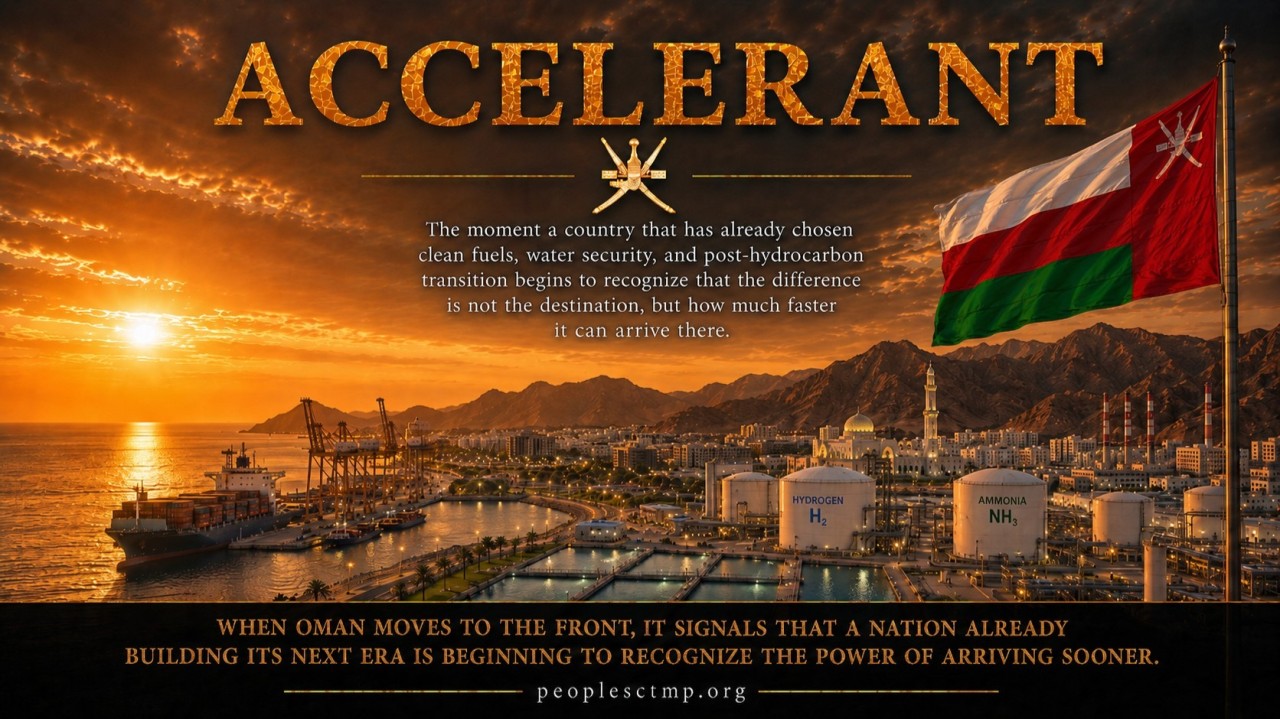
It is an accelerant for a journey already underway.
Oman’s 2040 Plan, Arriving Faster and Bigger
Here is where the logic becomes almost uncomfortably direct, because the platform’s outputs map, nearly one to one, onto the things Oman has already decided it wants.
Oman wants green hydrogen.
The platform makes green hydrogen.
Oman wants green ammonia, the carrier that lets hydrogen be shipped and sold to Europe and Asia.
The platform makes green ammonia.
Oman’s strategy reaches toward the wider family of clean molecules, methanol for shipping and chemicals, synthetic fuels for the hard-to-electrify sectors.
The platform makes the full green molecules suite: hydrogen, ammonia, methanol, and synthetic natural gas, all of it from clean electricity and water rather than from the gas Oman is trying to move beyond.
Now look at the scale and the speed, because this is where the platform does something Oman’s current path cannot easily do.
Oman’s flagship projects are enormous, and they are also slow, because they depend on building out vast fields of solar panels and wind turbines across the desert, and then financing each one through international consortia on concessions that run for decades and reach first production around 2030 and beyond.
That is the nature of intermittent renewables at national scale: huge land, huge capital, long timelines, and output that rises and falls with the sun and the wind.
The platform takes a different road to the same destination.
Its power does not come from intermittent sun and wind. It comes from the ocean, firm and continuous, twenty-four hours a day, every day, from a far smaller footprint.
That firmness matters enormously for making molecules, because electrolysers and ammonia plants want to run steadily, not in the stop-start rhythm of weather.
On that firm power, a single module is designed to produce green molecules at a scale on the order of two million tonnes a year across the suite, hydrogen, ammonia, and methanol, with synthetic natural gas at roughly eight hundred thousand tonnes a year.
Those are the platform’s design figures, and I will be honest about that flag in a moment, but hold the comparison: that is output in the range of, and in some categories beyond, what Oman’s marquee multi-billion-dollar projects are targeting for the end of this decade, from a single integrated module, on firm power, without waiting on the weather.
So the platform does not compete with Oman’s 2040 vision.
It is Oman’s 2040 vision, arriving on a shorter timeline, at a scale that meets or exceeds the national targets, powered by something steadier than the desert sun.
For a country that has already decided this is the future and is racing the clock on its gas, that is not a marginal improvement.
That is the difference between reaching the goal around 2040 and reaching it sooner, with more headroom than the plan ever assumed.
In One of the Driest Nations on Earth, the Water Is Not a Side Benefit
Oman is a desert country.
Water is not an abstraction there.
It is the oldest constraint on Omani life, the thing the falaj irrigation channels were built to manage thousands of years ago, the thing that limits where people can live and what can grow.
Modern Oman leans heavily on desalination to supply its cities, and desalination, the conventional kind, is expensive, energy-hungry, and tightly bound to the price of the very fossil fuels Oman is trying to move past.
Every assessment of Oman’s clean-energy ambitions names water scarcity as one of the real constraints on the plan.
Now look at what the platform does with water, because it turns the constraint into abundance as an ordinary part of how it runs.
The same near-free ocean power that makes the molecules also runs desalination at the scale of a nation.
A single module is designed to produce around two billion cubic metres of potable water a year, and here is the part that matters most for Oman: that water is given to the people of the host nation free of charge.
Not sold.
Not financed.
Not metered into a tariff that rises with fuel prices.
Free, with the giveaway written into the platform’s charter so that no operator and no official can quietly redirect it to commercial sale.
Put that against Oman’s reality.
Two billion cubic metres a year, measured against the basic daily water a person needs, is enough to cover the essential water of well over a hundred million people.
Oman’s entire population is in the range of five to six million.
So a single module’s free water allocation alone is many times what the whole country needs to drink, with an enormous surplus that could underwrite agriculture, industry, and the green-hydrogen projects themselves, which need clean water as a feedstock.
In one stroke, the oldest constraint on Omani life, water, and one of the named constraints on its hydrogen future, water again, both ease at once.
For a desert nation, water given free at that scale is not a nice addition to an energy project.
It may be the single most transformative thing in it.
And the water and the molecules are not two separate gifts.
They are the same act.
The clean power that splits water into hydrogen is the same power that desalinates water for the people.
The platform does not choose between feeding the export economy and feeding the population.
It does both, from the same sea, at the same time.
The Work
There is another dimension here that matters for any country, and matters especially for one deliberately trying to build a post-oil economy that employs its own people: the work.
Oman’s whole diversification challenge is not only about replacing gas revenue.
It is about creating real, skilled, durable employment for Omanis as the hydrocarbon era winds down, so that the new economy belongs to the country’s own people and not only to foreign contractors who arrive, build, and leave.
This is a stated priority of Vision 2040, raising in-country value, building local expertise, creating long-term jobs in the new industries.
A platform like this is, by its nature, an enormous and sustained employer.
Building and then running the power core, the desalination and water systems, the electrolysers and molecule plants, the ports and the supporting industry is a city-scale industrial undertaking that runs for years in construction and then for decades in operation.
The work is exactly the kind a diversifying nation needs: plant operators, electrical and instrumentation technicians, process engineers, chemists, water specialists, maintenance trades, the skilled roles that build a durable middle class and keep a country’s young talent building their lives at home rather than leaving to find that work elsewhere.
I am going to be honest about the numbers the way I always am, because that honesty is the whole point of how I work.
The precise per-module workforce figure is something I am still counting vertical by vertical, benchmarking against real industry standards, before I will publish a hard total, and I will not hand anyone a number I have not finished standing up.
But the shape is not in doubt, and it is large.
A buildout of this kind, in a country of five to six million people, is a national employment event, not a local one.
And because the platform is built to keep expanding rather than sit still, the work does not end when the first plants are commissioned.
It keeps going, and it keeps hiring, for decades.
For a country whose central economic task is to employ its people in the industries of the future, that is not a footnote.
It is close to the whole point.
Oman Did Not Pick This Future by Accident
It is worth pausing on why Oman, specifically, chose to become a clean-fuel hub, because the reasons are not arbitrary, and the platform fits them rather than fighting them.
Oman’s position is unusually well suited to exporting energy to the world.
Duqm sits on the Arabian Sea, on major global shipping routes, and crucially outside the Strait of Hormuz, the narrow chokepoint that so much Gulf energy must pass through.
That location is a genuine strategic asset: a country that can ship clean fuel to both Europe and Asia without threading the Strait has something its neighbours would envy.
Oman has built its whole hydrogen export thesis on this geography, anchoring production and export at Duqm and positioning itself to serve European buyers seeking to move away from Russian energy and Asian buyers seeking to decarbonise.
The platform suits that geography precisely, because it is a coastal system by nature.
It draws its power from the ocean and sits at the coast, exactly where an export hub belongs.
The molecules it makes, ammonia and methanol above all, are made to be shipped, and they would be made at the waterline, ready to move to the same European and Asian markets Oman is already courting.
So the platform does not ask Oman to abandon the export strategy it has built.
It pours an enormous, firm, owned supply of exactly the right products into exactly the export position Oman has already chosen, outside the Strait, on the open sea routes, at the scale the world’s decarbonising buyers are scrambling to secure.
For a country that picked its future partly because of where it sits on the map, the platform is built for that same map.
Owned, With No Debt and No Foreign Valve
Here is the part that should matter most to a nation thinking carefully about how it builds the next fifty years, because Oman is not only choosing what to build.
It is choosing how to be positioned when it is built.
Look at how Oman’s current hydrogen path is necessarily financed.
Multi-billion-dollar projects, built and owned by international consortia, on concessions that run thirty, forty, even forty-seven years, with the output largely committed to foreign buyers in Europe and Asia.
That is not a criticism, it is simply how megaprojects of that size get financed in the current world, and Oman has negotiated them shrewdly.
But it does mean that a great deal of the new economy is owned, operated, and financed from outside, for decades, before it fully returns to national hands.
The platform is built on the opposite principle, and its charter makes the principle binding.
It carries no debt.
None.
There is no creditor, no consortium that owns the core infrastructure, no multi-decade concession in which outsiders hold the asset until some distant handover.
No outside investor may hold more than a minority stake.
The internal prices are fixed and posted.
The free water cannot be sold.
The whole structure is designed, at the level of its own constitution, so that the host nation owns what is built and cannot have it quietly captured, mortgaged, or leveraged against it.
For Oman, set that beside the path it is already on and the contrast is clear.
The same destination, the clean-fuel economy, the water security, the diversification away from gas, but arriving as something the country owns outright rather than something it hosts on behalf of foreign owners for the next forty years.
A nation that is deliberately building its sovereignty for the post-oil era would understand, better than most, the difference between those two ways of arriving at the same place.
What This Is, and What It Is Not
I have to mark the edge of the claim clearly, the same as I do for every country, because an argument that reaches too far snaps at the first pull, and Oman’s decision-makers in particular deserve the honest version.
No Omani site has been studied.
Not the coast, not the depth offshore that the platform’s subsurface power core requires, not the grid connections, not the routing.
That work is real and it is not done, and I will not pretend otherwise.
Oman has a long coastline on the Arabian Sea, which is promising, but promising is not proven, and whether and where Oman offers the specific conditions the platform needs is a genuine engineering question that only fieldwork can answer.
The production figures, the molecule tonnages, the water volume, the employment, these are the platform’s design and planning numbers, derived from how a module is built to operate, not a promise stamped onto Oman specifically, and the real profile of any deployment must be proven against the real ground.
And the platform does not solve every challenge Oman faces, nor touch its politics.
It was never built to.
What it can do is narrower, and against Oman’s particular, already-chosen path it is almost exactly the thing.
It is about whether the clean-fuel and water-secure future Oman has already decided to build can arrive faster, at greater scale, and owned outright, rather than slower, at the mercy of the weather, and financed from abroad.
That is a humbler promise than a headline would want.
For a country that has already looked at its own future and chosen this direction, I think it is the one that matters.
The Only Question on the Table
So the logic closes where it began, with a country that has already made up its mind about where it is going.
Oman reaching the front of The Wall does not mean a decision has been made, or a deal struck, or that anyone has been chosen.
The Wall is not a petition to any government, not a vote, not an investment.
It takes no money, no name, no email, no identity.
It asks one thing: that a person register, once and anonymously, that their country should be considered, knowing the count is public and the order of consideration follows the count.
Of all the countries on earth that might look at a platform producing firm clean power, green hydrogen and ammonia and methanol and synthetic gas at national scale, and billions of cubic metres of free water in a desert, Oman is among the very few that does not need a single word of it explained.
It has already written this future into national policy.
It has already committed the capital.
It has already broken ground.
It has already decided that the era of raw hydrocarbons must give way to clean fuels and a diversified economy, and it is racing the clock on its gas to get there.
The gas will run down.
The desert will stay dry.
The old economy has a clock on it that everyone in Oman already knows.
The ocean has none of those limits.
Oman, more than almost any nation alive, already understands where this road leads, because it drew the map itself and has been walking it for years.
The platform simply offers to carry the country down that same road faster, at greater scale, with water for its people and ownership in its own hands.
And right now, quietly, one signature at a time, Omanis are pointing at the road they already chose and saying:
yes, this, and sooner.
Chris Coode Founder and CEO, HLX Inc. peoplesctmp.org