Indonesia: The Country the Sea Was Waiting For
June 30, 2026
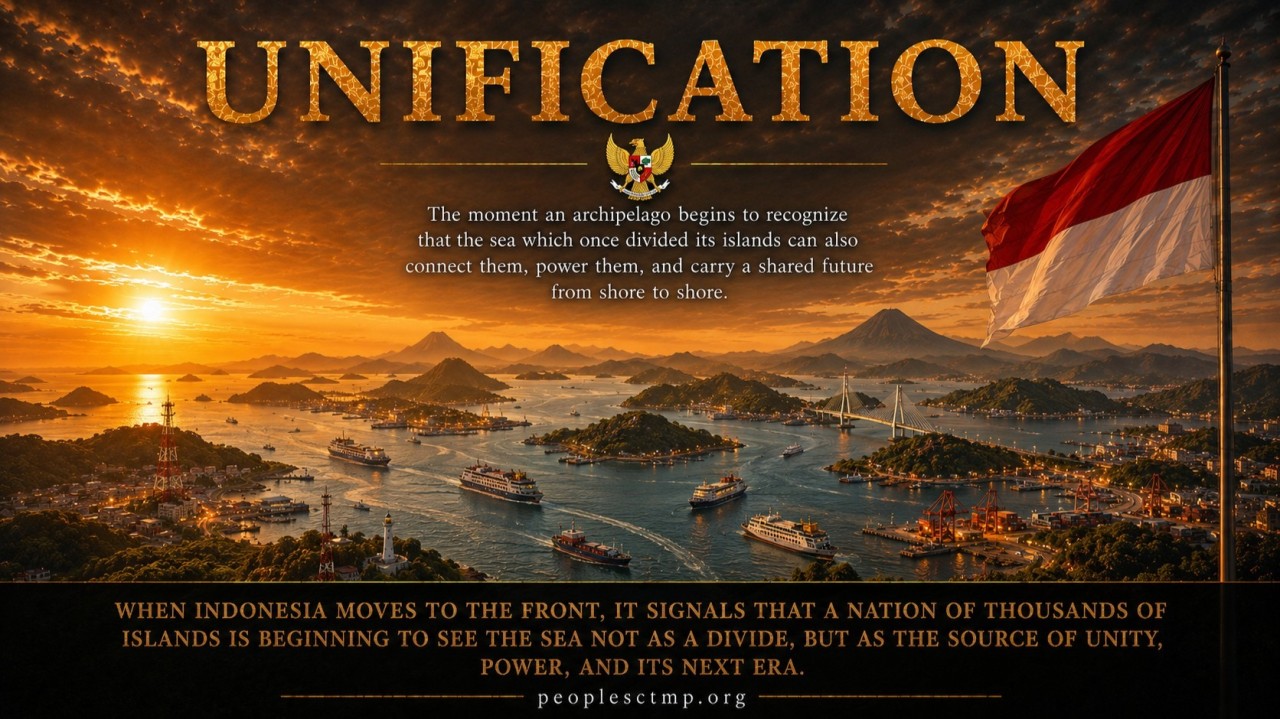
Picture the country from above. Not a map with a single outline you could trace with a finger, but a scatter of land thrown across the equator like a handful of seed, seventeen thousand islands, six thousand of them lived on, strung between two oceans. There is no other large nation shaped quite like this. And the shape is not a detail. The shape is the whole story.
Because if you are Indonesia, the sea is not your edge. The sea is your interior. It runs between every province, every market, every power line that was never built because you cannot run a wire across deep water the way you run one across a plain. Around two hundred and eighty million people live on that scatter of land, and the thing that connects them, and the thing that divides them, is the same blue thing in every direction.
So when Indonesia rose to the front of The Wall faster than any country before it, it is worth asking what a place like that is actually reaching for. And the answer, once you see it, is almost too neat. Indonesia is a country built on the sea, and the sea is precisely where this platform makes its power. The country has spent its whole modern history fighting the ocean that surrounds it. This is the first time anyone has offered to make that ocean the source of everything it needs.
Let me show you why it fits, piece by piece.
The engine that runs on something borrowed
Start with what Indonesia is trying to do, because it is enormous. This is the largest economy in Southeast Asia and one of the fastest-growing large economies on earth, and its government has set a goal that would change the lives of a quarter of a billion people: grow the economy by around eight percent a year, and do it by building heavy industry at home, nickel, steel, the metals and materials the whole world is scrambling for.
Here is the catch that nobody at the top can get around. You cannot grow an industrial economy eight percent a year without electricity to match, and a lot of it. Industry is not a service you can run on a phone. It is furnaces and smelters and factories, and furnaces and smelters and factories drink power by the gigawatt. The faster Indonesia grows, the more electricity it has to find, and right now it finds that electricity mostly by burning things.
Roughly half of Indonesia's power comes from coal, and much of the rest from gas and, especially on the outer islands, from diesel. Some of that fuel is dug at home. A great deal of it, particularly the oil, is bought from abroad and shipped in across the same crowded sea lanes that every other importer in Asia depends on. When those lanes get tight, and this past year they got very tight, the price of fuel jumps, and the price of fuel is the price of everything. The lights, the factories, the cost of living, all of it rides on a fuel bill that another country's troubles can inflate overnight.
So Indonesia is trying to sprint while carrying a fuel tank on its back that it has to keep refilling from a pump it does not own. That is the trap. The ambition is real and the talent is real, but the engine of the whole thing runs on something borrowed, burned, and exposed to every shock in the world.
And then there is the harder problem underneath even that one.
The problem you cannot wire your way out of
On the main island of Java, where most of the people and most of the factories are, you can at least build a grid. Power plants, transmission lines, the ordinary machinery of an electrified country. It strains, it leans on coal, but it functions.
Now go east. Go to the thousands of smaller islands where tens of millions of Indonesians live. You cannot simply extend an ordinary grid to them, because between you and them is deep ocean, and a normal transmission line is not a thing you casually lay across the sea floor for hundreds of miles. So those islands do what they can. They run on diesel generators, trucking and shipping in fuel at brutal cost, accepting outages and unreliable supply as simply the price of living where they live. The country has worked hard and gotten electricity to almost everyone on paper, but "almost everyone has some power" and "everyone has firm, cheap, reliable power" are two very different sentences, and the gap between them is where a great deal of Indonesian life is lived.
This is the part that no amount of ordinary grid planning fully solves. Geography is stubborn. The scattered shape that makes Indonesia beautiful is the same shape that makes powering it, evenly and affordably, one of the genuinely hard problems on the planet.
Which is exactly why the answer, when it comes, has to do two things at once: make an enormous amount of power, and then move it across water without losing it. Hold that second part in mind, because it turns out to be the quiet hero of this whole story.
The sea stops being the problem and becomes the answer
Here is the turn the whole thing pivots on, and it is so simple it is almost funny.
The platform makes its power from the sea, the same sea that touches every shore in the country. It draws on the ocean and turns it into firm, continuous electricity, the kind that does not flicker when a cloud passes or a shipment is late, because it is not waiting on the sun or the wind or a fuel delivery. It is just there, around the clock, drawn from the water itself.
And it does not arrive as some modest little plant. A single one of these platforms is built around three hundred billion watts of power. Three hundred gigawatts. To put that in terms of Indonesia's own scale: depending on what is counted, the country's existing power system is usually described somewhere between roughly seventy and about one hundred gigawatts of installed generation, built up over decades across the whole archipelago. One platform at three hundred gigawatts is still several times that entire national scale. This is not "more power." It is a step-change in the country's electrical foundation, with room for the eight-percent growth target, the industrial buildout, and reliable supply, all at once.
Now, an important honesty, because it matters and because it is also where the design gets clever. That power comes from a single source, sited wherever genuine engineering studies say it should go, on whatever stretch of coast and ocean depth actually suits it. It is not a magic generator dropped onto every island at once. A platform is one place. So the obvious question, the one a thoughtful Indonesian should ask immediately, is: what good is the largest power source on earth sitting at one point, if the country is six thousand islands?
The answer is the part most people never think about, and it is built into the platform as one of its own industries.
The quiet hero: moving the power without losing it
One of the seventeen connected verticals inside this platform is high-voltage direct current transmission. HVDC. It sounds technical and dull. For a country made of islands, it is close to everything.
Here is why. Ordinary alternating-current power lines, the kind strung on pylons across land, are terrible at crossing long distances and especially terrible at crossing water. Push power down a long undersea AC cable and it bleeds away, lost to the physics of the cable itself, until there is little left at the far end. That is the real reason you cannot just wire the islands together with a normal grid. It is not only the cost of the cable. It is that the power would not survive the trip.
High-voltage direct current is the technology built specifically to defeat that. It moves enormous amounts of power over very long distances, including under the sea, with remarkably small losses. It is how power is sent across hundreds and thousands of kilometres in the places on earth that have mastered it. And the platform does not buy this capability from someone else and bolt it on. It builds it, in-house, as one of its own verticals, designed from the start to take the single massive source of power and carry it out across long distances at very low loss.
Put those two facts together and the whole picture changes. The platform is one enormous source of clean power, and it comes with its own purpose-built system for moving that power across the exact kind of water that has always isolated the Indonesian islands. The country would not just be getting a power station. Depending on what the siting studies support, it would be getting the backbone of a new national grid: a single, vast, clean source, and the high-voltage arteries to carry it far and wide with little lost on the way.
And here is the piece that matters most for a nation that has spent its history dependent on imported fuel and external supply. A system like this can be designed with what engineers call black-start capability, the ability to bring itself and the network back to life from a cold stop, on its own, without leaning on any outside grid or fuel delivery to get going again. A country whose power has always depended on the next shipment arriving would have, for the first time, a foundation that can stand itself back up under its own power. That is not a small thing. That is the difference between a grid that is yours and a grid that is on loan from whoever sells you fuel.
So the sea that divided Indonesia becomes the source of the power, and the platform's own transmission vertical becomes the means of carrying that power across the very water that did the dividing. The oldest enemy becomes the engine, and the engine comes with its own driveshaft.
And the same machine pours out fresh water
Now hold onto something most people forget about a country made of islands surrounded by salt water: a lot of it is thirsty.
When you live on a small island, fresh water is not guaranteed just because you can see ocean in every direction. You can be ringed by water and still short of the kind you can drink, because the sea is salt and the rain is seasonal and the groundwater is limited and easily spoiled. Clean fresh water is one of the quiet, grinding constraints of island life across the whole archipelago.
The same platform that makes the power also makes water, because the cheap power runs desalination at the scale of a nation. A single module is built to produce around two billion cubic metres of fresh, drinkable water every year, and that water is handed to the people of the host country at no charge, written into the rules of how the platform operates so that it cannot quietly be turned into a product and sold back to the people it was promised to.
Two billion cubic metres is a number too big to feel, so make it human. The water a person needs for their basic daily life, drinking, cooking, washing, comes to roughly eighteen cubic metres a year. Two billion cubic metres covers the essential water of well over a hundred million people. From one platform. In a country where, on island after island, clean water has always been something you carefully manage rather than simply have.
So the same sea, through the same machine, answers the two oldest constraints of Indonesian life: the power that geography made expensive, and the water that geography made scarce. Both pulled from the ocean that was supposed to be the obstacle.
Cheap, and kept cheap on purpose
None of this would mean much to an ordinary family if the power came out cheap and then got marked up into something expensive before it reached their home. That is the usual way these stories end. A new source makes electricity cheaply, and then it passes through hands that each take a cut, and by the time it reaches the kitchen the savings have evaporated.
This platform is built specifically so that cannot happen, and the mechanism is worth understanding because it is the difference between a promise and a structure.
The power leaves the platform at a tiny fraction of a cent to produce, and is posted to the outside world at two and a half cents per unit, far below what almost anyone pays today. But the part that protects the ordinary person is a ceiling written into the platform's governing rules: the most an end user can be charged for that power, with every fee and tax and surcharge included, and still have it count as the real, verified article, is five cents per unit. Cross that ceiling, and the power simply loses the right to be called what it is. It is no longer recognized as the platform's verified output. The whole standing, the trust, the integration, the public certification, falls away for whoever broke the rule.
No document can physically stop a government from taxing or a company from overcharging. What it can do is make the cost of doing so unbearable. Picture being the utility, or the official, who takes the cheapest, cleanest power the country has ever had and marks it up past the ceiling. The moment you do, it is visible to everyone, and the power you are selling is publicly stripped of its verification. You would have taken the one thing that made your supply special and thrown it away for a little extra margin. You would not just be breaking a rule. You would be standing in front of two hundred and eighty million people, having been handed cheap power and water for your nation, and choosing to make it expensive anyway. No one survives being that person. The rule holds not because it is enforced with a hammer, but because violating it in full public view would be a kind of madness. That is a sturdier guarantee than most contracts, because it does not depend on anyone's goodwill. It depends on no one being willing to pay the price of betrayal where everyone can see.
Seventeen industries, one engine, growing itself
Here is where the thing stops being a power station and becomes an economy.
The platform is not one machine that makes electricity and stops. It is seventeen connected industries feeding off a single source of nearly free clean power and feeding back into each other. The power makes desalinated water. The transmission vertical carries it across the country. The water and power together make green steel and concrete, the materials of construction, at a fraction of the world price. The same power splits water into hydrogen and turns it into ammonia and methanol and clean fuels, the molecules that run shipping and industry. It runs data centers cooled by the ocean, fed by chips the platform makes itself from silica it pulls out of the ground as it builds. Each industry lowers the cost of the next, because none of them is paying market price for the thing the others produce. They are a single organism, and the blood that runs through all of it is power that costs almost nothing to make.
For a country whose entire growth plan is to build heavy industry at home, this is the difference between renting the future and owning it. Indonesia wants to turn its nickel and its steel into finished goods rather than shipping out raw ore. That takes vast, cheap, reliable power and water, exactly the two things the platform produces in abundance. It does not just give the country electricity. It gives the country the industrial base the electricity was always meant to unlock.
And it is built to grow, by rule, not by hope. The platform's own charter requires that a large share of what it earns is reinvested into expanding itself, on the order of ten percent more capacity every year. That figure is not arbitrary. It is tied directly to a hard limit on how much any outside investor is allowed to take out, the cap on private ownership and extraction. Because no one is permitted to drain the profits away, the profits have only one place to go, and that is back into building more, more power, more water, more transmission, more industry, compounding year after year. The same rules that stop the thing from being looted are the rules that force it to keep growing. Wealth that cannot be extracted has only one direction to travel, and that is forward, into more capacity for the country that hosts it.
Ten percent compounding sounds modest until you sit with it. A platform that grows ten percent a year roughly doubles, and then doubles again. Power, water, transmission, industry, all expanding on a curve, in a country that is itself sprinting to grow. The platform's growth and the nation's growth are built to rise together.
What two gigatonnes actually means
There is a number attached to all of this that is worth slowing down for, because it is hard to hold until you compare it to something real.
A single one of these platforms is designed to keep roughly two billion tonnes of carbon dioxide out of the sky every year, by replacing the burning of coal, gas, and diesel with clean power, and by making steel and concrete and fuel without the emissions those industries normally carry. Two billion tonnes. Two gigatonnes.
Put that next to the world's ledger. Humanity emits something on the order of thirty-seven billion tonnes of carbon dioxide from fossil fuels each year. Two gigatonnes from one platform is a meaningful slice of that whole global total, from a single installation. Put it next to countries instead. Two gigatonnes a year is more than the entire annual carbon emissions of a country like Japan, one of the largest industrial economies on earth. It is in the range of what enormous nations emit in total. One platform, quietly avoiding more carbon each year than most countries on the planet produce.
And consider where this one would sit. Indonesia is itself one of the world's larger emitters, precisely because it burns so much coal and diesel to hold its scattered grid together. A platform that avoids two gigatonnes a year, placed in a country emitting on that scale, does not just nudge a number. It changes the trajectory of one of the most significant emitters in the world, while giving that same country more power and more water and more industry, not less. The usual story is that cutting carbon means accepting less. Here, the country gets dramatically more, and the carbon falls anyway. That is the part that should stop people in their tracks.
Work for millions, building the thing itself
There is one more piece, and for a country of two hundred and eighty million people, much of them young, it may be the one that matters most at the kitchen table: the work.
Building something on this scale, the power core, the desalination, the transmission network, the steel and concrete plants, the chemical works, the data centers, the ports, is not a project. It is an era of construction, and then decades of operation, and both of those need people. Not a handful of imported specialists, but a vast domestic workforce, in the first year alone reaching into the millions across the full sweep of construction and the industries it stands up. Welders, electricians, line and cable technicians, plant operators, engineers, chemists, the skilled trades and the educated professions both, the kind of work that builds a middle class and gives a young person a reason to build their life at home instead of leaving to find a future somewhere else.
And because the platform is built to keep expanding every year, that work does not finish when the first plants switch on. It renews itself, hiring through every wave of the ten-percent growth, for as long as the thing keeps compounding. For a nation whose greatest asset is the size and youth of its own population, a machine that turns the surrounding ocean into millions of years of skilled work is not a side effect. It is the point.
Where the logic leads
Stand back and look at the shape of it.
A country scattered across the sea, fighting that sea for its whole history, rationing power it has to import and burn, managing water it has never had enough of, trying to sprint into the front rank of the world's economies while carrying the weight of all of that. And then a platform that takes the very sea that divided the country and turns it into the largest single source of power on earth, with its own transmission vertical to carry that power across the water at low loss, plus free water for a hundred million people, plus the backbone of a self-reliant national grid that can restart itself without leaning on anyone, plus two gigatonnes of carbon kept out of the sky each year, plus seventeen industries that compound by rule, plus work for millions, all of it owned by the nation rather than mortgaged to outsiders, all of it kept cheap by a structure that makes betrayal too costly to attempt.
It is not hard to see why Indonesians moved toward that faster than any people before them. They did not need it dressed up. A country made of islands understands the ocean better than anyone alive, understands both its cruelty and its scale, and here, for the first time, was the version where the ocean gives instead of takes.
Now the honest edge of it, because the case is strong enough that it does not need to be oversold. The figures here, the three hundred gigawatts, the water, the two gigatonnes of carbon, the work for millions, are how a platform is designed to perform at full scale, not a promise that such a thing appears overnight on any particular Indonesian shore. The platform is not a cure for everything the country faces, and it was never built to be. What it is, is a base layer, the power and the water and the transmission and the industry underneath every other thing a country tries to do.
But here is where I want to answer every person who has ever looked at a number like three hundred gigawatts and said, flatly, that it cannot be done. Because the way this actually gets built is the opposite of a leap of faith.
The country that earns first place, that reaches its count and moves first into review, does not get handed a three-hundred-gigawatt promise and told to trust it. It earns something real, and small, and standable-next-to: a fifty-megawatt proof of concept, built on ground that genuine siting studies, real ones, have already vetted. Fifty megawatts. Humble on the scale of what is coming, but real, running, and there to be seen, measured, doubted, and verified by anyone who wants to walk up and check.
And that humble fifty megawatts is not a demonstration that gets torn down when the cameras leave. It is the seed, built modular from the very first bolt, designed to be expanded. Fifty megawatts proven becomes two hundred and fifty megawatts. Two hundred and fifty becomes the beating core of the full three hundred gigawatts, the same machine, grown, not a different one promised. Every step earns the next. Nobody is asked to believe in the mountain. They are shown the first true step of the path, and then the next, and then the next, each one standing on the proven ground of the one before.
That is the answer to every voice on the planet that says no, it cannot be done. You do not argue with them. You build the fifty megawatts, and you let it run, and you let the doubters come and measure it themselves. Then you build the next piece. Proof does not shout. It just keeps working while people decide whether to believe their own eyes.
The coal can be burned and bought again. The diesel can be shipped in at a price someone else sets. The islands can stay just beyond the reach of every ordinary wire. That is Indonesia as the sea has always made it.
The platform is the other version. The one where the same sea that kept the islands apart is the thing that finally powers them, carried out across the water by lines built for exactly that purpose, starting from one honest fifty-megawatt seed that any skeptic is welcome to stand in front of, and growing from there into the largest clean foundation any nation has ever owned. And right now, quietly, by the thousands, Indonesians are pointing at that version and asking to be counted for it, asking, in effect, for the right to build the first seed on their own shore.
The Wall does not decide anything. It takes no money, no name, no email. It is simply a public count, and the count is rising, and today the country at the front of it is the one the sea was waiting for.
Where does your country stand?
Chris Coode, Founder and CEO, HLX Inc. · peoplesctmp.org