Eighty-Seven Austrians
July 6, 2026
On the morning a landlocked alpine republic of nine million people took first place in a planetary race, and what the size of that number actually means.
Chris Coode, Founder and CEO, HLX Inc. · peoplesctmp.org
I. What the board said this morning
Sometime in the night, while most of the world was asleep, the top of The Wall changed.
Austria is now first. First among 109 countries. Ahead of Oman, which had led. Ahead of Indonesia and its 280 million people. Ahead of the United States and its 340 million. Ahead of Brazil.
Here is the number that did it: 87.
Eighty-seven people in Austria have made their voices heard. That is the entire force that took first place on a planetary leaderboard. Not eighty-seven thousand. Eighty-seven human beings, in a country of nine point one five million, which puts Austria at 0.019 percent of its required count of 457,500. There are 457,413 Austrians still to go.
I want to sit with that number before doing anything else with it, because everything worth understanding about this project is folded inside it, and most of it is not what it first appears to be.
II. The size of eighty-seven
Eighty-seven people fit in a single Viennese tram. Comfortably, at that. They fit in one lecture hall at the University of Graz with rows to spare. A village church choir plus its audience. One floor of one office building on the Ringstrasse. A wedding, on the smaller side.
If you gathered them in a room, and you never could, because The Wall records no names and no one on Earth knows who they are, they would look like nothing. A meeting of a local history society. You would walk past that room without a glance.
That room is currently in first place among the nations of the world.
And I will not dress it up: in absolute terms, the room means almost nothing. Austria has covered nineteen thousandths of one percent of its threshold. The remaining mountain is 457,413 people high. If the story ended today, eighty-seven would be a footnote, and an obscure one.
But the story is not the size of the number. The story is what the number was able to do, and what it had to be made of in order to do it. Those are two different subjects, and each one deserves its own honest look.
III. What eighty-seven did to three thousand
Start with what it did.
As of this morning, 3,171 Americans have signed The Wall. 2,628 Indonesians. 2,018 Brazilians. Every one of those totals is dozens of times larger than Austria's 87. And every one of those countries is now looking up at Austria on the board.
This is not a glitch. It is the central design decision of the entire mechanism, operating exactly as built. The Wall does not rank countries by how many people they produce. It ranks them by progress toward their own required count, and each country's required count is five percent of its own population. So the United States is running at seventeen million. Indonesia at fourteen million. Austria at 457,500. Every nation runs against its own mountain, and the board shows only one thing: how far up its own mountain each nation has climbed.
Do the quiet arithmetic and you find something almost elegant underneath. Eighty-seven Austrians out of nine point one five million is roughly one Austrian in every hundred and five thousand. Three thousand one hundred and seventy-one Americans out of 340 million is roughly one American in every hundred and seven thousand. The difference between first place and fourth place on the entire planet, this morning, is that Austria's people moved at a very slightly higher rate than America's. Not a bigger crowd. A denser signal.
That is what the board measures, and it is the only thing worth measuring, because raw totals are a rich country's game and a big country's game. Shares are honest. On a board of shares, a republic of nine million and a republic of 340 million stand at the same starting line, and this morning the small one is ahead.
There is no other scoreboard on Earth that works this way. In every arena that matters, population is power, money is power, and the giants finish first by existing. The Wall is the one table where Austria and the United States sit as exact equals, and where eighty-seven careful people can outrank three thousand.
IV. The strangeness of Austria, and why it is not strange at all
Now the question everyone will ask, and should ask: why Austria?
Because on the surface it is a genuinely odd result. The CTMP is an ocean-fed system. Its core is seawater, entering subsurface channels, falling under gravity, turning turbines. Austria is one of the most famously landlocked countries in the world. It has not had a coastline in over a century. If you were placing bets on which nation's people would move first toward an ocean infrastructure platform, Austria would sit far down the list, somewhere behind every island state and every drought-stricken coast on the planet.
And yet. Look one layer deeper and the oddity dissolves into something close to inevitability.
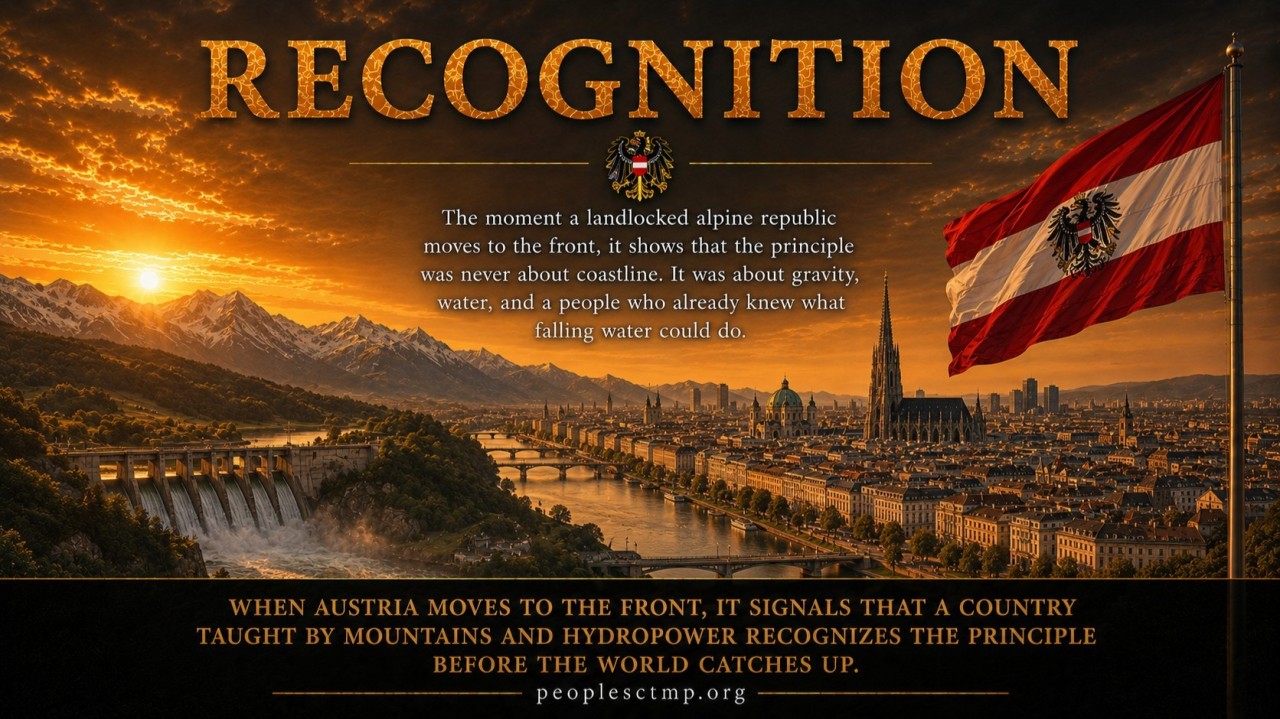
Austria is the falling-water country. Roughly three fifths of its electricity comes from hydropower, one of the highest shares of any developed nation on Earth. The Alps taught Austria, generations ago, the exact lesson the CTMP is built on: that water descending under gravity is the most honest power source there is. No fuel. No flame. No fluctuation with the weather of a single afternoon. Austrian engineers have been converting head and flow into national life for over a century. The turbine hall is not an exotic concept in Austria. It is a family employer. It is a school field trip.
So when the proposal arrived, the one that says seawater plus gravity plus turbines equals firm power at 2.5 cents per kilowatt-hour, Austrians did not need the physics translated. P equals rho g Q H eta is not a foreign sentence in a country that lives downstream of its own dams. They could read the equation the way a sailor reads weather.
I find something quietly moving in that. The first nation to the front of the board is not the one with the most desperate need or the largest population or the loudest media. It is the one whose own landscape had already taught it that the idea is sound. Austria looked at an ocean it does not possess and recognized a principle it has trusted for a hundred years.
The country with no coastline understood the ocean project first. Because the project was never really about the ocean. It was about gravity, and Austria lives in the mountains.
V. The other thing Austria knows
There is a second layer of knowing here, and it is less romantic.
Austria spent the last several years learning, the hard way, what it costs to run a modern life on someone else's molecules. Before 2022, Austria was among the most gas-dependent countries in Europe, drawing the overwhelming majority of its imports from a single foreign supplier. When that arrangement convulsed, Austrian households and Austrian industry felt it directly: in the heating bill, in the factory ledger, in the national conversation about what energy security actually means when the pipe belongs to someone whose interests are not yours.
This is a wealthy country. Stable, well governed, consistently ranked among the most livable places on Earth. Vienna wins those rankings so often it has become a cliché. And that is precisely what makes these eighty-seven signatures informative in a way that eighty-seven signatures from a crisis zone would not be.
When people sign from a country in blackout, the signal is need, and need is legible and expected. When people sign from Austria, the signal is something else. It says: even here, where the lights stay on and the trains run to the minute, people have done the arithmetic on their own system and found it wanting. Even in a country near the top of every quality-of-life table, there are people who understand that their energy security rests on arrangements they do not control, that their prices are set in markets and pipelines far beyond their border, and that comfortable is not the same as sovereign.
The comfortable countries were supposed to be the last to move. Comfort is the great sedative. If the knowing I keep writing about, the private gut-level understanding that the arrangement is absurd and does not have to be, if that knowing were only a symptom of desperation, then Austria should be silent. Austria is not desperate.
Austria is first.
Which tells you the knowing is not desperation. It is diagnosis. And it is present even at the top of the livability tables, sitting quietly in at least eighty-seven Viennese and Tyrolean and Styrian minds, waiting for somewhere to be put down.
VI. What the eighty-seven had to be made of
Now look at what these particular signatures cost, and what they paid nothing for.
No campaign ran in Austria. Not one euro of advertising was spent there. No Austrian politician endorsed this, no Austrian newspaper championed it, no Austrian celebrity lent a face. The Wall's own machinery gave Austrians nothing that it did not give the other 236 countries on the board: a page, in their language among 75 others, and a button.
And the button gives nothing back. No name is taken. No email. No account. No badge appears anywhere. No Austrian can prove to a friend that they were one of the eighty-seven, and no Austrian will ever be thanked, because there is no record of who to thank. Each of the eighty-seven acted entirely alone, invisibly, for a project whose first physical instance will almost certainly not be built in Austria, given the geography, which means they were not even signing for their own backyard. They were signing for the principle: that their country should be considered, that the queue should exist, that the deciding layer of the next civilization's infrastructure should be a public count rather than a private room.
I have said before that anonymous action with no reward is the only unfakeable signal, because you cannot buy what has no visible seller and no visible buyer. Austria just demonstrated the theorem at the national scale. Somewhere between the first Austrian signature and the eighty-seventh, this thing passed from person to person through channels I cannot see and will never see. A message forwarded. A link mentioned over coffee. A conversation on a train between Salzburg and Vienna, perhaps. I am inventing the details because the details are structurally unknowable, and their unknowability is the entire proof. Whatever carried this through Austria, it was not an engine. It was people, deciding, one at a time, in the dark.
VII. The fragility, which is the point
Here is what I like most about Austria's lead, and it is the part a normal organization would never say out loud.
It is fragile. Wonderfully, deliberately fragile.
The top five countries on the board this morning all sit at 0.019 percent, separated by margins thinner than the rounding. Oman, with 52 people, could retake first place before dinner if a handful more Omanis move. Indonesia needs a few dozen. A single evening's conversation in one Muscat living room, one Jakarta group chat deciding tonight is the night, and the board rearranges itself while Austria sleeps.
A conventional ranking would treat that instability as a flaw. It is the opposite. The instability is the invitation. A leaderboard that giants could lock up by existing would go static in a week and teach the world nothing except what it already knows, which is that big beats small. A leaderboard where 87 people can take first place, and 20 people can take it back, stays alive at human scale. It keeps the race inside the reach of a family, a workplace, a congregation, a single determined person with a phone and an evening.
Austria's flag at the top of the board is not a trophy. It is a demonstration, addressed to every small and mid-sized nation on Earth, and the demonstration reads: this position is available. It costs nothing, requires no one's approval, and can be taken by any group of people small enough to fit in a tram car, any night they choose.
I expect Austria to be overtaken. Possibly before this essay is a day old. When it happens, that will not be Austria losing. That will be the board doing the other half of its job.
VIII. The honest paragraph
Now the accounting I owe you every time, because the whole value of this evaporates the moment I inflate it.
Sixteen thousand four hundred and thirty voices, across 109 countries, is a fraction of a fraction. Austria, the world leader, has covered nineteen thousandths of one percent of its own threshold. No country is close. No verification programme has activated. Nothing is built. If every trend on the board froze today, all of this would amount to a curious artifact and nothing more. I do not know whether it stalls. Nobody knows. The mountain in front of Austria is 457,413 people high, and the mountains in front of everyone else are proportionally identical.
What I know is narrower. The mechanism was designed so that no giant could buy the front of the queue, so that a small country moving at a slightly higher rate would stand ahead of a superpower moving at a slightly lower one, and so that first place would remain permanently within reach of ordinary people acting in ordinary numbers. Until this morning, that was a design intention. As of this morning, it is an observed behavior. Austria, nine million people, landlocked, comfortable, unadvertised, sits above the United States on the strength of eighty-seven anonymous decisions.
Designs are claims. Behaviors are evidence. The board just produced its first piece of evidence that the smallest kind of nation can lead the largest kind, and it produced it without a dollar spent or a name recorded.
IX. The tram
Let me end at human scale, because that is where this actually lives.
Somewhere in Austria today there is a person who was one of the eighty-seven. Statistically they are on a tram right now, or in a lecture, or looking out a kitchen window at the mountains that taught their country everything it knows about falling water. Nobody around them knows what they did. There is no pin on their coat. Their own family does not know. The act left no trace on them at all, except one: this morning, their country leads the world, and they are one of the eighty-seven reasons why, and they know it, silently, completely alone.
I think about that person more than I think about the board.
Because the entire theory of this project compresses into them. Not the gigawatts, not the seventeen verticals, not the tariff. The theory is that scattered through every country on Earth are people carrying the same quiet diagnosis, that the cost of staying alive is artificial, that the arrangement is chosen and can be un-chosen, and that these people will act on it the moment acting becomes possible, even anonymously, even for nothing, even for a coastline their country does not have.
Austria just showed what it looks like when eighty-seven of them act in the same place.
The count is small. The mountain is enormous. Nothing is won, and Austria's lead may not survive the week.
But this morning, the front of the queue for the largest infrastructure proposal on Earth is held by a room's worth of people from a small alpine republic, and no institution placed them there, and no institution can remove them. The board simply recorded what they decided.
That is all The Wall has ever done. It does not ask anyone's permission. It records yours.
Eighty-seven Austrians just showed the other 236 countries how little that takes.
peoplesctmp.org. No account. No name. No email. Just your country.
Chris Coode, Founder and CEO, HLX Inc.