The Country the Blueprints Were Drawn For Just Took First Place
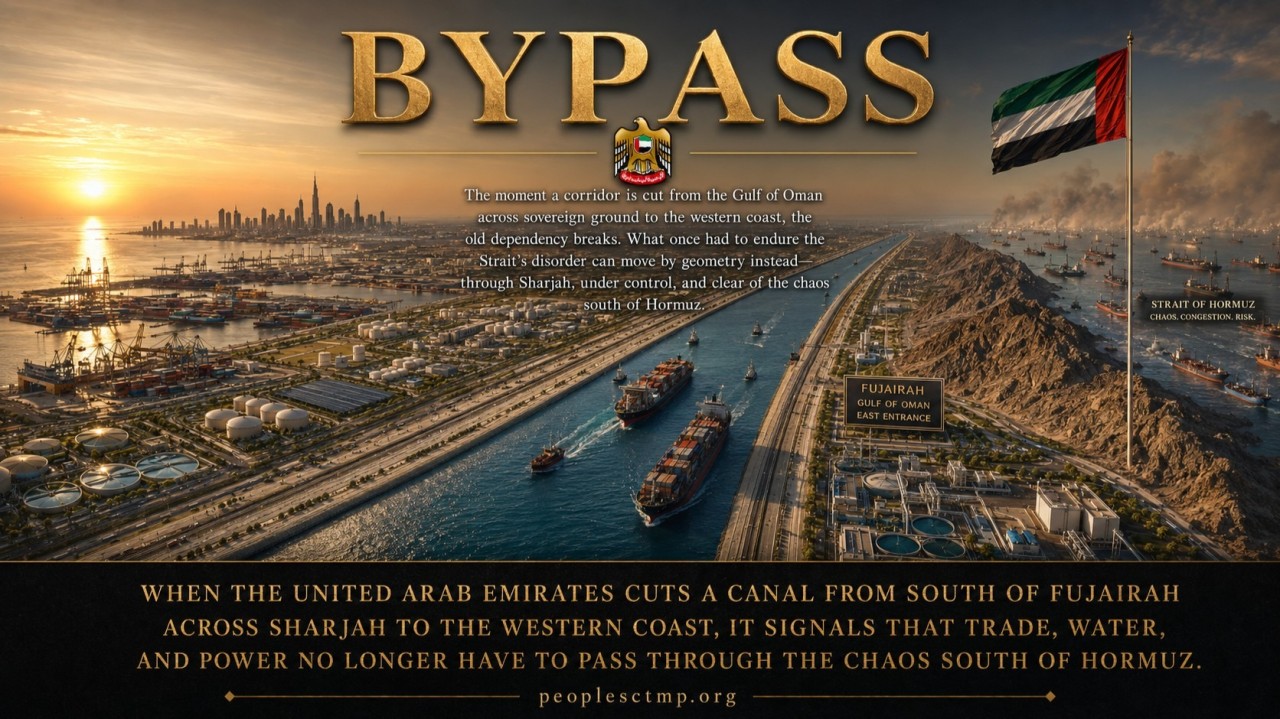
July 7, 2026
On the morning the United Arab Emirates seized the lead on The Wall, the strait its canal was designed to answer sits closed for the first time in modern history, and 113 anonymous people just pulled their country toward a machine they never knew was built for them.
Chris Coode, Founder and CEO, HLX Inc. · peoplesctmp.org
I. The board this morning
Sometime in the last day, the top of The Wall changed hands again.
The United Arab Emirates is now first. First among 109 countries with voices on the board, first in a race that Austria led yesterday and Oman led before that. The UAE stands at 113 recorded voices, which is 0.022 percent of its required count of 525,000, in a nation of ten and a half million people. Total voices worldwide: 18,210.
By now, readers of these essays know how to hold a number like 113 honestly. It is small. It would fit in two tram cars. The remaining mountain is 524,887 people high, and nothing is won.
But this particular 113 carries something none of the previous leaders carried, and it is time to say it plainly, because until today there was no reason to.
The people of the UAE just voted first for the machine that was designed for them first. And they did it in the exact year the machine's central strategic argument stopped being a hypothesis and became the largest energy disruption in recorded history.
I want to walk you through what that means, because the depth of it is the story.
II. The blueprints came first
Most people encountering the CTMP today meet it as a global proposition: 237 countries, one queue, deployment sequenced by public demand. That is true now. It was not where the work began.
The work began with one country. The original engineering deck, the one I have kept through every revision, is a UAE deck. It shows a specific corridor across a specific map, and along that corridor, in fixed positions, the seventeen verticals: the hydro galleries, the green steel plant, the concrete works, the hydrogen, ammonia, methanol, and synthetic gas plants, the chip fab, the data centers, the turbine factory, the TBM works, the transshipment complex, housing for seventy thousand workers, 150 kilometers of railway, 200 kilometers of highway.
That was not a sketch. Behind it sits the kind of paperwork no fantasy ever generates. The UAE external approvals ledger alone runs to more than two hundred distinct line items, each mapped to its actual counterparty: Cabinet-level critical infrastructure designation through NCEMA, restricted-area declarations with the Armed Forces and Coast Guard, full Strategic Environmental Assessment through MoCCAE, ten separate Environmental Impact Assessment packages covering everything from the intake and tailrace systems to the HVDC corridor to the brine diffusers, marine construction and dredging permits, drone survey permits through the GCAA, archaeology and chance-finds procedures with the Sharjah and Fujairah heritage authorities, cybersecurity conformity under the UAE Information Assurance Standard, explosives permits for tunneling, each with its frequency, its authority, and its budget line.
Nobody builds a 225-row regulatory map of a country as decoration. You build it because you intend to answer to every one of those authorities, and because you have already thought past the ribbon-cutting to the diffuser compliance monitoring in year fifteen.
And here I owe you a piece of history I have not written down publicly before. Before The Wall existed, I sat in negotiations with government officials of two Gulf states over this design. Serious rooms, serious people, genuine intent. And the process moved at the speed such processes move, which is to say: slower than 1,382 lives per day can afford. So the project did the only thing consistent with its own arithmetic. It stopped waiting for any room and went to everyone. The Wall was born, 237 countries were placed on one board, and the deployment queue was handed to the populations of the world instead of the calendars of ministries.
And now look at what the board did with that freedom. Of all the peoples on Earth, the one that has climbed to the front of the queue, anonymously, unprompted, unaware of any of this history, is the population of the very coastline the original blueprints were drawn for. I did not arrange that and could not have. The Wall takes no names and pushes no country. I simply find it to be the kind of irony that feels less like coincidence and more like the universe grading the homework: the institutions deliberated, the people decided, and the people chose the place the physics had already chosen.
III. The ground was read before anything was drawn
The UAE is, geologically, two countries. The west and center are a vast, stable apron: Quaternary sand over Miocene sedimentary rock, the quiet floor of an ancient foreland basin, among the least seismically active ground anywhere. The east is different. The Hajar range along the Gulf of Oman coast carries the country's structure: the Dibba zone, the ophiolite belt, the mapped thrusts and folds, and the transcurrent Wadi Ham fault running through the mountains toward the coast [12].
Both of those facts shaped the corridor. The alignment was chosen with the structural map open on the table: the long run crosses the stable sedimentary west and center, and the eastern approach threads the mountain structure with the mapped faults, not hope, determining the line. The soils and rock along the corridor were evaluated by a PhD geologist who sits on our Strategic Advisory Board, and the materials strategy in our public documents, the sulfate-resistant concrete, the chloride protection regime, the cavitation margins, was written for this ground and this seawater specifically.
One more deliberate choice sits in the alignment, and it matters as much as the geology: the corridor was routed to avoid every large population center. It runs through the open desert interior between the coastal cities, not through them. A kilometer-wide waterway is a piece of national anatomy; you place it where it serves the cities without ever endangering or displacing them. The line on the map is quiet on purpose.
When people hear "a canal across the UAE," they imagine a line drawn boldly by someone who has never held a core sample. The truth is the reverse. The geology was read first. The blueprint obeyed the ground.
IV. The canal itself: ninety-five kilometers of sovereignty
Now let me give you the object at full scale, because until now I have described it only by its function.
The canal runs approximately 95 kilometers from the Arabian Gulf coast to the Gulf of Oman coast. It is one kilometer wide. It is thirty meters deep. It is designed, from the first drawing, for two-way traffic.
Put those numbers against the two most famous canals on Earth. The Suez Canal is 193 kilometers long, roughly 24 meters deep, and for most of its length operates as a scheduled, largely single-file convoy system; a 2015 expansion twinned only a portion of it. The Panama Canal is 82 kilometers and moves ships through locks, which cap vessel size and throughput absolutely. The CTMP corridor is half the length of Suez, deeper than Suez, roughly four times the navigable width, sea-level with no locks, and fully bidirectional along its entire run. Two-way design is not a luxury. It is the difference between a waterway and a queue. Convoy canals ration time; this one does not. Thirty meters of draft clears the largest crude carriers and container ships afloat, fully laden, in both directions, simultaneously.
The excavation prism alone is about 2.85 billion cubic meters, and the build method is the platform eating its own cooking. The fleet of cutter suction dredgers specified in the original design excavates one billion cubic meters per year, while the tunnel boring machines, our own, manufactured in our own TBM works at a cadence external suppliers could never match, drive the subsurface galleries, intakes, and tailraces beneath and beside the channel. Eight hundred million cubic meters a year of the excavated material does not go to spoil heaps; it goes through the refined-materials vertical and comes out the other side as the silica, iron, kaolin, clays, and aggregates that feed the steel, concrete, wafer, and bagging plants. The canal digs itself into a mine, the mine builds the platform, and the platform powers the dig.
Estimated completion: five to six years from the start of excavation. Not five decades. Five to six years, because the machines that always gate such projects, the TBMs and dredgers and turbines, are not ordered from a decade-long global queue. They are made on site, which is the entire point of owning the supply chains.
Design throughput exceeds two billion barrels per year of oil equivalent, which is roughly 5.5 million barrels per day, alongside a transshipment complex handling 400 million barrels and ten million containers annually at the Indian Ocean end, beside Fujairah, already one of the largest ship-bunkering hubs on Earth.
For years, that 5.5 million barrel figure was a strategic abstraction. Then came this year.
V. The year the hypothesis became history
I have to write this section with unusual care, because it involves living events and living nations, and I will not paint any country as a villain. That is not diplomacy on my part; it is the actual analysis. What follows is what happened, drawn from the public record, and then what it means, which has no villain in it at all.
Until this year, roughly a quarter of the world's seaborne oil trade and a fifth of its liquefied natural gas passed through the Strait of Hormuz [1][2]. In late February, war came to the region: the United States and Israel launched strikes on Iran, and in the days that followed Iran declared the strait closed, enforced the closure with warnings, boardings, and sea mines, and the waterway that had never been shut for any extended period in the modern era went dark [1][2][3]. The consequences arrived at the speed of physics. Tanker traffic collapsed to almost nothing [1]. Roughly two thousand ships and twenty thousand mariners were stranded inside the Gulf [1][6]. Gulf producers shut in millions of barrels per day of production because the cargoes had nowhere to go [4]. QatarEnergy declared force majeure, removing about a fifth of global LNG supply overnight [5]. Brent crude ran from the seventies past one hundred dollars within days; tanker spot rates tripled; war-risk insurance premiums for a single transit multiplied [1][4]. The International Energy Agency characterized it as the largest supply disruption in the history of the global oil market, larger than 1973 [4][6]. A memorandum of understanding to end the war and reopen the strait was signed in mid-June; within days the reopening was contradicted, reasserted, and contradicted again, and as I write, the central channel remains mined, minesweeping is estimated in months, insurers cannot price the risk hour to hour, and transit operates under conditions and fees set at the strait itself [3][4][6][7].
Now, the part with no villain. Step far enough back and what failed this year was not a country. What failed was a geometry. For half a century, the entire industrial world consented to route a fifth of its lifeblood through a passage a few kilometers wide, bordered by nations with their own histories, fears, and imperatives, and simply assumed the passage would stay open because it always had. Every state involved acted according to pressures any state would recognize. The flaw was never in any flag. The flaw was in the design of the system: a civilization that builds itself a single point of failure will, eventually, experience the failure. This year, it did. The strait did not betray the world. The world's architecture betrayed itself, and every nation trapped on either side of that waterway, including Iran, including the Gulf states, including the stranded mariners of forty flags, is paying for an arrangement none of them individually created.
Which is exactly why the answer cannot be naval. You cannot patrol your way out of a geometry problem. Escorts, blockades, and minesweepers address the symptom while ratifying the design flaw. The only durable answer to a chokepoint is to make it stop being one.
That is what a 95-kilometer, kilometer-wide, thirty-meter-deep, two-way, sovereign, land-secured corridor from the Gulf to the open Indian Ocean is. It cannot be mined, because it is not open sea. It cannot be closed by any third party, because it lies entirely within one nation's territory, under one nation's protection, away from every contested water. Its 5.5 million barrels per day of capacity is more than three times the land bypass the UAE already built for exactly this reason, the Habshan to Fujairah pipeline, whose designers understood the geometry problem decades before this year proved them right [8]. And unlike a pipeline, it carries everything: crude, containers, ammonia, methanol, grain, machinery, in both directions at once.
And here is the part I want every household that paid this year's energy bills to sit with. The price you paid above last year's price was not the cost of oil. It was the cost of geometry: a risk premium, an insurance multiple, a rerouting surcharge, a scarcity spike, all of it flowing from one narrow passage being narrow. A corridor like this one deletes that premium for every barrel that uses it, and one hundred percent of that deletion lands, eventually, in the price of fuel, fertilizer, freight, and food. That is the near-term gift. The long-term gift is larger and quieter: every CTMP module built anywhere on Earth reduces the world's need for the barrels themselves, and when the modules number in the dozens and then past one hundred across the planet, the question stops being what oil costs when a strait closes, and becomes why the price of a strait ever governed the price of a human life at all.
VI. The strategy the country already wrote
Here the story stops being about geography and becomes about destiny, because the UAE has spent a decade telling the world, in formal published strategy, exactly what it intends to become. Read those documents next to the CTMP design and the alignment is almost uncomfortable.
The UAE was the first country in the Middle East and North Africa to commit to net zero by 2050, and carried that commitment onto the world stage as host of COP28 [9][10]. Its updated Energy Strategy 2050 commits AED 150 to 200 billion by 2030 and aims to triple renewable capacity to 14.2 gigawatts by 2030 [9][11]. It already hosts three of the largest single-site solar plants on Earth [11].
Hold that ambition, sincerely held and expensively pursued, against the arithmetic of one module. The national target is 14.2 gigawatts by 2030. A single module is 300 gigawatts of firm, zero-carbon baseload, roughly twenty times the entire 2030 national renewable target, at 95 percent capacity factor, with no intermittency to firm, at a posted tariff of 2.5 cents per kilowatt-hour.
The National Hydrogen Strategy, developed with Fraunhofer and GHD and launched at ministerial level, targets 1.4 million tonnes of low-carbon hydrogen per year by 2031, of which one million tonnes green, requiring by its own analysis some 15.3 gigawatts of solar and 8.7 gigawatts of electrolysers; it targets 7.5 million tonnes by 2040 and 15 million tonnes by 2050, with hydrogen oases, two by 2031 and five by 2050, and names Fujairah among the key hubs [9][10][13][14].
The CTMP's hydrogen vertical produces two million tonnes in its first year, all green. Year one exceeds the entire national 2031 target, green and blue combined, by more than forty percent, and under the ten percent annual mandate reaches roughly 4.7 million tonnes by year ten and about 12.2 million tonnes by year twenty: one module, by itself, delivering the trajectory of the country's entire 2050 hydrogen ambition, decades early. The strategy documents call for hydrogen oases. The CTMP is a hydrogen oasis with a 300 gigawatt heart, a port on the Indian Ocean, and its own steel mill.
VII. The molecules, repriced at the true internal cost
Now the revision this essay exists partly to publish, because our own earlier figures were, deliberately, too conservative.
The green fuels cost stack in our public deck was computed at a power price of one cent per kilowatt-hour, which felt appropriately cautious at the time. But the platform's canonical internal transfer price, the physics price of its own electrons, is $0.0008 per kilowatt-hour. Eight hundredths of one cent. Recomputing the deck's own published cost build-ups at the true internal power price, with every non-power line item held exactly where the deck put it, yields the following, and I show the arithmetic so anyone can check it.
Green hydrogen. Electrolysis at roughly 52,000 kilowatt-hours per tonne: power falls from $520 to $41.60 per tonne. Add the deck's unchanged capital recovery ($255), fixed O&M ($50), and variable O&M and water ($55): plant-gate cost of approximately $401 per tonne. Against green hydrogen auction discovery near $4,800 per tonne [15], that is under nine percent of the market price. Selling at our standing 20 percent below benchmark, $3,840 per tonne, the margin is roughly 89.6 percent.
Green ammonia. Hydrogen feed at 0.178 tonnes per tonne of ammonia falls to about $71.60; process power falls to under a dollar; capital and O&M unchanged: approximately $204 per tonne, against a clean-ammonia benchmark near $900 [15]. At a sale price of $720, the margin is roughly 71.6 percent.
Green methanol. Hydrogen feed at 0.188 tonnes falls to about $75.60; CO2 transfer, capital, and O&M unchanged: approximately $217 per tonne, against e-methanol signals near $1,800 [15]. At $1,440, the margin is roughly 85 percent.
Synthetic natural gas. Hydrogen feed at 0.5 tonnes falls to about $201; the rest unchanged: approximately $392 per tonne against benchmarks near $1,000 [15]. At $800, the margin is roughly 51 percent.
Hold those four numbers a moment: $401, $204, $217, $392. Fertilizer is ammonia, and ammonia at a fifth of today's clean benchmark is cheaper food on every continent. Shipping fuel is methanol, and the plant sits beside one of the planet's great bunkering hubs, on the ocean side of the strait, in the very year shipping learned what the strait costs. And green steel, which the Masdar and EMSTEEL pilot in Abu Dhabi has already proven at demonstration scale as the region's first green-hydrogen-reduced iron [16], scales in the CTMP to fifteen million tonnes a year fed by hydrogen at $401. A country that sells the world its energy today gets to sell the world its energy tomorrow, as electrons, molecules, and metal, at prices no competitor can reach, because no competitor owns falling water at this scale.
VIII. The water, and the reversal of a forty-year drawdown
Underneath every strategy the UAE has published sits one quiet hydrological fact: this is among the most water-stressed nations on Earth. The aquifers are ancient, the drawdown has run for decades with agriculture historically the largest draw, and the country already banks desalinated water underground at Liwa, among the largest strategic aquifer reserves ever attempted, precisely because everyone who has done the arithmetic knows what the curve implies [17].
The CTMP was designed against that curve. Every module gives two billion cubic meters of potable water per year to the host nation. Free. Not sold, not subsidized, given in full, as a constitutional term.
Now the arithmetic that exists nowhere else on Earth. At the World Health Organization's basic service level of 50 liters per person per day, two billion cubic meters serves about 109.6 million people. The UAE has ten and a half million. The gift is roughly ten times the basic-needs demand of the entire national population, every year, forever. So the UAE would face the strangest water question any arid nation has ever been asked: what do you do with ten countries' worth of surplus fresh water?
Three layers. First, people and cities, fully served, permanently. Second, the aquifers: the surplus becomes the recharge stream that reverses the drawdown, extending the Liwa logic from an emergency reserve measured in days to a national restoration measured in decades. A falling water table is not destiny; it is a flow imbalance, and for the first time the inflow would exceed the outflow. Third, and largest, the land itself.
IX. The desert as farmland
The UAE imports the overwhelming majority of its food, and its National Food Security Strategy states the ambition plainly: to lead the world in food security within a generation [18]. The country has already built the proof of how a desert does that: Bustanica in Dubai, the largest vertical farm on Earth, producing more than a million kilograms of greens a year on a fraction of the land and around 95 percent less water than field agriculture, indoors, beside an airport, in one of the hottest places on the planet [19].
Vertical farming's global problem, the one that bankrupted its most famous ventures, was never the biology. It is the electricity bill. At grid prices, the lettuce loses, which is why the industry's graveyard is full and Bustanica remains an exception sustained by exceptional backing.
Now change the inputs. Power at 2.5 cents per kilowatt-hour, firm, around the clock, a fraction of what any controlled-environment farm on Earth pays. Water in structural surplus, ten times national basic demand, free. And the input nobody counts: waste heat, the rivers of low-grade thermal energy from the platform's data centers and industrial verticals, which controlled-environment agriculture absorbs as a productive sink, greenhouses first, aquaculture second, vertical-farm modules where the crop economics close, with the Energy OS routing thermal streams to biological demand.
At those inputs, the equation that killed vertical farming inverts, in the one country that has already demonstrated the operational model and written food security into national strategy. Greenhouse and vertical-farm clusters along the corridor, drinking surplus desalinated water, breathing CO2 from the industrial loops, warmed and cooled by recovered heat, lit by the cheapest firm power in the world, producing greens, tomatoes, strawberries, herbs, fish, and seedlings at desert latitudes, twelve months a year, immune to drought, kilometers from a ten-million-TEU port that can export the surplus to a region that imports almost everything it eats.
The UAE as a net agricultural power is not a slogan. It is the arithmetic consequence of 300 gigawatts, two billion cubic meters, and recovered heat, applied to a nation that has already built the world's largest vertical farm. The desert does not lack fertility. It lacks cheap energy and cheap water, which are the same thing, and the CTMP is a machine for manufacturing exactly that thing in exactly this place.
X. Built for the culture, not adapted to it
One alignment more, briefly, because it was in the original design and it matters here more than anywhere. The CTMP carries no debt and no interest-bearing instruments, structures every venture as shared risk and return, publishes its contracts, costs, and outputs in full, dedicates its first fruits to public benefit, and prohibits pollution, exploitation, and extractive waste by constitutional rule. Anyone versed in Islamic finance will recognize the list: the prohibition of riba, the principles of musharakah, the avoidance of gharar and darar, the maqasid themselves. The architecture satisfies Sharia not by exception but by design, because the parasites Sharia was written to exclude are the same parasites the CTMP was engineered to exclude. In the UAE, the system's ethics are not a compliance exercise. They are a homecoming of a second kind.
XI. The 113
So return to the board, and to the 113 people who put this country first.
They signed anonymously, as everyone does. No name, no email, no account. They received nothing, as everyone receives nothing. Statistically, almost none of them have seen the old deck, read the approvals ledger, or traced the corridor on the structural map. They signed for the same reason people in 108 other countries have signed: because they carry the knowing, the gut-level understanding that water and power and food should not be instruments of anxiety, and because this year, in this region, that knowing stopped being abstract. They watched the strait close. They watched two thousand ships go still. They live inside the geometry problem.
And by signing, without knowing it, they moved to the front of the queue for the one deployment on Earth that already exists on paper down to the drone permits, drawn for their coastline, threaded through their geology, aligned with their nation's published destiny, and built to dissolve the exact chokepoint that just held the world's economy hostage.
The honest paragraph, as always. 113 voices is 0.022 percent of the threshold. There are 524,887 to go. The lead is fragile by design; Austria sits two rounding errors behind, and any country can retake first place tonight. Nothing is built, nothing is decided, and if the count stalls here, all of this remains a blueprint and a ledger. I will not pretend otherwise.
But I will say precisely what today's board means. The institutions I once sat across deliberated at the speed of institutions, and the moment passed to the world. The world built a public queue. And the first population to lead that queue, in the very season the strait proved every line of the design thesis at a cost the whole planet is still paying, is the population the blueprints were drawn for. The engineering is done. The ground has been read. The permits are mapped. The strategies are aligned. The water is waiting. The canal has a start date the moment the count earns it.
The Wall does not ask anyone's permission. It records yours.
peoplesctmp.org. No account. No name. No email. Just your country.
References
[1] Wikipedia, "2026 Strait of Hormuz crisis." Closure since 28 February 2026; IRGC warnings, boardings, and sea mines; ~25% of seaborne oil trade and ~20% of global LNG pre-war; traffic collapse; toll and conditional-passage arrangements; ~20,000 mariners and ~2,000 ships stranded (IMO, 21 April). https://en.wikipedia.org/wiki/2026_Strait_of_Hormuz_crisis
[2] Congressional Research Service, R45281, "Iran Conflict and the Strait of Hormuz: Impacts on Oil, Gas, and Other Commodities." Strait declared closed 4 March 2026; ~27% of world maritime trade in crude and products transits the strait; attacks on shipping. https://www.congress.gov/crs-product/R45281
[3] CSIS, "The Strait of Hormuz in 8 Charts" (March 2026). Effective closure since 2 March; reopening declared 17 April and reversed a day later; conditional transits along preapproved routes; commodity price effects. https://www.csis.org/analysis/strait-hormuz-8-charts
[4] Hormuz Strait Monitor, Crisis Timeline. IEA characterization as the largest supply disruption in the history of the oil market, surpassing 1973; Brent from ~$75 to above $100; tanker spot rates tripling; ~6.7 million b/d of Gulf production shut in; mined central channel; June MOU and subsequent reversals. https://hormuzstraitmonitor.com/crisis-timeline/
[5] Carra Globe, "Strait of Hormuz Closure 2026." Carrier suspensions (Maersk, MSC, CMA CGM, Hapag-Lloyd); QatarEnergy force majeure removing ~20% of global LNG supply; price-impact scenarios of $100 to $130 per barrel. https://carraglobe.com/strait-of-hormuz-closure-2026/
[6] Al Jazeera, "When will Strait of Hormuz be safe for commercial shipping again?" (28 April 2026). ~2,000 ships stranded; US estimate of ~six months to clear mines; insurer inability to price hour-to-hour risk; IEA largest-disruption characterization. https://www.aljazeera.com/features/2026/4/28/when-will-strait-of-hormuz-be-safe-for-commercial-shipping-again
[7] House of Commons Library, CBP-10636, "Israel/US-Iran conflict 2026: Reopening the Strait of Hormuz." Toll-transit reporting (Lloyd's List); UNCLOS transit-passage framework; UN Security Council resolution vetoed 7 April; Iran statements on continued control of the strait. https://researchbriefings.files.parliament.uk/documents/CBP-10636/CBP-10636.pdf
[8] Wikipedia, "2026 United States naval blockade of Iran." Blockade 13 April to 29 May; conditional passages and tolls up to $2M per ship; 14 to 17 June agreement and Versailles MOU; pre-war baseline of ~25% of seaborne oil trade through the strait. https://en.wikipedia.org/wiki/2026_United_States_naval_blockade_of_Iran
[9] UAE Ministry of Energy and Infrastructure, "Energy Strategies to Achieve Net Zero." Updated Energy Strategy 2050: triple renewables, AED 150-200B by 2030; National Hydrogen Strategy: 1.4 mtpa by 2031 (1.0 green, 0.4 blue), 7.5 mtpa by 2040, 15 mtpa by 2050. https://www.moei.gov.ae/en/about-ministry/energy-strategies-to-achieve-net-zero
[10] The Official Portal of the UAE Government, "National Hydrogen Strategy." Hydrogen oases (two by 2031, five by 2050); hard-to-abate emissions reductions of 25% by 2031 and 100% by 2050; alignment with Net Zero 2050 and COP28. https://u.ae/en/about-the-uae/strategies-initiatives-and-awards/strategies-plans-and-visions/environment-and-energy/national-hydrogen-strategy
[11] The Energy Year, interview with H.E. Suhail Al Mazrouei, UAE Minister of Energy and Infrastructure. 14.2 GW renewables target by 2030; three of the world's largest single-site solar plants; Fujairah among key hydrogen hubs; >AED 200B clean-energy mobilization. https://theenergyyear.com/articles/strategic-priorities-for-the-uaes-energy-transition/
[12] Structural and geological mapping of the UAE (published structural map): foreland-basin sediments across the west and center; Dibba zone, ophiolite belt, and transcurrent Wadi Ham fault in the eastern Hajar. (Public geological survey literature of the UAE.)
[13] Green Hydrogen Organisation, country profile: United Arab Emirates. 15.3 GW solar PV and 8.7 GW electrolyser capacity required for the green portion of the 2031 target. https://gh2.org/countries/united-arab-emirates
[14] Fraunhofer ISE, "National Hydrogen Strategy of the United Arab Emirates." Strategy authorship (Fraunhofer CINES and GHD); production scenarios to 2050. https://www.ise.fraunhofer.de/en/press-media/press-releases/2023/national-hydrogen-strategy-of-the-united-arab-emirates-fraunhofer-and-ghd-advisory-develop-a-coherent-framework.html
[15] CTMP public deck, "The green fuels" and "What we're going to do to the green fuel industry." Published cost build-ups (power, CapEx, O&M, feed ratios) and market benchmarks: green H2 auction discovery ~$4,800/t (India IOCL ~$4.7-5.0/kg); clean ammonia ~$900/t (EU H2Global pilot); e-methanol ~$1,800/t; SNG ~$1,000/t. Recalculation in this article substitutes the canonical internal power transfer price of $0.0008/kWh into the deck's own build-ups, all other line items unchanged.
[16] Green Hydrogen Organisation / Masdar-EMSTEEL announcements. First MENA pilot producing green steel via green-hydrogen direct reduction, Abu Dhabi, fully operational. https://gh2.org/countries/united-arab-emirates
[17] Public reporting on UAE water security: multi-decadal groundwater drawdown with agriculture historically the largest draw; Liwa strategic desalinated-water aquifer storage reserve among the largest ever built. (UAE water security strategy literature.)
[18] The Official Portal of the UAE Government, National Food Security Strategy 2051: ambition to lead the Global Food Security Index within a generation.
[19] Public reporting on Bustanica (Emirates Crop One, Dubai): world's largest vertical farm, >1 million kg of greens annually, ~95% less water than field agriculture.