Two Oceans, One Answer
July 11, 2026
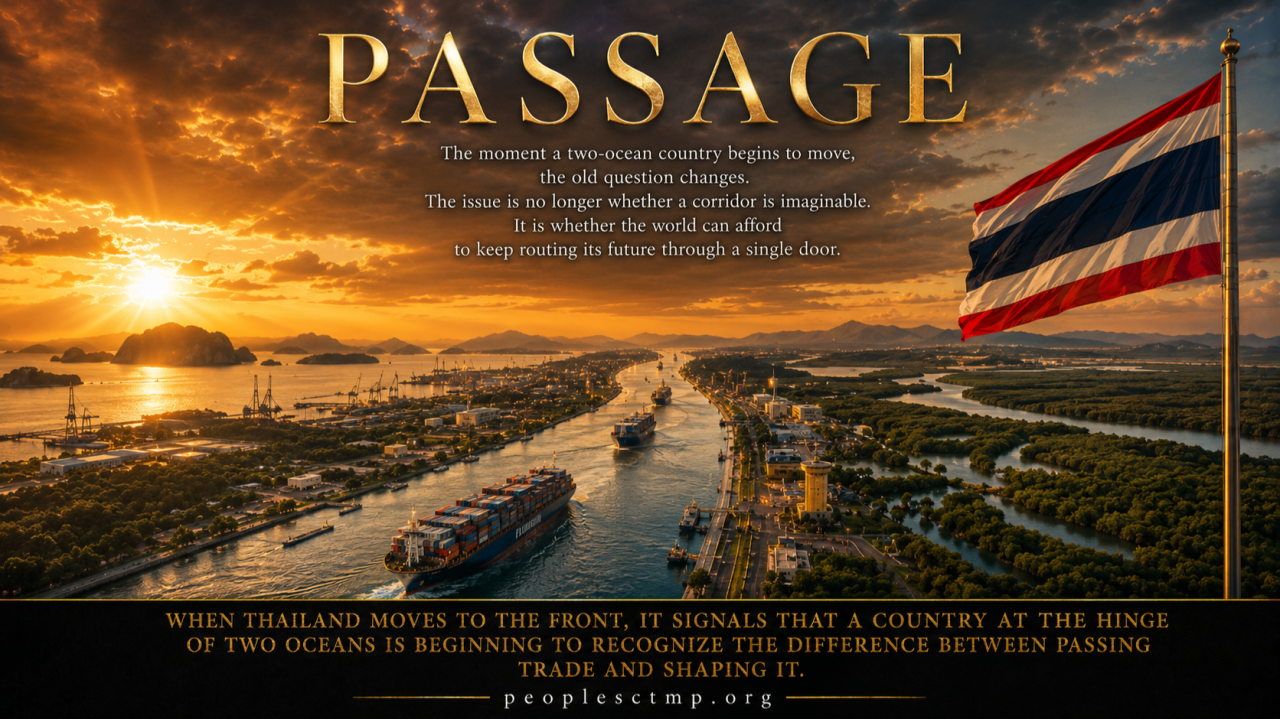
Thailand just took the lead on The Wall. Not with the most voices. With the most progress toward the only number that matters. Here is what a two-ocean country may have set in motion.
by Chris M. Coode, founder, CTMP
I. The board this morning
Thailand leads The Wall.
Understand exactly what that sentence means, because the board is more honest than any leaderboard you have ever seen, and its honesty is the story.
The Wall has now recorded 21,828 voices across 109 countries, out of 237 listed. Thailand did not lead by piling up the biggest raw number. Thailand has 831 voices. India has 8,191 and sits at number twenty-four. The United States has 3,173, Indonesia 2,628, Brazil 2,018, and all of them trail a country that recorded 831.
That is because The Wall does not rank countries by total signatures. Every country carries its own required count: five percent of its population, with a floor of 250,000 for the smallest nations. Countries are ranked by progress toward their own number. Thailand's required count is 3,605,000, five percent of its 72 million people, and its 831 voices put it at 0.023 percent of the way there, the furthest along of any nation on Earth. The United Arab Emirates sits second at 0.022 percent of its 525,000. Austria third. Oman fourth. India's 8,191 voices are the largest raw total on the board, but India's mountain is 72 million, five percent of 1.44 billion, so its progress reads 0.011 percent and the board tells it the truth.
Sit with the design for a moment, because I will confess in this article that parts of this project keep revealing themselves to me, and this is one of them. A board ranked by raw count would have been decided on day one by population, and 180 nations would have looked at the standings and gone home. A board ranked by progress toward five percent of yourself is a board on which Lebanon and India climb the same mountain, each their own. No nation is too small to lead. No nation is big enough to coast. And five percent is not a vanity number. Five percent of a population, standing up in public with nothing offered in return, is more people than most revolutions, referendums, and founding movements ever gathered. The Wall does not ask the world for applause. It asks each country for a mandate, and it publishes, next to every flag, exactly how much of that mandate remains: for Thailand, 3,604,169 people still to come.
A leaderboard that shows you how far you have left to climb is a leaderboard that cannot flatter you. The leader this morning stands at two hundredths of one percent, and the board says so, in public, beside the crown. I know of no other project on Earth that scores itself this way. Thailand leads a race that has barely begun, and both halves of that sentence are the point.
I will not presume to know why 831 Thais signed. The Wall records a country and a moment and nothing else, and their reasons remain theirs. But when the nation furthest up its own mountain happens to be the one country on Earth that sits beside the most concentrated maritime chokepoint in the world, I am allowed to notice. And I am obliged to answer with what the front of the line could mean.
II. The canal, assessed honestly
Start with the water that moves the world. In 2025, more than 102,500 ships passed through the Strait of Malacca, carrying nearly a quarter of global trade and around 29 percent of seaborne oil. That is not a shipping lane. That is a single point of failure for the industrial metabolism of Asia, and this spring's Hormuz crisis reminded everyone how few doors the world economy actually has.
Thailand is the one country that could open another door, and it has known this for three hundred and fifty years, since a cut across the Kra Isthmus was first proposed in the seventeenth century. Bangkok has never stopped believing in the corridor. This year it is actively reviving a roughly 90-kilometer land bridge from Ranong to Chumphon, twin deep-sea ports joined by rail and road, at an estimated thirty to thirty-one billion dollars, and officials describe the land bridge as more viable than a canal. Read that carefully. It does not say Thailand doubts the corridor. It says Thailand wants the corridor and judges a canal to be the harder build.
Here is my assessment, and I own every word. That judgment is entirely correct for any builder that shops (please see Newsletter published this weekend in CTMP Primer). A sea-level ship canal of 100 to 130 kilometers means an excavation prism approaching a billion cubic meters, boring machines from order books that run years deep, dredging capacity the market cannot spare, concrete by the tens of millions of cubic meters at market prices, and capital raised at interest against a decade of uncertainty. Priced from the market, the canal loses to the land bridge every time. Bangkok's arithmetic is sound.
But the CTMP does not price from the market. The platform's own works produce 300 tunnel boring machines a year. Its concrete pours from the very rock the excavation removes. Its steel comes from its own hydrogen furnaces, its power from its own core, its capital from a Charter that carries no debt and pays no coupon. And I will be precise where precision is owed: the platform's dedicated dredging and heavy civil marine fleets do not exist yet. They are designed into a subsequent module, and the canal program sequences accordingly, with the first module's works building the capacity the marine phase then draws on. That is how the platform treats every gap: not as a purchase, but as the next organ to grow. Every line item that makes the canal the harder buy is a line item the platform either already makes or is building the works to make.
On routing, I concur with the strongest independent analysis. Not the narrow northern pinch at Ranong and Chumphon, whose famous 44 kilometers is a cartographer's temptation laid across a mountain chain beside protected estuary systems. Not the deep southern Route 9A, 128 kilometers into a region whose security Thailand and Malaysia were discussing at prime-ministerial level this very month. The disciplined choice is the central corridor: the Surat Thani to Krabi and Phang Nga axis, broadly paralleling the Highway 44 spine Thailand built decades ago with a median already reserved for future transport. Planning envelope: 100 to 130 kilometers, entirely within Thailand, aligned with the country's own long-standing corridor logic.
And on value, honesty over headline. A Thai canal removes roughly 1,200 kilometers of sailing for qualifying voyages, about 36 to 46 hours of sea time, for a realistic net gain of 1.2 to 2 days after transit and pilotage. Tankers and bulk carriers on Gulf-to-East-Asia runs win most; feeder traffic wins less. If the canal diverted just five to ten percent of Malacca's traffic, the global fleet would recover roughly 7,700 to 15,400 ship-days every year. Real and material. But the deeper value is the extraordinary day, not the ordinary one. This is, first and last, a resilience asset: a second door for a world that has been living too long in a house with one.
That is the canal case, and it now yields the page, because the canal, remarkable as it is, is the smallest thing the corridor would carry.
III. The line we will not cross
Before anything else, the absolute.
The northern corridor's Andaman mouth sits in the protected Kraburi mangrove estuary. The central corridor's western reaches approach the Krabi river complex, a Ramsar wetland of global significance. So let there be no ambiguity and no future lawyer's comfort: the CTMP will never decimate environmentally sensitive areas. Not for schedule, not for tolls, not for the corridor of the century. Full stop.
If an alignment exists that bends around the protected systems, engineered with the patience our own machines make affordable, the canal follows it. If no such alignment exists, the canal is not built, and the corridor takes another published form, because this platform already builds covered land bridges lined with its own concrete. A project whose founding argument is that waste is a failure of ownership does not get to treat a mangrove forest as an externality. No honest ledger has a column where a wetland enters as zero.
The Earth is not a stakeholder in this project. The Earth is the senior partner. A complex industrial platform that intends to rewrite how economies operate is still, at the end of every calculation, a tenant here. We build accordingly or we do not build.
IV. What actually arrives: first the power, then everything the power becomes
A canal delivered by the CTMP is not a canal. It is the visible seam of a module, and the module arrives in a strict physical order, because in this architecture every output is a downstream form of one thing.
First, the power. The core: 300 gigawatts of firm hydroelectric baseload, available more than 93 hours in every hundred, roughly 2,500 terawatt-hours a year. Thailand's entire national consumption is on the order of 200 terawatt-hours; the module produces more than ten times that. It is offered at a posted tariff of two and a half cents per kilowatt-hour at the metered delivery point, and under the Stewardship Charter that tariff is a fixed system constraint. Not a promotional rate, not an operator policy that a future board can revise. Fixed, published, and enforced by a deterministic logic engine that no human operator can override to raise it. The Charter goes further downstream than any pricing document I know of: for electricity to carry the CTMP Verified mark, the end user's total price, all fees, all charges, everything on the bill, must stay within a published ceiling of five cents. Governments can tax; the Charter claims no authority over sovereign taxation and never will. But if any chain of intermediaries stacks the end price above the ceiling, that chain simply loses the right to call the product CTMP Verified, and the public record says so. The test is what the person at the end of the wire actually pays.
Then, from the power, the water. This ordering matters and I state it canonically: desalination is a machine for converting electricity into fresh water, so the water follows the electrons. Once the core energizes the desalination vertical, two billion cubic meters a year of clean water flow to the host nation as a gift, with the Charter's posted water schedule providing for essential-use allocations priced at zero, distribution charges permitted only as audited cost recovery, and every cubic meter metered, logged, and publicly attested. On a peninsula that knows drought on one coast and flood on the other, that is not a line item. It is a covenant with a meter on it.
Then the climate arithmetic, at its true size, and it is larger than even sympathetic readers assume, because they count only the electricity.
Count the electricity first. Every terawatt-hour of firm zero-carbon power that displaces coal avoids roughly 0.9 to 1.0 million tonnes of CO2; displacing gas, roughly half that. A module's 2,500 terawatt-hours, set against the regional generation mix it would actually meet, avoids on the order of one and a half to two billion tonnes of CO2 per year. All of global aviation emits about one billion tonnes. One module, on the power alone, outweighs the entire aircraft fleet of Earth.
Now count the materials, because the platform's two heavy verticals happen to target the two dirtiest industries in existence. Steelmaking emits roughly 2.6 to 2.8 billion tonnes of CO2 directly every year, around four billion tonnes counting its energy chain, seven to eight percent of everything humanity emits, more than all road freight combined. Cement and concrete add roughly eight percent more, about 1.5 billion tonnes from cement manufacture alone, because conventional structural concrete carries roughly 400 kilograms of CO2 in every cubic meter. Together, the two materials civilization is literally built from account for approximately one seventh of the entire global emissions problem. These are the two industries the platform replaces at the source: steel reduced with green hydrogen instead of coal, concrete formulated and cured without the conventional clinker burden.
Run the first-year numbers. Sixty million cubic meters of green concrete, and I state for the record that sixty million is the published minimum, subject to upward revision as deployment needs firm: displacing conventional concrete's footprint, that is on the order of 20 to 25 million tonnes of CO2 avoided in year one. Green steel at the fixed first-year rate of 4 to 8 million tonnes: against the industry's roughly two tonnes of CO2 per tonne of steel, another 8 to 16 million tonnes avoided. Call it 30 to 40 million tonnes a year from the two materials alone, before the first external kilowatt-hour is sold, and before counting what the concrete gives back: mineralized CO2 locked into the curing of the canal lining, the highways, the housing, every pour turning a structure into a modest carbon sink for the life of the asset. And at the canal's surface, one more instrument: every diverted voyage burns one to two fewer days of heavy fuel oil, compounding across tens of thousands of transits a year.
Then the rest of the body, each organ inheriting the cheap electron. Green molecules: 2.5 million tonnes of methanol and 2.6 million tonnes of ammonia a year at plant-gate costs in the low two hundreds of dollars per tonne, exactly the fuels world shipping is desperate to buy and cannot, which makes a CTMP canal the first place on Earth where a ship can save two days and its emissions profile in the same transit. Compute: 4 to 5 gigawatts of the core converted to sovereign-scale processing on a peninsula astride Asia's cable routes, cooled by two oceans, its waste heat cascading into greenhouses and aquaculture. Wafers refined from the excavation's own silica. And the machine works themselves, 300 TBMs and 200 turbine sets a year, which remain after the module is finished and convert Thailand from a country that imports heavy machinery into one that exports the means of making civilizations.
No single element is the offer. The offer is that they arrive as one body, at cost inside, under Charter.
V. The Charter is not a constitution, and the difference is the whole design
I have been careful in this article to say Charter and never constitution, and the distinction is not stylistic. It is the deepest structural choice in the platform.
A constitution claims sovereignty. The Stewardship Charter explicitly claims none. It does not govern people. It does not claim authority over taxation. It does not challenge the sovereign rules of any host country, and it is written, in plain language, to say so. It governs one thing only: the infrastructure, and the terms on which the infrastructure connects to the world. Participation is voluntary. Anyone can decline. Anyone who connects does so under the same published constraints, with no special lanes, no exceptions sold for influence, no preferential terms for parties with leverage.
Its invariants are few and absolute. No debt and no liens anywhere in the platform, because a lender with security over assets has leverage, leverage becomes influence, influence becomes capture, and capture becomes rent; the Charter deletes the instrument rather than policing the temptation. No internal profit between verticals, because margins that are forbidden at the customer's meter will otherwise migrate inward to hide in transfer pricing. Mandatory transparency: every kilowatt-hour and every cubic meter metered, time-stamped, logged, and independently attested, with tamper-evident records that make unauthorized changes visible.
And here is the part that should be studied in every governance textbook: the Charter's enforcement contains no weapon. It cannot shut anything off, and it forbids itself from trying. Hospitals, water systems, and life-safety infrastructure are never bargaining chips; no consequence under the Charter is designed as a life-critical interruption of power or water. Even a government that outright seizes a CTMP facility faces no coercion. It keeps the physical asset. What it loses is the network: the integrations, the supply chain, the attestations, the right to label its output CTMP Verified. Enforcement is a label and a ledger, not a switch. The system does not ask anyone to trust the operator, and it does not threaten anyone with the dark. It asks the world to verify the outputs, and it makes the cost of leaving visible, and it lets sovereign nations decide.
A structure that refuses sovereignty, refuses leverage, refuses coercion, and still holds its prices fixed across decades: that is not a company and it is not a state. It is a new category, and the honest name for its law is the one it chose. A charter.
VI. The engine: surplus that compounds and prices that undercut, at the same time
Now the arithmetic that outlasts everything above.
Under the Charter, the platform does two things simultaneously that conventional firms treat as opposites. It retains its surplus, compounding at ten percent a year inside the body: no dividends leaving for an exchange, no interest leaving for a lender, no listing converting a sixty-year asset into a ninety-day performance. And at the same time, it sells its non-essential outputs, the steel, the molecules, the wafers, the cable, at roughly twenty percent below the prices incumbents charge, under published pricing corridors and public price disclosure, because the Charter does not need high margins to grow and does not permit hidden ones anywhere.
Most enterprises must choose: fatten the margin or take the market. The platform's cost base, built on the eight-hundredths-of-a-cent electron and at-cost internal transfers, lets it do both at once: undercut every incumbent by a fifth and still bank a surplus that compounds. And compounding at ten percent is a force human intuition consistently underrates. It doubles in roughly seven years. It quadruples in fourteen. An order of magnitude in about twenty-four. A child born in the host nation in the module's first year would, by her mid-twenties, live beside an organism roughly ten times the size her parents watched break ground, with not one step of that growth financed by debt, extracted as dividend, or taken from her country as rent. The conventional megaproject is born owing and spends decades servicing what built it. This one is born owning, sells for less than everyone, and never stops growing.
VII. Ten million hands
Here is the number in this article to read twice: the deployment plan calls for a workforce approaching ten million people in the first year.
There has been nothing like it in peacetime. The Manhattan Project peaked near 130,000 people. Three Gorges employed a small fraction of this. Ten million is not a labor force. It is a working nation within a nation, and it is why the human systems are Charter-standing organs rather than amenities. The workforce lives inside the module, not beside it. Their homes are platform-built. Their children attend platform-built schools. Their hospitals stand minutes away, not provinces away. Electric rail carries them to the tunnel face and home again. No fly-in camps. No barracks at the fence line. A body does not warehouse its own cells, and this platform does not warehouse its people.
For Thailand and its neighbors, consider what the number does to the oldest economic sentence in Southeast Asia, the one where a young person leaves home to find a future. Ten million positions across seventeen verticals, from tunnel crews to fab technicians to teachers to physicians to turbine machinists, is a labor market that reverses the direction of ambition. The remittance economy runs backward. The diaspora books flights home. And because every vertical trains as it builds, the module's deepest export after twenty years will not be methanol or wafers. It will be ten million people who know how to build anything.
I mark this as I mark everything: a design value, published before the fact, offered for audit rather than applause. It is also the largest peaceful mobilization of human capability ever put on paper, and it is on paper now.
VIII. The hard sentence
Here is the sentence a founder is supposed to bury, set instead in its own section.
Coordinating this will be extraordinarily challenging. A seventeen-vertical organism. A ten-million-person first-year workforce. A hundred-kilometer marine corridor threaded around ecosystems we have sworn absolutely to protect. Marine fleets that arrive with a subsequent module and must be sequenced honestly. Sixteen fabs, two coastlines, one immovable Charter. Nothing of this shape has ever been managed, and parts of the discipline will have to be invented while being practiced. A project that claims its own coordination is a solved problem is lying or small, and this project is neither.
What I can report is that the assembly of that discipline has begun. The relevant people, the ones who have run the world's largest builds, fleets, grids, ports, and mobilizations, are being earmarked now. And the structure hands them something no predecessor ever had: no lenders to appease, no quarterly theater, no internal contracts to litigate, and a Charter that has already made the unmovable decisions, on debt, on margin, on the environment, so that no manager will ever face pressure to unmake them. We are not underestimating the mountain. We are noting that, for the first time, the climbers will not be carrying the finance industry on their backs.
IX. The Wall did this
Now stand back and see the whole thing in order, because the order is the miracle.
The Kra corridor has been studied for three hundred and fifty years. The chokepoint numbers have been public for decades. The engineering has been feasible for a generation. Kings, ministries, and consultancies reached versions of this article's conclusions over and over, and filed them, because the question that killed the corridor was never geological or financial. It was: who wants this badly enough to go first, and how would we ever know?
The Wall is the first machine ever built to answer that question, and look at how carefully it refuses to cheat. It could have ranked nations by raw count and crowned the largest. It ranks them instead by progress toward five percent of themselves, so that a nation of 72 million and a nation of eleven thousand climb on equal terms. It could have hidden the distance remaining and sold the illusion of momentum. It publishes, beside every flag, exactly how many people have yet to come: 3,604,169 for the leader. It could have harvested names, emails, data, donations-for-influence. It takes a country and a moment, and its own Charter section states in writing what it is not: not a petition, not a security, not a governance instrument, not a legal claim on anyone. It is a demand ledger. It exists so that deployment can follow actual demand instead of inferred demand, actual people instead of intermediaries paid to speak for them.
And on that unforgiving instrument, on a board that flatters no one and counts everyone against their own five percent, 831 Thai citizens just carried their country past 108 others to first place. Not because anyone paid them; the board has no mechanism to pay anyone. Not because anyone organized them; the feed shows the opposite, a link moving hand to hand through a population that decided, on its own, that their country should count. Eight hundred and thirty-one people, against a required count of 3.6 million, at two hundredths of one percent, leading the world. Every founding movement in history looked exactly like this at this exact moment: implausibly small, absurdly early, and moving.
Nothing is decided by a leaderboard, and I will not insult those 831 people by pretending their voices bind them or anyone. India's 8,191 are one afternoon of motion from an answer. Indonesia's 2,628 and America's 3,173 are coiled. A hundred and nine countries are already climbing and a hundred and twenty-eight have yet to place their first voice. The race was designed never to be over, because a mandate that must be continuously earned is the only kind this Charter recognizes.
But something is true this morning that was not true last week, and it will stay true whatever the board says tomorrow. The oldest infrastructure question in Southeast Asia, the one three and a half centuries of power could not close, has received its first answer from the only constituency that was never asked. Not a ministry's letterhead. Not a consultancy's forecast. Eight hundred and thirty-one first movers, standing on a public ledger that offered them nothing, asking for the future in the one currency that cannot be counterfeited.
Two oceans. One answer. Freely given, publicly counted, and 3,604,169 voices from complete.
The people went first. The mountain is published. Now Thailand climbs it.
peoplesctmp.org. No account. No name. No email. Just your country.