The Kingdom at the Gate
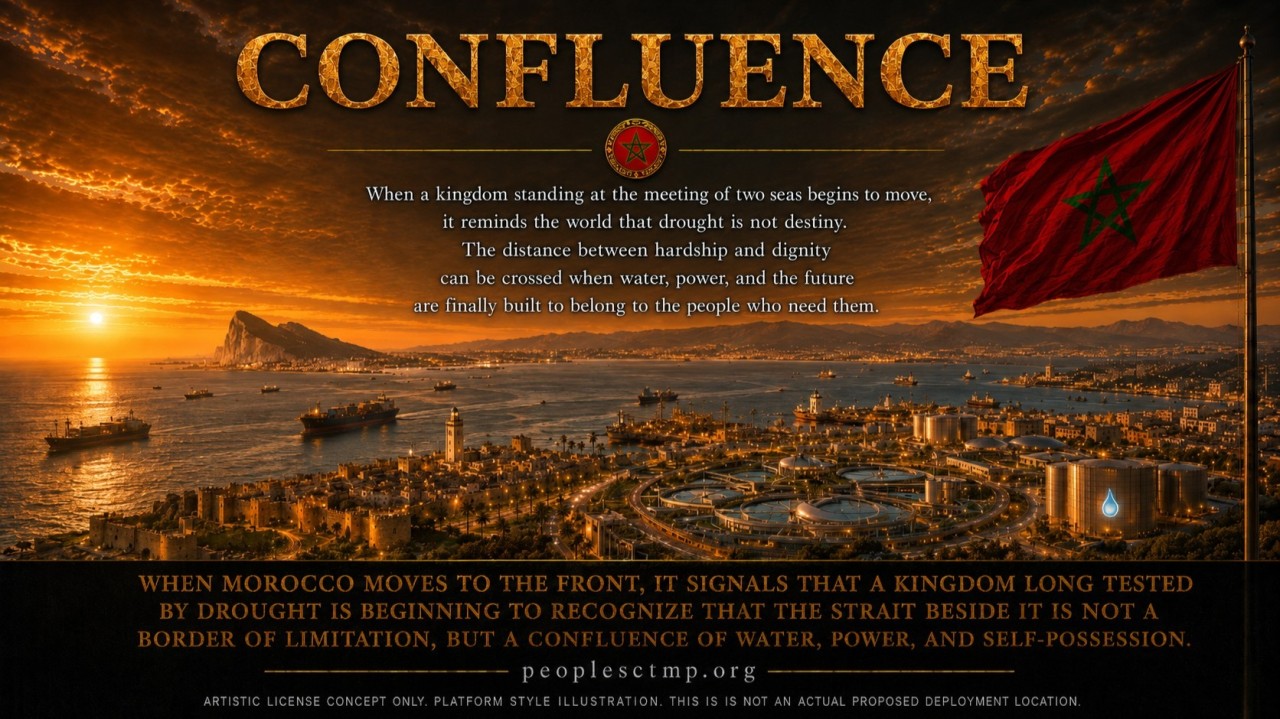
Morocco leads The Wall. India just became the first nation to reach five figures. And the question everyone asks about the free water has an answer made of pure arithmetic. Follow the chain.
I. The board this morning
Two things happened on The Wall that have never happened before, and they happened in the same week.
Morocco took first place. Four hundred and sixty voices, recorded on a public board that offers nothing, asks nothing, and collects nothing but a country and a moment, carried the Kingdom of Morocco past 109 other nations to the top of the leaderboard. The board now shows 24,208 voices across 110 countries. Morocco stands at 0.024 percent of its required count of 1,890,000, which is five percent of its 37.8 million people, and the board publishes, beside its flag, exactly how much mountain remains: 1,889,540 voices still to come.
And India crossed into five figures. Ten thousand one hundred and six voices, the first nation in the board's history to reach a five-digit count. Roughly four out of every ten voices on the entire Wall are now Indian. Under the ranking rules, India sits at nineteenth place, because its required count is 72 million and the board ranks progress toward each country's own number, not raw mass. Both truths stand side by side, and both are the point: Morocco leads the race, and India owns the record. A board that can honor a 460-voice leader and a 10,106-voice milestone in the same breath is a board that measures two different kinds of magnificence at once, and lies about neither.
I hold to my standing discipline: I do not know why any individual signed, because The Wall is built not to know. But I owe every reader, and especially the skeptics among my subscribers, the thing that separates this project from every feed you scrolled today. A feed asks for your attention. A ledger asks for a decision. And decisions deserve logic, stated in the open, step by step, where anyone can attack it.
So today, instead of leading with the geography, I will lead with the question I am asked more than any other. The question that decides whether this platform is real or another beautiful rendering.
How can you possibly afford to give away the water?
Follow the chain. Every link is stated in the open.
II. The chain: why the water is free
Step one. The platform's electricity costs $0.0008 per kilowatt-hour to produce. Eight hundredths of a cent. This is the published owner-cost derivation: a 300 gigawatt hydroelectric core with no fuel, ever; no debt service, ever; no liens; no internal margins between any vertical and any other, by Charter. Strip a kilowatt-hour of its financial clothing, the fuel bills, the lender's coupon, the stack of intermediary markups, and what remains is almost nothing. Every number that follows descends from this one.
Step two. Fresh water is electricity wearing another shape. Desalination is a water technology whose dominant operating input is energy. A modern seawater plant spends roughly three to four kilowatt-hours to make one cubic meter of drinking water, and energy is a dominant operating cost, which is why desalinated water is expensive across much of the Earth. Everywhere, that is, where electricity costs real money. Run the platform's number: three and a half kilowatt-hours at $0.0008 is about one quarter of one cent per cubic meter. The energy inside a tonne of drinking water, one of the things that makes water unaffordable across much of the planet, costs this platform less than a paperclip.
Step three. Scale it and watch it stay small. The full gift, two billion cubic meters a year, consumes roughly seven terawatt-hours annually. The module produces about 2,500. The entire national-scale water program, enough for the basic daily needs of up to 110 million human beings at roughly fifty liters each, draws barely one quarter of one percent of the module's output. At owner cost, the energy bill for all of it is on the order of six million dollars a year. Not billion. Million. A rounding error inside a rounding error. That is the energy bill, not the total installed and operating cost of desalination, conveyance, storage, or distribution; those costs remain inside the platform's full water-cost derivation.
Step four. Now the part almost nobody prices: the ocean can help pay us to take the water. Desalination has a famous byproduct, brine, the concentrated reject stream that the industry treats as its defining embarrassment: pumped back to sea, an environmental liability, a disposal cost. The CTMP is designed not to dispose of brine. It is designed to refine it. Brine is seawater with the minerals pre-concentrated, which makes it not waste but ore in liquid form: salts, magnesium, potash, bromine, and a run of industrial minerals behind them. The platform's published desalination and brine refinery documentation puts the indicative gross value of those refined outputs at approximately thirty billion dollars per module-year, honestly bounded by published market-absorption corridors, because flooding world mineral markets without discipline would crater the very prices the figure assumes. That is not a net-revenue forecast: recovery yield, purity, processing cost, capital requirements, and actual market uptake must all be demonstrated.
Step five. Close the loop and read what it says. The water's energy cost: single-digit millions. The water's byproduct stream: indicated gross value in the tens of billions. The plant that makes the "free" water is not designed as a charity. It is designed as a mineral refinery whose feedstock is the sea and whose byproduct happens to be the drinking water of a nation. We do not give the water away despite the economics. We give it away because of them. The gift is not generosity straining against cost. The gift is routing: the platform keeps the minerals, the people keep the water, and, if the recovery assumptions are demonstrated, the ledger can close with the giver ahead.
This is the same logic that runs the entire body, and it is why I keep insisting that circularity here is bookkeeping, not branding. The tunnels that carve the hydro channels yield hundreds of millions of cubic meters of rock: refined into concrete aggregate, silica for wafers and glass, iron for the steel mills. The mine and the construction site are the same hole. Captured process CO2 becomes methanol and synthetic gas. Electrolysis oxygen feeds the steel furnaces. The compute district's waste heat warms greenhouses and fish farms. Dozens of material streams, every one of them a purchased input somewhere in the conventional economy, every one of them arriving here as the byproduct of something the platform had to do anyway. Waste is matter that fell through a gap between two balance sheets. The platform has no gaps, so it has no waste, and that, precisely that, is where the water comes from.
You now hold the complete answer to the only question that matters. Everything else in this dispatch is geography and people. But the geography is remarkable, so stay with me one more section.
III. Morocco: the country the chain was waiting for
Run the chain from Section II against one specific coastline and watch the links start ringing.
Morocco has endured one of the longest drought sequences in its modern history. Reservoirs drawn toward dead storage, cities under restriction, farmers reading empty skies. Step two and step three are not abstractions there. They are the difference between a harvest and an exodus. A country in year after year of drought does not need a white paper to understand a machine that turns the Atlantic into fifty liters per person per day at a quarter of a cent per tonne of energy.
Morocco imports roughly ninety percent of its energy, paying the world, in hard currency, for the one commodity its own geography could drown it in. Step one lands there with a weight no wealthy nation can feel: a posted tariff of two and a half cents per kilowatt-hour, fixed by Charter, against an economy built on imported fuel.
And Morocco is not a country that needs convincing that gigawatts can rise from ambition, because it built Noor. The Ouarzazate solar complex was for a time the largest of its kind on Earth. The kingdom set renewable targets that embarrassed richer nations and proposed transmission to Europe so seriously that what was designed as the world's longest subsea power link was drawn from its coast, even though the original UK route was later rejected by the British government. The CTMP does not arrive in Morocco as science fiction. It arrives as the finished version of a sentence Morocco started writing twenty years ago.
Now the link I did not see until the chain forced it, and I have written more than thirty of these dispatches. Fertilizer, the thing that feeds the human race, is three letters: N, P, K. Nitrogen. Phosphorus. Potassium. Morocco sits on roughly seventy percent of the planet's known phosphate reserves; it is the P in the world's food supply, and its flagship industry buys nitrogen, as ammonia, at world prices to turn that rock into product. The platform's molecules vertical is designed to produce 2.6 million tonnes of green ammonia a year at a plant-gate cost near $204 per tonne against benchmarks several times higher. That is the N. And step four above, the brine refinery, is designed to produce potash. That is the K.
Read it again slowly. One country holds the P. One platform is designed to manufacture the N and recover the K, the K arriving literally as a byproduct of the drinking water. A single module on the Moroccan coast is designed to complete the fertilizer alphabet in one place, at input costs the platform is designed to drive far below incumbent benchmarks, in the country that already ships the world its phosphorus. I have never seen an industrial fit this exact, and I did not construct it. Four hundred and sixty Moroccans surfaced it by walking onto a board.
Add the door itself: Morocco faces both the Atlantic Ocean and the Mediterranean Sea, with the Strait of Gibraltar at its northern edge, fourteen kilometers of water carrying the western gate of the Mediterranean world. Readers of this series will feel the rhyme. Two weeks ago the board was led by Thailand, neighbor of the Malacca chokepoint. Now it is led by the neighbor of Gibraltar. Twice in a fortnight, the peoples who live at the doors of world trade have walked to the front of the line. I built the ranking mechanism. I did not build that. The board keeps teaching its maker.
IV. The people, honestly
Why did 460 Moroccans sign? Why did ten thousand Indians? I will not pretend to know, because the board is built not to tell me: no form fields, no surveys, no comment box. That silence is the price of the signature's purity, and I pay it gladly in every dispatch by refusing to put words in anyone's mouth.
What I can do is read the daylight. In Morocco, the plausible spectrum stands in plain view: water in a drought, a fixed bill in an import economy, work in a young country whose graduates board planes to matter elsewhere, the Noor generation's earned conviction that big clean energy is a national genre, and simple pride as the flag climbs. In India, where 10,106 people have now built the tallest raw column on the entire board, the spectrum is its own: a nation of 1.44 billion whose relationship with power cuts, water tankers, and imported energy needs no explanation from me, and whose people have just demonstrated, at five figures, without one rupee of promotion, that the demand this board was built to detect is not hypothetical.
Every voice counts identically: the farmer's, the engineer's, the student's, the skeptic's who signed as a dare. And the absence of any reward remains the evidence that no marketing budget can buy. Nobody was paid. Nobody was even thanked by email, because we do not know who anybody is. Twenty-four thousand two hundred and eight people, in 110 countries, gave the only thing the board accepts, a moment of unbought intent, and received exactly one thing back: the sight of their country moving.
The mechanics, for every new reader: each nation's required count is five percent of its population, floor of 250,000. Rankings track progress toward that own number, which is how 460 leads and 10,106 holds nineteenth, and why neither fact diminishes the other. The first published gate is the First Independent Review, triggered at 0.05 percent of population with a floor of 2,500; for Morocco that number is 18,900. I state the mechanism and stop there, as always. This project's entire credibility rests on the fact that I do not push countries up their own mountains. The gates open at the people's numbers or they do not open.
V. What acceptance would mean: the ladder and the terms
If a leading nation carries its mandate through the gates and chooses to host, here is the whole offer, in the open, identical for every country on Earth, because the Charter forbids special lanes and exceptions sold for influence.
The ladder first, because scale must be earned in public. We do not arrive asking anyone to believe in 300 gigawatts. We arrive with a 50 megawatt proof-of-concept, the earned prize of the country that leads The Wall through verification: a complete working expression of the platform in miniature, power flowing, water flowing, every meter logged and independently attested from day one, built on the premise audit this, then decide about the rest. Then the 250 megawatt scale-up, proving the module logic at industrial size. Then the full module. Each rung is designed to finance the next, with zero debt at every stage, because a ladder climbed without borrowing is a ladder no lender can pull away. The physical order inside every rung is fixed: power first, because everything else, beginning with the water, is a downstream shape of the power.
The terms, plainly. Citizens receive Core electricity at a posted tariff of two and a half cents per kilowatt-hour at the metered delivery point, fixed by Charter as a system constraint no operator can raise, with a hard ceiling of five cents on the end user's total bill for anything carrying the CTMP Verified mark. Citizens receive the water of Section II: gifted, essential-use allocations priced at zero, basic daily needs covered for up to 110 million people, which blankets Morocco's 37.8 million nearly three times over with the surplus available to the farms that have spent years praying at empty reservoirs. The deployment model projects a first-year workforce approaching ten million positions across seventeen verticals at wages designed to run above prevailing standards, housed in platform-built homes, served by platform-built hospitals, schools, and rail, because a body does not warehouse its own cells.
The nation keeps everything. The Charter claims no sovereignty, governs no people, touches no taxation. Its enforcement contains no weapon by design: hospitals, water systems, and life-safety infrastructure are never bargaining chips, and no consequence under the Charter is ever a shutoff. The only thing the platform can withhold, from anyone, up to and including a government that seizes a facility outright, is a label and a network. And what we ask is the mandate, operating conditions under the host's own law, and the Charter taken whole, because the constraints are the machine: no debt, no liens, at-cost internal transfers, mandatory transparency, fixed tariff. A participant who needs an exception to those is not compatible with the platform, and the honest answer is to decline, not negotiate.
VI. Why we bleed for it anyway
I am writing this past the five hundredth consecutive day of work on this platform, no days off, at the end of another long shift, and I will keep sparing you the romance because there is none. There is only the arithmetic: the platform's published conservative counting boundary identifies 1,382 preventable deaths every day from the specific water-and-energy pathways it counts. The counting logic is published and open for inspection. It is the only deadline this project has ever had, and it does not pause on weekends, so neither do I.
We are not doing this for our health, and we are not doing it for sainthood. We are doing it because Section II is true. Because the deaths are a rounding error away from preventable, and the thing preventing the prevention was never physics and never money. It is structure: the debt, the margins, the queues, the decade procurements, the entire apparatus that keeps a cubic meter of water expensive while the energy inside it costs a quarter of a cent. I concluded years ago that the apparatus could not be reformed, only exited, so the platform exits it. Surplus retained and compounding at ten percent a year inside the body. Non-essential outputs sold at roughly twenty percent below incumbent prices, because a platform with this cost floor does not need fat margins and its Charter does not permit hidden ones. Nobody extracts. That is the entire business model, and the only reason it reads as impossible is that everyone has spent a lifetime inside the structure it exits.
VII. What I do not know
The concessions, unsoftened, as the record demands. Nothing is built; every figure here is a published design value, and the Charter binds the platform to metered, attested, public reporting from the first operating day so that every claim above becomes checkable against an instrument instead of my prose. Morocco's lead is 460 against a mountain of 1.89 million, a magnificent beginning and a beginning only; the board has changed hands three times in two weeks and can change tonight. The brine figure is indicative and bounded by the platform's own published absorption analysis, not a revenue promise. Morocco is a real country with real politics of water, land, and industry that belong to Moroccans and their institutions at their own pace. And the environmental absolute binds on the Moroccan coast exactly as everywhere: the platform will never decimate environmentally sensitive areas, full stop, and anything that cannot honor that is not built. The Earth remains the senior partner.
VIII. The ledger and the feed
Here is the closing thought, and it is the reason this dispatch walked you through a supply chain of brine instead of leading with applause.
The internet you scrolled today is a feed. A feed wants your attention, holds it with heat, and asks nothing else of you, which is why it changes nothing. The Wall is not a feed. It is a ledger, and a ledger wants exactly one thing: a decision, recorded, counted, and permanent. Feeds run on outrage because outrage is renewable. Ledgers run on logic, because a decision without logic is just a mood with a timestamp.
So this project publishes its logic the way other projects publish their highlight reels. The water is free because the energy inside it costs a quarter of a cent and the brine it leaves behind contains an indicative gross mineral value of approximately thirty billion dollars under the platform's published assumptions. The power is priced at two and a half cents because the published design-basis owner cost is eight hundredths of one and the Charter forbids anyone, forever, from harvesting the gap. The fertilizer alphabet is designed to complete on the Moroccan coast because the country holds the P and the platform is designed to manufacture the N and recover the K, one of them literally dissolved in the drinking water's shadow. Attack any link. Their derivations are all published. That is the invitation, and it has not changed since the first document: audit, not belief.
Four hundred and sixty Moroccans put their kingdom at the front of that logic this week. Ten thousand one hundred and six Indians proved, at five figures, that the demand is a fact and not a forecast. Twenty-four thousand two hundred and eight people across 110 countries have now made a decision where the world could see it, on a board that gave them nothing but the count.
The gate of the Mediterranean has watched empires pass through it for three thousand years. This week it did something no empire ever managed.
It opened from the inside.
Make your voice heard. Make your country count.
peoplesctmp.org. No account. No name. No email. Just your country.