Seventy-Two Million
Aug 03, 2026
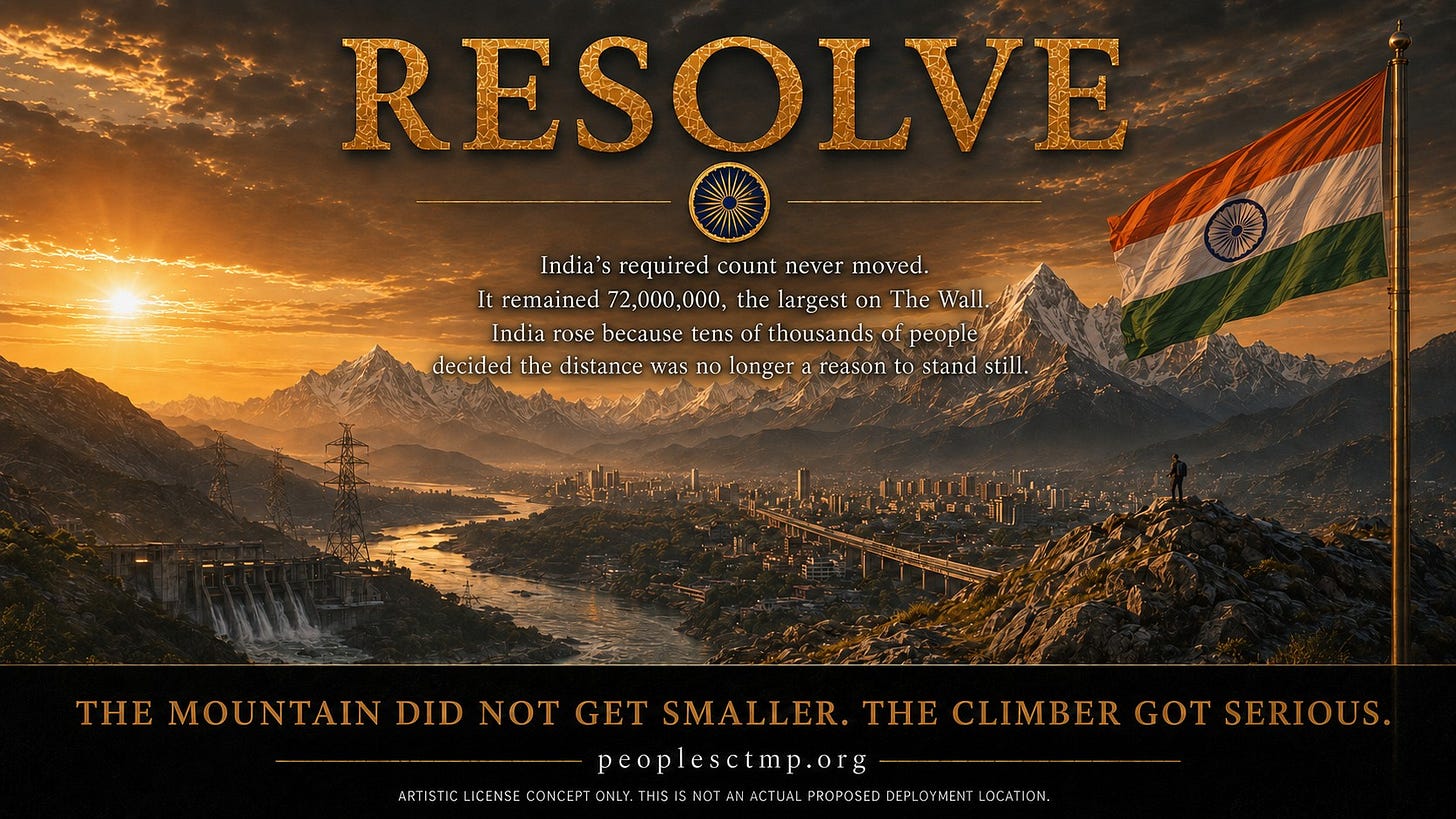
India has taken first place on The Wall. It did it while climbing the tallest requirement any nation on the board carries. What follows is the logic of why this was always the likeliest ending to these last several weeks, and the arithmetic of what it would mean if the machine this board exists to summon were ever stood up at the scale of the one nation whose own scale matches it.
For weeks, anyone watching the board saw the same picture. India everywhere and India nowhere. Nearly one voice in two, across the entire Wall, across more than a hundred countries, was Indian, and yet the flag sat mid-table, fifth, then closing on the top eight, then through it, climbing a slope so long that its raw mass, the largest any nation has ever contributed to this instrument, still translated to hundredths of one percent.
That was not a paradox. That was the instrument working. The board ranks nations by progress toward their own required count, five percent of their own population, and five percent of India is 72,000,000 human beings. No nation has ever been asked for a number like that, for anything, in the history of asking. The board asked anyway, because the rule is the rule, and the rule does not bend for size in either direction. It would not let India’s mass buy a lead the proportion had not earned. And now that the proportion has been earned, it will not let anyone pretend the achievement is small.
At the time of writing, India holds first place on The Wall. The tallest mountain on the board now has the leading climber. Both records, the largest absolute count and the highest relative progress, fly the same flag.
Understand what had to be true for that sentence to be written. Costa Rica led this board with a required count of 262,500. Mexico led it with a required count of six and a half million. India leads it against seventy-two million, a threshold that exceeds the entire population of most countries on the board, a threshold that contains within it more human beings than have voted in most elections ever held. Progress against a mountain like that does not come from a news cycle. It comes from the thing this board was built to detect and the only thing it is capable of detecting: a very large number of people, acting one at a time, with nothing offered to them and nothing collected from them, arriving at the same conclusion independently.
The question worth four thousand words is why they arrived at it. And the answer is that India’s ascent was overdetermined. Three separate logics, need, capacity, and mandate, all converge on the same flag, and each one connects to every part of the machine this project proposes to build. Follow them in order, because they are not three arguments. They are one argument, seen from three sides.
I. Need: the country that burns coal because physics gave it no alternative
Start with the wires, and start with respect, because the standard telling of India’s energy story is lazy and this project does not traffic in lazy tellings.
India generates roughly three quarters of its electricity from coal. It imports close to ninety percent of its crude oil. Its energy import bill runs to well over one hundred billion dollars in a typical year, a river of national wealth flowing outward, every year, forever, to purchase the one input everything else depends on. The lazy telling stops there and calls it a failure of will.
It is nothing of the kind. It is a rational answer to a cruel constraint. A civilization of 1.4 billion people, industrializing, urbanizing, electrifying, requires firm power: electricity that is there every hour of every day, through monsoon and drought, at a price a developing economy can carry. And for the entire history of the electrical age, humanity has known exactly two species of firm power at that scale: the kind you burn, and the kind you dam. India has dammed what its rivers allow. The rest of the firmness has to be burned, and so India burns it, not out of ignorance but because no third species existed. This is the same nation that founded the International Solar Alliance and built one of the largest solar fleets on Earth. India’s intent is not in question. India’s problem is that the sun sets, and a steel mill does not.
Now place one number beside that constraint. A single CTMP module is engineered to deliver approximately 2,500 terawatt hours per year of firm, carbon free, ocean fed baseload, available more than 93 percent of all hours, at an owner cost of eight hundredths of a cent per kilowatt hour.
India’s entire existing grid, every coal station, every dam, every solar park, every reactor, all of it together, generates less than that in a year.
One module. More firm clean energy than the whole present output of the most populous nation on Earth. That is not an increment to India’s energy debate. That is a third species of power, the one whose absence explains the coal, arriving with the firmness of the thing you burn and the cleanness of the thing you cannot, at a cost an order of magnitude below either. A nation that has spent seventy years solving the equation firm power equals combustion does not need the significance explained. Every engineer in every load dispatch center from Gujarat to Bengal can read that sentence in one pass, because it is the sentence their entire profession has been waiting for someone to be able to write.
II. Need: the water
The second need is harsher, and it is measured in India’s own government arithmetic.
The NITI Aayog’s landmark assessment put roughly 600 million Indians under high to extreme water stress, and attributed on the order of two hundred thousand deaths a year to inadequate access to safe water. India draws more groundwater than any nation on Earth, roughly a quarter of the global total, running down aquifers that took millennia to fill in order to grow a single generation’s food. Cities have watched their reservoirs approach empty. Farmers drill deeper every season for water that retreats faster than the drills.
Against that, read one line of the platform’s design: each module gifts 2 billion cubic meters of potable water per year to its host nation. Not sold at a preferential tariff. Gifted, in full, forever, as a Charter obligation. At fifty liters per person per day, that is drinking water for roughly one hundred million people, delivered from the one source India can never deplete, the ocean, powered by the one input the module makes nearly free.
And the mechanism that pays for the mercy is the part an Indian reader will appreciate most, because India knows better than anyone that mercy without economics is a press release. Desalination at the module’s internal power price carries an energy cost of about a quarter of one cent per cubic meter, the energy component of a wider system cost the design offsets by refining the concentrated brine, the industry’s most notorious waste stream, into salts, magnesium, potash and bromine worth an indicated thirty billion dollars per module year. The waste funds the gift. The sea pays for its own distribution. A civilization that has spent decades watching its water table fall while its fertilizer bill rises will notice that this one design reverses both curves with the same loop, which brings us directly to the third need, because in India, water and fertilizer are not two subjects. They are one subject called food.
III. Need: the molecules, the steel, and the sovereignty of made things
India subsidizes fertilizer for its farmers at a scale that has exceeded twenty billion dollars in a single year, and it does so while standing among the world’s largest importers of urea, which is to say: India pays twice, once to buy the molecule abroad and once to make it affordable at home, and the price of both payments is set in markets India does not control, denominated in the natural gas India must also import. Every spike in world gas prices lands, eventually, on the cost of an Indian harvest.
The platform’s Green Molecules vertical produces ammonia, the parent molecule of urea, at a plant gate cost of approximately 204 dollars per tonne, because ammonia is mostly hydrogen and hydrogen is mostly electricity and the module’s electricity costs almost nothing. That is a fraction of what the world market has charged in any recent year. India has already declared, through its National Green Hydrogen Mission and its five million tonne target, that it understands green molecules are the hinge of its industrial future. The declaration is sincere and the physics is unforgiving: green hydrogen made with grid power at grid prices cannot undercut grey hydrogen made from gas. Green hydrogen made at eight hundredths of a cent per kilowatt hour does not merely undercut it. It retires the question. The mission India has announced is, at the module’s power price, simply arithmetic.
The same sentence repeats down the entire industrial line, and India stands at the receiving end of every clause. India is the world’s second largest steel producer, with a declared ambition of 300 million tonnes of capacity, and nearly all of it rides on coal. The platform makes 8 million tonnes a year of green steel using its own hydrogen, at cost, inside the body. India is building metro systems in more than twenty cities, driving rail tunnels through the Himalaya, raising the highest railway bridge on Earth, a nation in the middle of the greatest tunneling and civil works century of its history, and the platform manufactures 300 tunnel boring machines and 200 giant turbine generator sets per year, in-house, because the world’s order books could never supply them. India has launched a national semiconductor mission because it knows that a civilization that cannot make its own wafers computes at the pleasure of those who can, and the platform’s wafer vertical refines 20 million 300 millimeter wafers a year from silica dug out of its own tunnels, feeding an ocean cooled compute district governed by dispatch rules written into charter rather than into commercial contracts, with life safety loads standing permanently senior to compute. Even the platform’s HVDC cable vertical, thousands of kilometers a year of the most backordered product in the global energy transition, answers a bottleneck India’s own grid planners know by heart, because India already operates some of the longest high voltage corridors on Earth and needs many more of them than any manufacturer will promise to deliver.
Seventeen verticals, and it is difficult to find one that does not map onto a standing item of Indian national policy. This is the deep reason the ascent was overdetermined. For most nations, this platform is a proposal. For India, it reads like a consolidated answer to the last two decades of its own five year plans, with the financing inverted and the middlemen deleted.
But every one of those verticals shares a single input, and it is not electricity. It is the input the whole architecture stands on, the one this project has now measured to the individual, and the one that makes India not merely a candidate beneficiary of the machine but very nearly a precondition for it.
IV. Capacity: the largest deployment workforce in human history
The platform’s Second Edition workforce assessment, consolidated from seventeen independently controlled vertical models, states its central finding without anesthesia. In its first operating year, the architecture requires 25,900,911 construction job years and a standing recurring workforce of 3,016,889 full time positions. Not over a decade. In Year 1.
Sit with the construction number, because the assessment itself refuses to soften it: a claim of nearly twenty-six million job years on the global construction labor market, in a single year, is not a hiring plan, and no single national market can supply it. That is the hardest operational fact in the entire program, stated plainly in its own documentation.
And there is exactly one country on Earth that makes that sentence merely hard instead of absurd.
India adds on the order of ten million new workers to its labor force every single year, the largest inflow of working age human beings on the planet, arriving annually, looking for exactly what a linear economy has struggled to provide them. India’s construction workforce is not hypothetical and not untested: it is the workforce that raised the skylines of the Gulf, millions strong across Dubai and Doha and Riyadh, sending home well over one hundred billion dollars a year in remittances, the largest such flow in the world, earned largely on other nations’ monuments. The skills exist. The scale exists. The discipline of megaproject labor exists, proven across forty years and a dozen foreign countries. What has never existed is a project on India’s own side of the water sized to employ that capability at its full depth.
Now read the structure of the jobs, because this is where the assessment’s most important rule lives, and where the difference between this platform and the gig scaffolding of the modern economy becomes a matter of published accounting.
The assessment reports two populations and forbids their addition. Construction job years are a flow: labor consumed by the build, 25.9 million units of it in Year 1, falling to 2.7 million in Year 2 once the standing start is complete, then compounding for three decades until annual construction reaches 36.7 million job years by Year 30, higher than the year it began. Recurring positions are a stock: people who hold a standing job in a given year, 3.0 million of them in Year 1, and here the assessment’s most consequential disclosure applies. Of those, 1,041,389 are industrial and technical payroll, the operators of plants and ports and fabs and grids. The other 1,975,500 are the civic and service economy of the first city the architecture builds and must sustain: the teachers, nurses, physicians, safety workers, administrators and shopkeepers of a resident population of nine million people in Year 1, on a compounding path the models carry to 142.8 million by Year 30. The platform does not build a facility with a labor camp attached. It builds a society, and it counts the society’s payroll as its own obligation, in the open, in a separate labeled column, because two thirds of the headline number is a city and calling a city a plant would be the kind of category error this documentation program exists to make impossible.
By Year 30, the complete recurring requirement reaches 47,111,758 standing positions, 15.8 million of them industrial and technical, a figure that by itself exceeds the manufacturing employment of most industrialized nations. Across the full horizon the program consumes 489 million recurring job years and 404 million construction job years, inside published corridors that are asymmetric and honest about being so. These are not gig positions, not zero hour contracts, not app mediated piecework. A recurring FTE is a person with a standing job, a wage ladder, a credential that travels, and a training academy behind them, in a program whose own policy annex specifies wage floors, fatigue rules, portable certification and worker housing as first mile infrastructure, machine verifiable in the platform’s registry rather than self certified in a brochure.
And the wages are not an expense the platform grudges. They are where the money is designed to go. More than half of every revenue dollar the platform earns is retained and reinvested rather than distributed, that is the compounding engine, and the majority of that reinvested flow is payroll: the wages of the millions who operate, maintain, teach, heal, build and expand the body. There are no shareholders standing between the surplus and the workforce, because the Charter forbids the existence of the pipe through which surplus normally leaves. The ten percent annual compounding that carries one module’s capacity to 2.59 times itself in a decade and 6.73 times in two is, viewed from the labor side, the same curve that carries the standing workforce from three million to forty-seven million: the assessment states it in one line, the jobs and the output are the same curve viewed from two angles. A nation of ten million new workers a year, reading a design whose first year requires twenty-six million job years of construction and whose steady state grows headcount fifteen fold in thirty years, is not reading a threat to absorb. It is reading the first machine ever drawn at the scale of its own demography.
That is the second logic, and notice what it does to the first. India’s need and India’s capacity are not separate facts. The country with the largest unmet requirement for firm power, clean water and cheap molecules is the same country holding the largest workforce on Earth capable of building the machine that produces them. The lock and the key were cut in the same place.
V. Mandate: why the terms matter as much as the machine
Which leaves the third logic, the one The Wall itself measures, and it begins with a question any thoughtful Indian is entitled to ask: we have heard large promises from large projects before, so what binds this one?
The answer is the Stewardship Charter, and it deserves a plain description, because it is the part of the architecture that exists specifically for people who have been burned.
The Charter is the platform’s governing instrument, and its load bearing clauses are invariants, which means they are not policies a future board can revise. The external tariff is posted at 2.5 cents per kilowatt hour and fixed as a system constraint no operator can raise, with an all-in ceiling of five cents on the end user’s bill for anything carrying the platform’s verification mark. Internal transfers move at computed cost, with internal profit defined as a violation, auditable and forbidden, so the cheap kilowatt hour cannot be quietly repriced on its way through the body. The platform carries zero debt and will never list on an exchange, so no lender’s covenant and no quarterly earnings call can bend a sixty year asset toward a ninety day appetite. The water is gifted, with essential use priced at zero, as an obligation rather than a gesture. Every output is metered, independently attested, and published. And the enforcement architecture contains no weapon by design: no shutoffs, ever, with hospitals, water systems and life safety loads never available as bargaining chips, because a system whose arithmetic is sound does not need hostages. Even the platform’s compute is dispatched under charter rules that hold life safety senior to commerce, decided by published logic rather than by negotiation.
That instrument is, at this writing, in open revision toward its next public edition, with its draft published for the world to mark up, its change control rules requiring documented justification and public notice for any amendment, and its invariants standing outside the amendment process entirely. A constitution being edited in public, by a project that has not yet poured concrete, is an unusual sight. It is meant to be. The terms are being fixed before the leverage exists to break them, which is the only moment terms can honestly be fixed.
For seventy-two million Indians to eventually put their names beside a demand, the demand has to be worth the name. The Charter is what makes it worth the name: not the promise of the machine, but the permanent, published, weaponless terms under which the machine is allowed to exist.
VI. If
Now the conditional, stated as a conditional, because that is what it is. The Wall is a demand instrument, not a siting decision; no study of any kind has been conducted in India, nothing in this architecture has been physically built anywhere, and the 50 megawatt proof that anchors the published pathway is design complete with its first construction still ahead. First place earns what the methodology assigns to first place: the first independent review, and the first position in every conversation that follows. That is the whole claim, and it is enough.
But the question the country is actually asking itself, voice by voice, is the conditional one, and it deserves a straight answer. If a module were deployed in India, what would Year 1 mean there?
It would mean a single installation delivering more firm clean electricity than the entire present Indian grid, at a posted tariff of 2.5 cents, into the most price sensitive large economy on Earth. It would mean two billion cubic meters of gifted water arriving annually into the country whose own planning documents count six hundred million people as water stressed. It would mean ammonia at 204 dollars a tonne entering the calculations of a treasury that has spent twenty billion dollars in a year subsidizing the imported version, and green steel and domestic wafers entering the plans of ministries that have already, on their own, declared both to be national missions. It would mean a standing-start construction year drawing on the order of twenty-six million job years, answered substantially by the one labor force on Earth deep enough to answer it, at wages funded by the majority share of a revenue stream that is charter bound to stay inside the body. It would mean a first city of nine million residents with its schools and hospitals counted as platform payroll from the first morning, growing along a published compounding path for thirty years. And it would mean all of it under an instrument that fixes the price forever, forbids the debt forever, and holds the hospitals harmless forever, in writing, in public, before the first shovel.
That is what seventy-two million voices would be voices for. The board does not promise it. The board makes it answerable, which no instrument in history has done before.
VII. The engine and the summit
There is a shape to what the last several weeks have shown, and it is worth naming as this dispatch closes.
Every prior leader taught the board a lesson. Costa Rica proved a small nation could reach the front on conviction alone. Mexico proved the curve could bend, hard, in a single surge. India has now proved the thing the instrument most needed proven: that the rule holds at maximum scale. That a requirement of seventy-two million, a number that would have been dismissed as designed to be unreachable, does not exempt the nation that carries it and does not excuse it, and that the largest population on the board would neither coast on its mass nor be crushed by its mountain, but would simply climb, for weeks, in public, until the proportion itself surrendered.
Nearly half of every voice on The Wall is Indian, and now the leading progress is Indian too, and for the first time since the board began, its two deepest truths, the record and the lead, the engine and the summit, fly one flag. Like every nation on the board, India still stands roughly a dozen doublings from its five percent, and a doubling remains what it has always been: one person who has spoken, standing beside one who has not, for ten seconds, with nothing to join, nothing to buy, and nothing collected.
And the race behind the new leader has not paused to applaud. Mexico’s surge is days old. Costa Rica stands within a rounding error of the front. Brazil, Poland, Morocco, the Emirates and Somalia hold the rest of the top eight, five continents inside one leaderboard, every one of them measured by the same unbending rule, every one of them capable of retaking the summit with a single week’s conviction. That is not a threat to India’s achievement. It is the reason the achievement means something. A lead that nothing defends except continued belief is the only kind of lead this instrument knows how to award.
Seventy-two million is not a number this civilization has ever asked of itself honestly. India just became the first nation to lead the board while carrying it.
The mountain did not get smaller. The climber got serious.
MAKE YOUR COUNTRY COUNT.
peoplesctmp.org. No account. No name. No email. Just your country.