Three Days
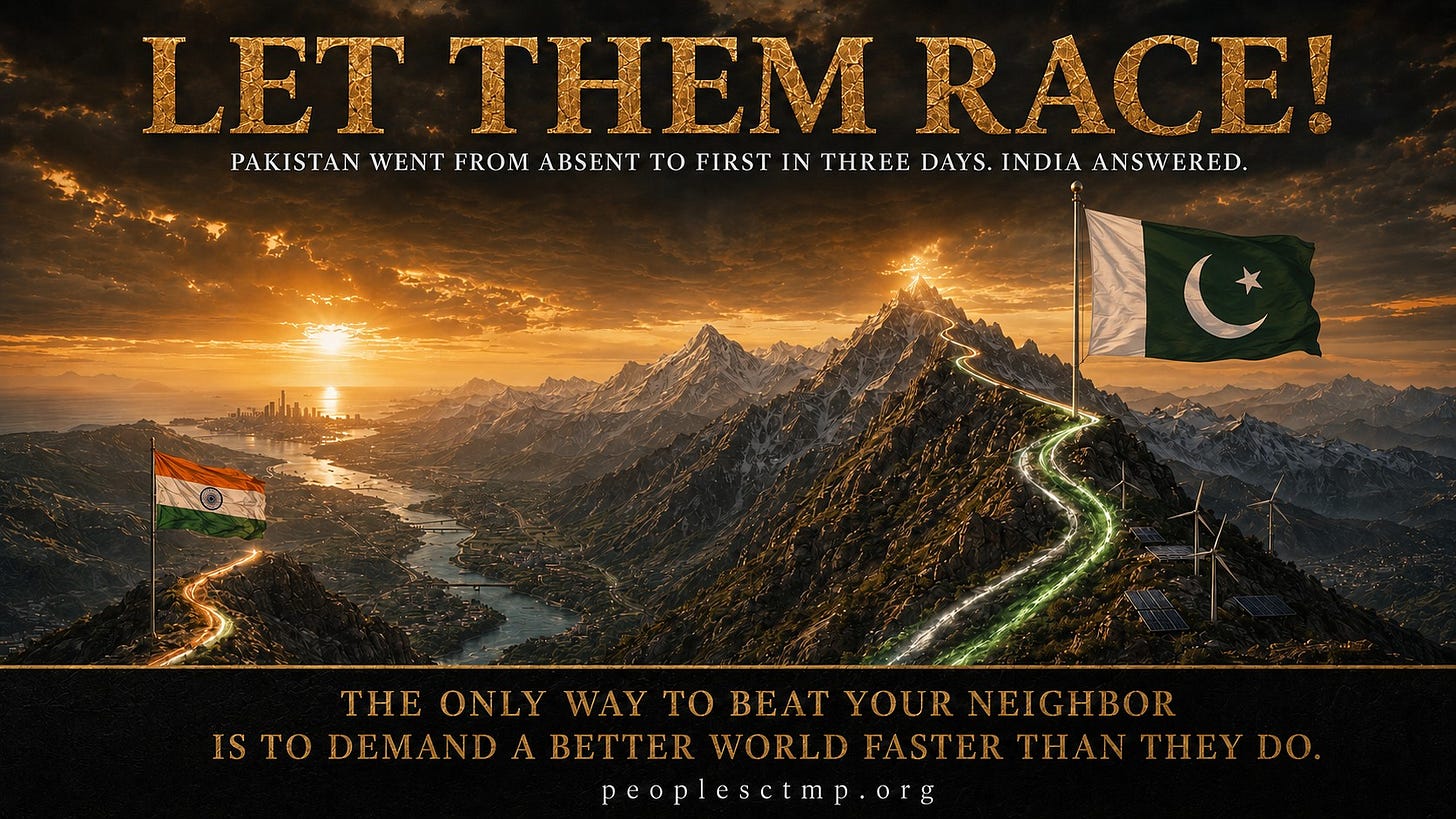
Pakistan was not on The Wall. Then it was the 112th flag to appear. Three days later it was first. This is the story of the fastest ascent in the board’s history, the neck and neck race it has ignited with India, and the reasons, written plainly into Pakistan’s own circumstances, why this particular nation moved this particular fast.
PART ONE: THE ASCENT
I. What the board recorded
The facts first, because they are worth stating bare.
Three days ago, Pakistan did not appear on The Wall at all. One hundred and eleven nations had voices on the board. Pakistan had none. Then a first voice appeared, and Pakistan became the 112th country in the race. Within seventy-two hours it had 7,502, and it was not merely on the board. It was first on the board, ahead of every nation on Earth, ahead of the neighbor that had spent weeks climbing to the summit and had held it with the largest mobilization the instrument had ever measured.
And India answered. Yesterday India stood at roughly thirty-four thousand voices. Today it stands at 41,308. In a single day, India added more voices than Pakistan’s entire three-day total, the strongest single day in India’s entire climb, delivered not at the beginning of its campaign but in response to losing the lead.
Sit with the arithmetic of that exchange, because it explains everything about how this board works. India added seven thousand voices in a day and Pakistan, with barely more than that in total, holds first place anyway. That is not a glitch. That is the rule doing precisely what it was built to do. Every nation climbs its own mountain, set at five percent of its own population. India’s mountain is seventy-two million. Pakistan’s mountain is roughly twelve million, five percent of some two hundred and forty million people. The board measures each nation’s progress up its own slope, and by that measure, the only honest measure that lets a country of five million race a country of a billion, Pakistan’s 7,502 stands fractionally higher on its mountain than India’s 41,308 stands on its own.
Neck and neck is the precise term. Two nations, separated by hundredths of a percent, trading the summit of a board that 110 other countries are climbing, with the two largest mobilizations in the instrument’s history now running simultaneously, against each other, in public, in real time.
The board has never seen anything like this. And the board was built in the certainty that one day it would.
II. How something spreads when nothing pushes it
Now the question everyone asks first: how. How does a nation go from absent to first in three days when nothing was advertised, nothing was purchased, and nobody was paid?
We can answer part of that with certainty, because the certainty is structural. We run no campaigns in Pakistan. We have no office there, no partner there, no budget there, no press apparatus anywhere. The Wall collects no accounts, no names, no emails, so there is no list to seed, no audience to target, no algorithm to buy. Whatever carried this signal into Pakistan, it was not us, because we own nothing capable of carrying it.
What remains, once every purchased channel is eliminated, is the oldest propagation network in human history: people telling people. And Pakistan is one of the most densely networked societies on Earth for exactly this kind of transmission. Nine million or more Pakistanis live and work abroad, across the Gulf, Britain, North America, and beyond, sending home on the order of thirty billion dollars a year, which means tens of millions of daily conversations already flow between Pakistan and the rest of the world through kitchen tables, job sites, and phone screens. A signal that reaches the diaspora reaches the nation by nightfall. And the signal had been getting louder next door for weeks: India’s climb to first place was, by its final days, the largest demonstration of public demand the board had ever recorded, unfolding in the feeds and family group chats of a subcontinent where India’s news is Pakistan’s news within the hour, and always has been.
So the honest reconstruction is simple, and it needs no conspiracy and no marketing genius. For weeks, the most watched race on the board was being run by the neighbor. The neighbor won it. And within seventy-two hours of that victory becoming visible, Pakistan appeared, surged, and took the summit, through nothing but the mechanism the board was designed around: one person who has spoken, standing beside one who has not, for ten seconds, at zero cost, with nothing collected.
There is one more structural reason the surge was even possible, and it deserves to be named because it is a deliberate feature and not luck. On this board, arriving late costs a nation nothing. The rankings do not reward tenure. There is no compounding advantage for early countries, no points for seniority, no penalty for absence. The mountain is the mountain, whether a nation starts climbing on day one or day four hundred. The instant Pakistan’s first voice appeared, Pakistan’s race began at full standing, against its own five percent, on equal terms with every flag that had been on the board for a year. An instrument that punished latecomers would have told Pakistan it had already lost. This instrument told Pakistan the summit was three days away, and Pakistan took it at its word.
III. The rivalry, converted
And then there is the engine underneath the surge, the one every South Asian reader identified before finishing the first paragraph.
India and Pakistan compete. It is one of the defining facts of the modern world. When these two nations meet at cricket, more human beings watch than watch any other sporting event on the planet. The rivalry runs through partition and war, through science and cinema, through every arena either nation has ever entered. It is, by any measure, among the most powerful competitive energies on Earth, and for seventy-eight years, nearly every channel it has flowed through has been zero sum: for one to rise, the other must fall.
Look carefully at what it is flowing through now.
Pakistan taking first place did not diminish India’s position by one voice. India’s forty-one thousand stand exactly where they stood, every one of them permanent, every one of them still climbing India’s own mountain. India’s ferocious answer, seven thousand voices in a day, did not remove Pakistan from the board or slow its count. Each nation’s surge builds its own case for its own review of its own deployment, and the other’s surge takes nothing from it. The two largest mobilizations in the board’s history are now feeding each other, each side’s intensity recruiting the other side’s next voice, and the sum of the contest is not zero. The sum of the contest is the two fastest-growing demands for clean power and clean water ever recorded, side by side, on the same instrument.
This is, as far as we can tell, the first India-Pakistan race in history in which neither side can lose anything. The rivalry has finally found a channel shaped like a ratchet instead of a seesaw. Let them race. The board was built to hold it, and the region they share is the one place on Earth where both of them winning would matter most.
And before leaving the ascent, look once at its arithmetic, because the speed itself is a signature. Zero to 7,502 in seventy-two hours means Pakistan’s count, on average, multiplied hour over hour from the moment the first voice appeared, the purest exponential opening any nation has yet printed on this board. Readers of these dispatches have seen the doubling arithmetic before: Mexico’s summit sits twelve doublings from where its surge began, India’s roughly the same from its current count. Pakistan, three days old on the board, already stands fewer than eleven doublings from its twelve million, which means that in seventy-two hours of pure word of mouth, with no presence, no spend, and no push, Pakistan closed the same share of its mountain that other nations took weeks to close. Curves that open like that are not reacting to information. They are releasing pressure that was already there. The remainder of this article is about the pressure.
That is the ascent. Now the deeper half of the story: why Pakistan, specifically, moved at a speed no nation had moved before. Because a signal only propagates this fast through a population that was already primed to receive it, and Pakistan, on the plain evidence of its own daily life, may be the most primed nation on the board.
PART TWO: THE WHY
IV. What electricity costs in Pakistan
Begin where every Pakistani household begins: the bill.
Pakistan’s power sector is carrying one of the heaviest burdens in the developing world. The system’s circular debt, the unpaid gap that cycles between fuel suppliers, generators and distributors, is measured in the trillions of rupees. A large share of generation runs on imported fuel, liquefied natural gas and coal and oil purchased in dollars, which means every slide in the rupee lands directly on the meter. Layered on top are capacity payments, under which consumers pay for power plants whether or not those plants generate, a structure that in recent years has had households effectively billing themselves for idle machinery. Tariffs have been raised again and again under successive stabilization programs, and in the summer of 2023 electricity bills grew so heavy that people carried them into the streets in protest, in city after city, in one of the most widespread demonstrations of bill pain any country has seen. Behind the prices stands the older companion, load shedding, the scheduled darkness that two generations of Pakistanis have organized their days around.
Hold that lived reality against two numbers from this platform’s Charter. The posted external tariff is 2.5 cents per kilowatt hour, fixed as a system constraint that no operator has the authority to raise. The all-in ceiling on an end user’s bill for anything carrying the platform’s verification mark is five cents. Not an introductory rate. Not a subsidy waiting for a budget crisis to remove it. A constitutional constant of the machine, published before the machine is built, precisely so that no future negotiation can touch it.
For a household in Lahore or Karachi that has watched its tariff multiply within a few years, the proposition is not abstract. It is a bill cut to a fraction of what arrives today, denominated in a price that cannot move, generated without a single dollar of imported fuel, from a source no exchange rate can reach. The cost of energy, reduced by a massive margin, is not this platform’s slogan for Pakistan. It is the platform’s opening sentence, and Pakistan may be the country on Earth best equipped to understand it on first reading.
V. The quantity: one module against one country
The price is half the story. The other half is a number that changes what Pakistan is.
Pakistan’s entire electricity system, every plant of every kind, generates well under two hundred terawatt hours in a year. A single CTMP module is engineered to deliver approximately 2,500 terawatt hours annually, firm, carbon free, more than 93 percent of all hours.
One module is roughly fifteen times Pakistan’s entire current generation.
Read that again, slowly, in Pakistani terms. It does not mean the end of load shedding; load shedding stops being a concept that requires a word. It does not mean meeting demand; it means demand, all of it, national, industrial, agricultural, residential, met about fifteen times over, with the surplus standing by. And a surplus of that scale is not waste. It is an export economy waiting for wires and ships. Power with a lot to spare becomes electricity sold to every neighbor with a grid. It becomes green hydrogen and ammonia and methanol, molecules the whole world is committing to buy, manufactured at a plant gate cost no fuel-importing competitor can approach. It becomes green steel, energized fertilizer for Pakistan’s own farms in place of imported urea, wafer lines and compute districts drawing power at a price no commercial operator anywhere will ever see. Pakistan currently spends a punishing share of its foreign exchange importing energy. The module inverts the flow. The country that pays in dollars for every unit it burns becomes a country that is paid in dollars for the units it has to spare.
Nations have reorganized their entire histories around smaller inversions than that.
And one Pakistani reader in particular will feel the inversion before anyone else: the one who manages natural gas. Pakistan runs one of the crueler resource triages on Earth, every winter, largely out of public view. The country’s gas fields are declining, and the gas that remains must be split between three claimants that each call themselves essential and are each correct: the power plants that keep the lights on, the fertilizer plants that make the urea that grows the nation’s food, and the homes that cook and heat with it. In hard winters, someone loses. Fertilizer plants idle so stoves can burn, or power plants sputter so fertilizer can flow, and in shortage years the country imports urea at world prices to fill the gap its own triage created. It is a zero sum contest between eating, heating and lighting, refereed annually, in scarcity.
The module dissolves the referee’s job entirely. Electricity stops drawing on gas at all, releasing that share instantly. The molecules vertical then manufactures hydrogen and ammonia, the parent of urea, from electricity and water at a plant gate cost of roughly 204 dollars per tonne of ammonia, beneath any gas-based producer’s floor, in any quantity Pakistani agriculture can absorb, with the surplus exportable to a fertilizer-hungry world. The gas that remains underground becomes what a wealthy country’s reserves are: an option, not a lifeline. A nation that has spent decades choosing every winter between its stoves, its harvests and its lights will not need the significance of that explained. It is the end of the choosing.
VI. The water
If the energy argument is powerful in Pakistan, the water argument is personal.
At independence, Pakistan held more than five thousand cubic meters of fresh water per person per year. Today it stands near one thousand, the internationally recognized scarcity line, among the most water-stressed major nations on Earth. The country’s life runs overwhelmingly through a single river system, the Indus, on which the world’s largest contiguous irrigation network and most of the nation’s food depend. Beneath the cities, aquifers fall year on year. And the sky has become an unreliable partner in both directions: the floods of 2022 put vast stretches of the country underwater and upended the lives of over thirty million people, while the droughts between such years scorch the same fields the floods had drowned. Too much water, then too little, and never enough of the kind you can drink.
The platform’s design speaks into that reality with one clause: each module gifts 2 billion cubic meters of potable water per year to its host nation. Gifted, as a Charter obligation, at essential-use pricing of zero. At fifty liters per person per day, that is clean drinking water for roughly one hundred million people, nearly half of Pakistan, drawn from the one source that no drought can empty and no upstream event can touch, the Arabian Sea, purified by the one input the module makes nearly free. The economics carry themselves: the concentrated brine, refined rather than dumped, yields salts, magnesium, potash and bromine at an indicated value of thirty billion dollars per module year, so the mercy is funded by the waste stream of its own process. For a nation whose water anxiety is upstream, seasonal, and existential, the significance of a permanent, sea-fed, charter-bound source of drinking water requires no elaboration. Every Pakistani already knows what it means. That knowledge is very likely part of why three days was enough.
VII. The jobs, and who they are for
Pakistan is one of the youngest large nations on Earth. Around two thirds of its people are under thirty. On the order of two million new workers enter its labor force every year, and for decades the country’s answer has been partly to export them: Pakistani labor helped raise the skylines of the Gulf, and the remittances those workers send home, roughly thirty billion dollars a year, stand among the pillars of the national economy. The skills are proven. The work ethic is proven, on other nations’ monuments. What Pakistan has never had is a project on its own horizon sized to employ that capability at home.
Now read the platform’s consolidated workforce assessment, built from seventeen controlled vertical models. In its first operating year, one deployment requires 25,900,911 construction job years and a standing recurring workforce of 3,016,889 full time positions, of which roughly one million are industrial and technical payroll, plants, ports, fabs, grids, and nearly two million are the civic and service economy of the first city the architecture builds and sustains: teachers, nurses, physicians, safety workers, administrators, for a resident population of nine million in Year 1 on a path the models carry to over 140 million by Year 30. The complete standing requirement compounds to 47 million positions by Year 30, with annual construction ending higher than it began. These are not gig positions. A recurring position is a wage ladder, a portable credential, a training academy behind it, and worker housing built as first-mile infrastructure, with wage floors and fatigue rules verified in the platform’s registry rather than promised in a brochure.
And the wages are where the money goes by design. More than half of every revenue dollar the platform earns is retained and reinvested rather than distributed, and the majority of that reinvested flow is payroll: the wages of the millions who operate, teach, heal, build and expand the body. There are no shareholders positioned between the surplus and the workforce, because the Charter forbids the pipe through which surplus normally leaves. For a nation of two million new workers a year, sitting beside the largest labor mobilization ever specified on paper, in a region that holds the only labor pools on Earth deep enough to answer it, the employment chapter of this platform is not a footnote to the energy chapter. For millions of Pakistani households whose sons and daughters currently board planes to build other countries, it may be the whole book.
One more page of that book deserves turning, because it answers the question Pakistani families ask immediately after the wage question: where would all these people live? Pakistan carries a housing deficit measured in the millions of homes, a gap that grows with every year of urbanization and that no program has yet closed. The platform’s answer is structural rather than promissory: the first city is not an amenity attached to the machine, it is one of the machine’s organs, built from the platform’s own concrete and steel, on the platform’s own rail, with its schools, clinics and hospitals counted as platform payroll from the first morning. Nine million residents housed in Year 1 of a single deployment, with dwellings, transit, education and care delivered as first-mile infrastructure rather than as an afterthought left to markets that have never once, anywhere, housed a workforce of this scale on their own. A country that has watched its cities strain and its housing programs fall short is being shown a design in which the homes are not what the jobs eventually pay for. The homes are part of what the machine builds first, because a workforce is not a logistics problem. It is an organ of the body, and the body houses its own.
VIII. The terms: a country that has read the fine print before
There is a final reason the signal landed fast in Pakistan, and it is the least flattering to the world and the most important to say carefully.
Pakistan has more experience than almost any nation alive with the standard terms on which large help arrives. It has entered more than twenty programs with the International Monetary Fund since independence, each bringing its conditions, its tariff adjustments, its austerity. It has hosted corridor-scale infrastructure built on external financing, and it has learned, in its budgets, what debt-financed development costs across the decades that follow the ribbon cutting. None of that is said with blame toward any lender or any partner; nations do what the available instruments allow. It is said to explain a national instinct: Pakistanis read terms. A population that has watched tariffs rise to service yesterday’s borrowed generation does not ask whether a new machine is impressive. It asks who holds the paper.
This platform’s answer is the strangest answer in infrastructure, and for a terms-reading nation it may be the decisive one. Nobody holds the paper, because no paper exists. The platform is charter-bound to zero debt: no loans, no sovereign guarantees, no liens, nothing for any future crisis to call. The tariff cannot rise, because it is fixed as a system constraint rather than negotiated as a rate. The water cannot be repriced, because it is gifted by obligation. And the enforcement architecture contains no weapon at all: no shutoffs exist in the design, and hospitals, water systems and life-safety loads are never available as bargaining chips, under any circumstances, against anyone. A machine that cannot indebt you, cannot reprice you, and cannot switch you off has removed, structurally, every lever Pakistan’s history has taught it to check for. The governing Charter that locks all of this is, at this writing, in open public revision toward its next edition, its draft published for the world to challenge, its invariants standing outside the amendment process entirely, and the honest boundary alongside it is short: the board is a demand instrument, first place earns the first independent review, and nothing in this architecture has been physically built anywhere yet, with the 50 megawatt proof design-complete and its first construction ahead. That is the whole caveat, and Pakistan’s climbers did not need it whispered. It is printed on every page.
IX. The trajectory
So assemble Pakistan’s position, the way the board’s newest climbers evidently have.
A coastline on the Arabian Sea, the ocean-fed architecture’s native habitat, holding one of the region’s great natural deep-water harbors and a generation of hard-won experience in corridor-scale construction. A location at the hinge of three enormous markets: the Gulf’s energy economy to the west, China and Central Asia to the north, and the subcontinent’s billion-and-a-half consumers to the east. The youngest large workforce on Earth, already proven on the world’s most demanding construction sites, currently exported for lack of a project worthy of it at home. A fifteen-fold energy surplus available from a single module, at a fixed price no rival economy pays, with the excess convertible into the exact exports, electricity, molecules, steel, compute, that the coming half century will bid for most fiercely. Drinking water for half the population, from a source beyond drought. And terms, fixed in charter, that delete the specific failure modes Pakistan’s economic history is made of.
Notice, too, how precisely the platform’s own organs rhyme with ambitions Pakistan has already declared. The second word of this project’s name is Transshipment, and its port vertical is specified at ten million containers a year, a scale of maritime ambition Pakistan announced to the world when it set out to build a deep-water transshipment future at Gwadar. The instinct that the country’s coastline is a hinge of world trade rather than an edge of it is not something this platform needs to sell to Pakistan. Pakistan committed to that instinct years ago; what it has lacked is the energy platform underneath that makes a great port more than a gate. And the region’s electricity geography inverts along the same line. South Asia has spent years engineering corridors to import hydropower southward across difficult terrain, because firm clean power was something the region assumed had to come from somewhere else. A module on the Arabian Sea coast turns the compass around: the corridors fill in the other direction, and the country that planned its future as the last stop on other nations’ power lines becomes the first stop on its own.
Nations are not made superpowers by resources; the last century is a graveyard of resource-rich stagnation. Nations are made by the removal of their binding constraint. Pakistan’s binding constraints, named by every economist who has ever studied it, are energy it cannot afford, water it cannot secure, debt it cannot escape, and a young population it cannot yet employ. Now read the four preceding sections of this article again as a single list. The machine on this board is not incidentally relevant to Pakistan. It is a point-by-point answer to the specific set of shackles, and a population that lives inside those shackles recognized the key faster than any population before it. Three days is not a mystery. Three days is what recognition looks like when it happens to two hundred and forty million people at once.
X. Two flags, one summit, nothing lost
The board tonight shows something no instrument has ever shown: the two halves of the subcontinent, 1.7 billion human beings between them, holding first and second place on a global leaderboard of demand for clean power and clean water, driving each other upward by the hour, in the only contest either has ever entered where the other’s gain costs them nothing.
India’s answer is already underway, seven thousand voices in a day and accelerating, and Pakistan’s lead is as unguarded as every lead on this board: defended by nothing except its people’s continued conviction, exactly as designed. Pakistan stands roughly eleven doublings from its twelve million. India stands roughly eleven from its seventy-two. Both mountains will be climbed the only way any mountain on this board has ever been climbed, one person beside one person, ten seconds at a time, and the summit will change hands again, perhaps tomorrow, perhaps tonight, and the extraordinary thing, the thing worth stopping to see plainly, is that it does not matter which flag is on top when you read this. Every voice either nation adds is permanent. Every voice builds that nation’s own case, on its own mountain, toward its own review. The race between them has no loser, and the pace between them has no precedent, and the two facts share one explanation: for the first time, the subcontinent’s oldest rivalry is being run on an instrument where the only way to beat your neighbor is to demand a better world faster than they do.
Let them race.
MAKE YOUR COUNTRY COUNT.
peoplesctmp.org. No account. No name. No email. Just your country.