Czechia, The Country With No Coastline Just Took First Place
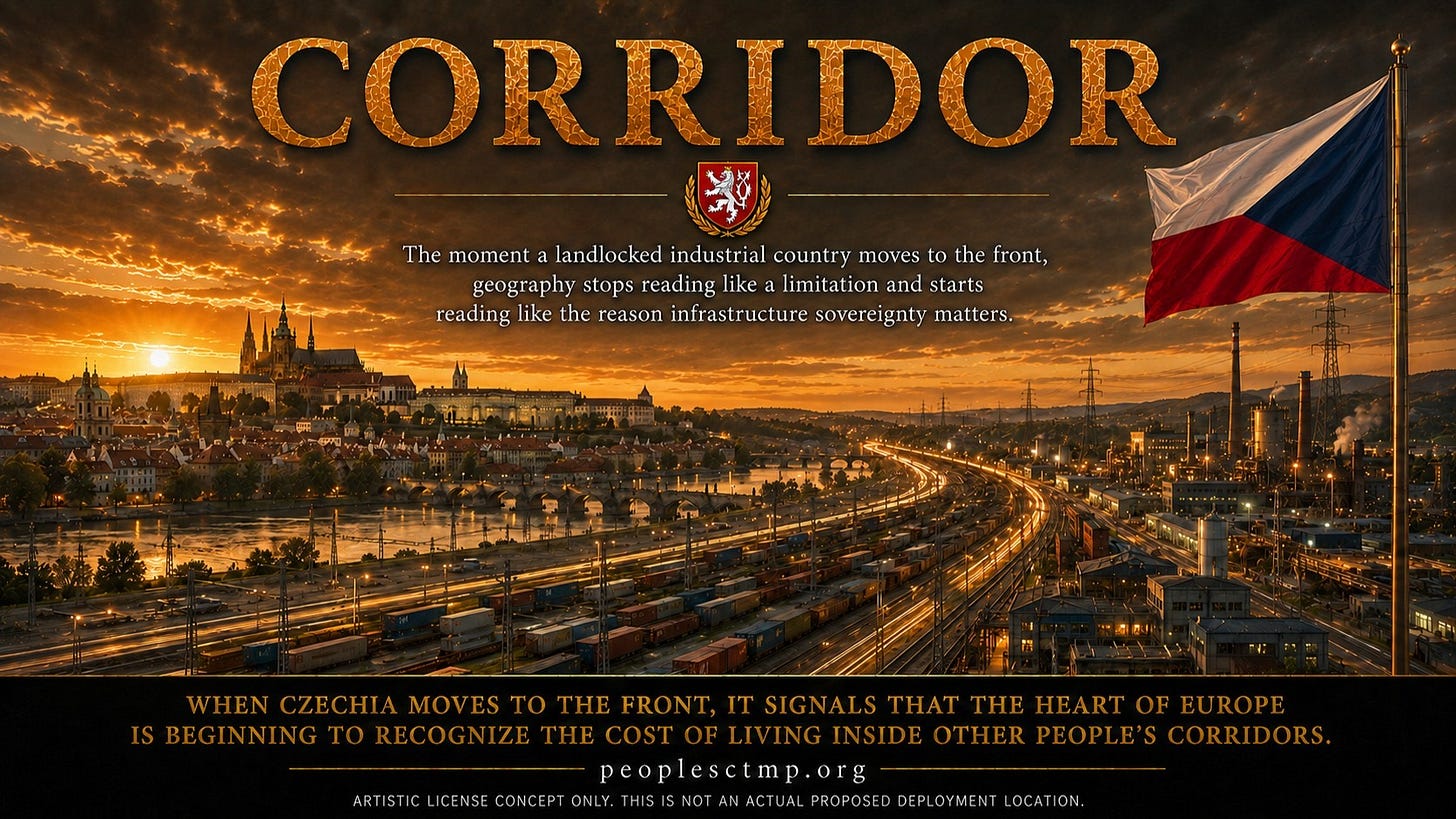
A dispatch from The Wall, on Czechia, on arithmetic, and on what a landlocked industrial nation understands about infrastructure that the rest of the world is still learning.
A country with no coastline is now leading a global race about ocean-fed infrastructure.
If The Wall dealt in irony, that would be the headline. But The Wall does not deal in irony. It deals in arithmetic, and the arithmetic says something far more interesting than irony ever could: the country that best understands what CTMP is for might be a country that cannot see the sea from any point inside its own borders.
This dispatch does what every dispatch does. It records the numbers as the board showed them, explains the mechanics that produced them, and then asks the only question worth asking when a nation takes the front of this race: why this country, and why now?
The answer, in Czechia’s case, runs deeper than a sharing cluster having a good week. It runs through pipelines that cross other people’s territory, through a coal question that has no easy answer, through an export machine that lives and dies on input costs, and through a canal that Czech engineers spent centuries drawing and never got to dig.
Start with the numbers, because the numbers always come first.
The arithmetic of first place
At the moment this dispatch was written, the board recorded 521 voices for Czechia. Czechia’s population is 10,909,500, which sets its finish line, five percent of its own people, at approximately 545,475 voices. That puts Czechia at 0.0955 percent of the way up its own mountain.
Point zero nine five five percent. And that is first place on Earth.
Here is what the leaders looked like, measured the way The Wall actually measures:
Czechia: 521 voices recorded, roughly 47.8 voices per million residents. Mozambique: 1,461 voices, roughly 43.0 per million. India: 61,037 voices, roughly 42.4 per million. Pakistan: 9,786 voices, roughly 40.8 per million.
Read that list twice, because it contains the entire design of The Wall in four lines. India holds more than one hundred and seventeen times as many raw voices as Czechia. India is not in first place. Mozambique holds nearly three times as many. Mozambique is not in first place. Because every nation’s requirement is five percent of its own population, the board is effectively ranking countries by voices per capita, and by that measure, the measure that treats a Czech voice and an Indian voice and a Mozambican voice as exactly equal claims on their own nations’ futures, Czechia is ahead.
And the margin that decided it was almost nothing. Not long before this dispatch, Czechia stood at 440 voices and needed only about 29 more to pass Mozambique. It then reached 521, a gain of 81 voices. Eighty-one people. One productive cluster of Czechs, sharing one link through their own networks, was sufficient to carry an entire country past three nations with far larger raw counts and into first place in a global race.
That is not a flaw in the system. That is the system, working exactly as designed, at exactly this early stage of the climb. When every country is below one tenth of one percent of its own requirement, leadership belongs to whoever moves first, and moving first is something 81 determined people can do. Later, when countries are tens of thousands of voices up their mountains, leads will be built by cities. Right now, they are built by group chats. The record will show which countries understood that while it was still true.
The mountain that makes 521 people matter
It is worth pausing on the mechanic itself, because Czechia’s first place is the cleanest demonstration of it the race has yet produced.
The Wall could have ranked countries by raw totals. Almost every global leaderboard does. And if it did, the top of the board would be a permanent portrait of the ten most populous nations, in roughly population order, forever. Every other country on Earth would be mathematically informed, on day one, that its voice was rounding error. A public consent instrument that structurally favors the largest populations is not a consent instrument. It is a census with extra steps.
So The Wall gives every nation its own mountain: five percent of its own population, no more, no less. A country of ten million and a country of a billion climb the same gradient, each theirs. The rankings measure altitude on your own mountain, and only that.
Czechia is what that rule looks like when a smaller nation takes it seriously. Ten million people, a requirement of about 545,475, and a present count of 521, and that is enough for the top of the board, today, because the rule says progress is measured against your own line and Czechia’s progress per resident is currently the best on Earth. No nation is too small to lead. No nation is big enough to coast. The board has now proven both halves of that sentence with live data: India leads on raw count and Czechia leads the race, at the same time, on the same board, with no contradiction anywhere.
For every smaller country watching: this is the proof that the door is open. The requirement scales to you. The question is only whether your networks move.
Who Czechia actually is
Now the deeper question. Why might this country, of all countries, be the one whose networks moved?
Strip away the postcards and look at the machine. Czechia is not primarily a tourism economy or a services economy. It is one of the most intensely industrial, export-dependent economies in Europe. Exports represented approximately 74.8 percent of its GDP in 2025, by the European Commission’s own 2026 country assessment. Three quarters of the economy, earned by selling manufactured things to the rest of the world: machinery, vehicles, steel-intensive goods, chemical products.
An economy like that lives or dies on its input costs. Electricity. Steel. Industrial heat. Hydrogen and chemical feedstocks. Freight. Carbon compliance. Imported materials. Every one of those lines feeds directly into whether a Czech factory’s quote beats a competitor’s quote, and every one of those lines has been moving against Central European industry for years.
And underneath the export machine sits the coal question. Coal still supplies approximately 28 percent of Czechia’s total energy while accounting for roughly 59 percent of its fuel-combustion emissions, and the OECD’s assessment of the country describes the predicament plainly: the coal must go, and the industrial employment and export competitiveness must stay. The International Energy Agency adds that Czech energy and carbon intensity remain above the average of its member countries, even as the country works to phase out coal and expand nuclear generation.
Put it in one sentence, because Czech readers already carry this sentence around with them: how does an industrial country remove its coal without making its factories, its steel, its machinery, and its exports uncompetitive?
That question does not have a comfortable answer inside the current menu of options. Which is precisely why a different menu got 521 people’s attention.
What CTMP reads like from Prague, Brno, and Ostrava
Here is what I have come to understand from watching which countries surge and when: different nations read the same project and see different documents.
A drought-stressed country reads CTMP and sees the water: two billion cubic meters per year, given to the host nation, not sold. A load-shedding country reads it and sees the firm power. A debt-burdened country reads it and sees the zero: no banks, no bonds, no interest running while you build, a rule written permanently into the Charter.
An industrial exporter with a coal problem reads the same pages and sees something else entirely. It sees an industrial-survival architecture.
Look at the platform through Czech eyes, vertical by vertical. Electricity at a posted, fixed price of two and a half cents per kilowatt-hour, capped by Charter at five cents all-in for verified products, a design value on paper and labeled that way, but a design value that would transform every cost line a Czech factory has. Green steel, made with clean power instead of coking coal, for an economy whose exports are steel-hungry. Green hydrogen and chemical feedstocks, the inputs of the next industrial era, priced from the same cheap electrons. Concrete at platform cost. And around all of it, the architecture that makes the numbers possible in the first place: one platform that builds its own machines, makes its own materials, generates its own power, and buys almost nothing from outside, because every outside purchase adds a markup and a waiting line, and markups and waiting lines are what kill giant projects. Nine out of ten of them, according to the largest academic database of megaprojects ever assembled.
A Czech industrialist does not need that explained twice. Czech industry has spent a century watching what supply chains do to the people at the end of them. A project whose entire design is the refusal to stand at the end of anyone’s supply chain reads, in Czechia, less like an environmental campaign and more like a national strategy document someone finally wrote down.
The corridor condition
And then there is the fact of the map itself, which I said at the start might be the reason for Czech leadership rather than the irony of it.
Czechia is landlocked. Landlocked does not mean isolated; Czechia is connected to the entire planet. It means something more precise and more permanent: every physical connection to that planet passes through somebody else’s territory. The petroleum arrives through foreign pipelines. The gas arrives through foreign pipelines. Trade reaches the sea through German and Polish and other European ports, over cross-border rail and highways, under transit agreements that Czechia can negotiate but never unilaterally control.
The country just lived a demonstration of what that condition means in practice. Czechia stopped importing Russian oil in 2025, a genuine diversification achievement, and it became possible only after the TAL pipeline from Italy was expanded and connected through Germany. Even the act of reducing one dependency ran through infrastructure crossing two other countries. That is not a criticism of anyone. It is simply the permanent operating condition of a landlocked industrial state: exposure to corridors, neighbours, and other people’s infrastructure decisions, forever, as a baseline fact of national life.
Now consider what class of vulnerability CTMP is explicitly designed to reduce. Dependence on external suppliers. Dependence on external lenders. Dependence on infrastructure someone else owns, prices, and can close. The platform’s answer to all three is the same answer: own the supply chain, refuse the debt, make the parts. A population that has spent its entire national existence mastering the art of depending carefully on other people’s corridors does not need a seminar to grasp why a project would be architected to need none.
The people of a landlocked country understand infrastructure sovereignty the way people who grew up thirsty understand water. Not abstractly. In their bones.
The canal they never got to dig
There is one more thread in Czech history that this project touches, and it is impossible to look at the board and not notice it.
The platform’s name begins with the words Canal and Transshipment. And Czechia is a country that spent centuries returning, generation after generation, to one recurring engineering dream: the Danube-Oder-Elbe water corridor, a canal system that would have connected Czech territory toward the North Sea, the Baltic, and the Danube basin. Emperors considered versions of it. Engineers of the First Republic drew it. Planners of every subsequent era revisited it. The modern proposal was finally terminated by the Czech government in 2023, after one more national round of asking whether the old dream could be made to pay.
Nobody should claim that the 521 people on the board were thinking about a cancelled canal when they added their voices. There is no evidence of that, and this record does not print claims without evidence. What the canal history demonstrates is something quieter and older: the strategic problem of being an industrial economy without direct access to the sea is woven into Czech infrastructure thinking at the level of national memory. For three hundred years, the question “how does this country connect itself to the world’s water on its own terms” has kept returning to Czech drawing boards, and for three hundred years the answer has been: not yet, not affordably, not alone.
Then a public board appears, attached to an integrated platform of energy, industrial production, and transformative transport infrastructure, and it asks every country the same question: do your people want a different infrastructure future? A proposition like that can land on an old national constraint even when no individual participant articulates the whole systems logic. Sometimes a country’s history answers before its commentators do.
The honest paragraph
Every dispatch carries one, and this one carries it in plain view, because Czech readers deserve the same precision the rest of the record gets.
First place on The Wall earns a country priority in the review process. It does not manufacture a coastline. If the canonical 300 gigawatt module requires marine intake and discharge, that exact configuration does not fit inside Czech borders, and a Czech first review would examine what does: a cross-border arrangement with a coastal partner, a remotely sited module delivering power home through high-voltage transmission and industrial corridors, a regional Central European structure, or an honest engineering finding about what Czech territory can and cannot host. The public chooses who is reviewed first. Engineers determine what can be built. Both of those sentences are load-bearing, and neither cancels the other.
And the standing disclosure, printed in every dispatch because it is true in every dispatch: nothing has been physically built. The 50 megawatt proof-of-concept is complete in design, and its first physical construction is the next milestone before any scaling toward a full module. Every figure in this article that describes the platform, the tariff, the water, the timeline, is a design value from published documents, labeled as such on the record, and the record itself, hashed, signed, dated, and versioned, lives at exactly one address. What Czechia has won is a place at the front of the queue of nations whose people have started saying, in public, that they want this reviewed. At this stage of the project, that is precisely what there is to win, and 521 people just showed how little it costs to win it.
The race as it stands
Now widen the lens, because Czechia’s climb rearranges the whole board’s story.
India still holds the largest raw count on Earth, 61,037 voices, a number that represents more human beings than most countries’ entire movements. Pakistan holds 9,786 and has led the percentage race before; the rivalry between those two nations, the first in their shared history where both sides build rather than destroy, is still the deepest storyline this board has produced. Mozambique’s 1,461 voices carried it to the front of the race and held it there until this week. None of that is diminished by Czechia’s lead. It is what Czechia’s lead is made of: a race real enough that holding first place requires continuing to climb.
And the margins remain razor thin, which is the part every reader in every country should sit with. The gap between first and second place on this board is currently measured in a few voices per million residents. Czechia passed Mozambique on a swing of dozens of voices. Whatever country you are reading this from, the arithmetic is nearly certain to be the same: a single afternoon of one determined network, one workplace, one campus, one extended family group chat, is enough to move your nation multiple places on a global leaderboard. That will not stay true forever. It is true now. The countries that understand the value of an early lead are the ones taking turns at the front of the board while everyone else waits to be convinced.
The board does not wait with them. It just counts.
What a Czech voice did, and what yours does
Here is the full accounting of what one of those 521 Czech voices accomplished, so there is no mystery about what is being asked of you.
It took about ten seconds. It cost nothing. It asked for no account, no name, no email. It moved a public number up by one, permanently, in the open, where every ministry, every journalist, and every neighbour can see it. Multiplied by 520 others, it put a nation of ten million at the front of a race being watched in more than a hundred countries, and it did so under a rule published in advance that guarantees the same opportunity to every other nation on Earth.
That is the entire transaction. No reward, no coupon, no mailing list. One voice, one country, one climb.
If you are Czech: your country is on top of the world today, at less than one tenth of one percent of its own mountain. The lead was built by 81 people in a single push. It can be extended the same way, and it can be lost the same way. Both of those facts are now yours to act on.
If you are anywhere else: a country of ten million just showed you the price of first place at this stage of the race. Your country’s mountain is waiting, sized exactly to your population, exactly as fair as Czechia’s. Nobody is coming to climb it for you.
And to whoever lit the Czech flame, the person or handful of people whose sharing carried 81 voices onto the board in one surge: the record sees what you did, even though it will never know your name. That is the whole design. Carry the flame one link further. Send the board to one more person who has never seen it. Every country that has ever led this race got there exactly that way: one person who decided their nation should count, and refused to keep the link to themselves.
The board is live. The count is public. Your country is on it, somewhere, right now, at some altitude on its own mountain, and the only number that will ever move it is the next voice.
Add your voice → peoplesctmp.org
MAKE YOUR COUNTRY COUNT.
No account. No name. No email. Just your country.