Eight Hours and Five Minutes
Why Ecuador moved, what the CTMP actually is, and why the same idea is crossing borders
14 August 2026
Chris Coode, Founder and CEO, HLX Inc. · peoplesctmp.org
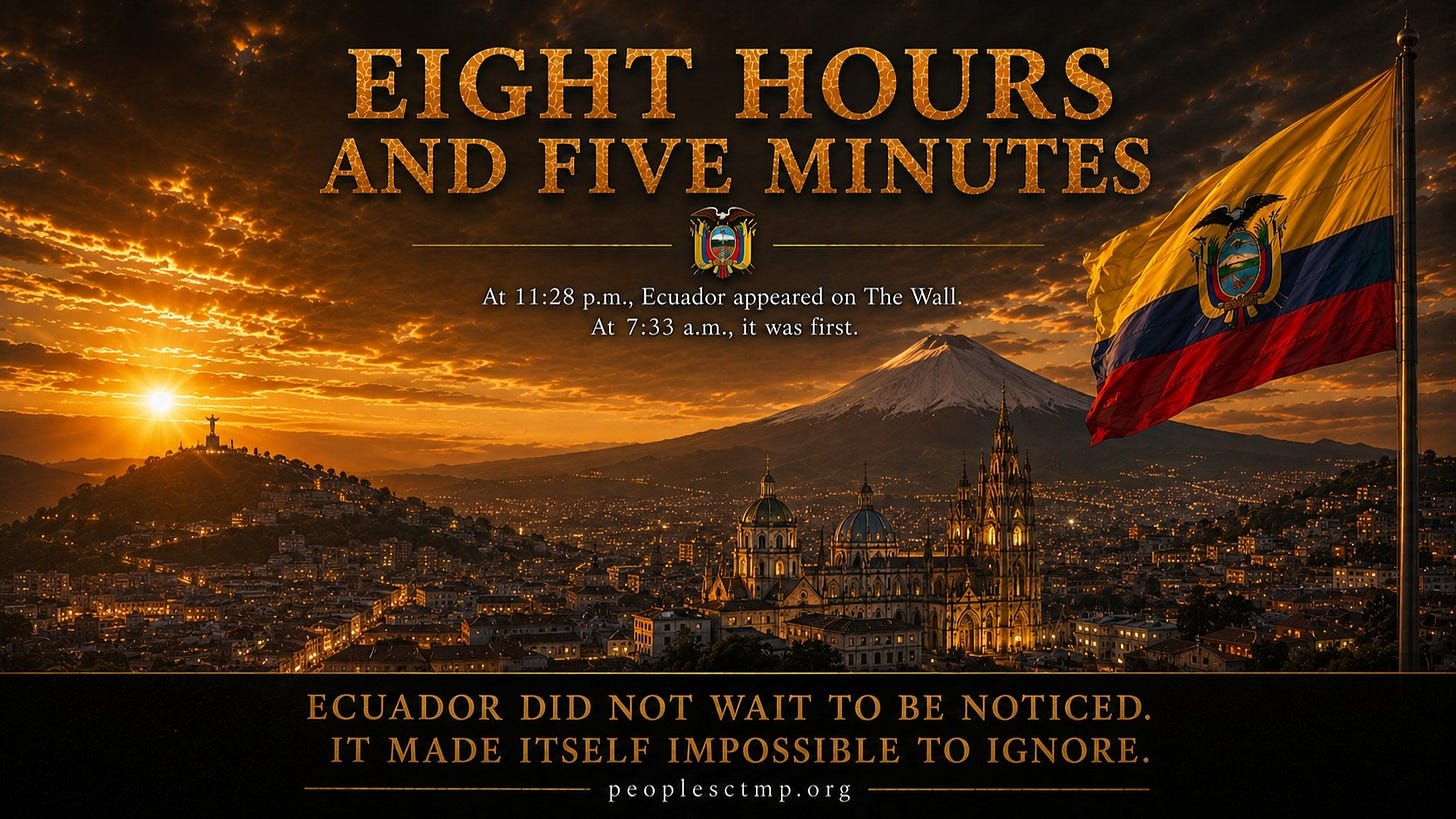
At 11:28 p.m. Ecuador time, Ecuador appeared on The Wall.
At 7:33 the next morning, it was first.
Eight hours and five minutes.
Yesterday, Ecuador had no visible place in this race. Most people looking at the board would have assumed that meant Ecuador was not interested. Then one link reached one person. That person passed it to another. Before breakfast, 1,444 voices had carried Ecuador past every eligible country on The Wall.
India had 81,160 voices at the same moment. Ecuador did not pretend that 1,444 was larger than 81,160. The Wall ranks each country by how far it has moved toward its own required count. India’s required count is 72 million. Ecuador’s is 910,000. The board was not saying Ecuador had more people behind it. It was saying Ecuador had moved farther toward its own line.
By then, The Wall carried 146,302 voices across 119 countries. Ecuador was not an isolated curiosity. It was the sharpest edge of something already moving across the planet.
That distinction gave Ecuador a fair race. It did not hand Ecuador the lead. People still had to move the country there.
This article is not really about a ranking. It is about why a link that asks for no name, no account and no email could move through a country that quickly. It is about what people may be recognizing inside the CTMP, often before they could explain the entire machine themselves.
It is also about why the same recognition is now appearing in countries that share no border, language, religion or politics.
What the CTMP is when the numbers are removed
If I begin by telling an ordinary person that the CTMP is a 300 GW firm renewable energy architecture, I have already made the idea smaller than it is.
Three hundred gigawatts is an engineering scale. It is not a human meaning.
The human meaning begins with a simple question: what becomes possible when a country has enormous amounts of dependable energy at a price low enough that energy stops deciding who gets to live well and who does not?
A mother does not experience electricity as a grid model. She experiences it as food staying cold, clean water reaching the tap and a home that does not disappear into darkness for half the day. A farmer experiences it as irrigation, fertilizer, refrigeration and a crop that reaches market before it spoils. A young engineer experiences it as the difference between building serious machinery at home and buying a plane ticket because the serious work exists somewhere else.
That is where the CTMP begins.
Energy is the engine, but energy is not the destination.
The platform is designed to turn firm renewable power into the things a modern country repeatedly pays too much to obtain: freshwater, steel, concrete, fertilizer, clean fuels, turbines, tunnel-boring machines, transmission, ports, industrial computing and the infrastructure required to build more infrastructure.
Those are not separate projects standing beside one another for effect. They are meant to feed one another.
Low-cost power produces water and industrial heat. Power and water support steel, concrete, food production and manufacturing. Steel and concrete build the tunnels, factories, ports and transmission systems. The factories build turbines and boring machines. Fertilizer supports agriculture. Clean fuels support shipping and industry. Ports move what the country produces. Revenue is reinvested into the next piece of capacity.
The output of one part becomes the input of another.
That is the central idea.
Most infrastructure projects buy their critical inputs from somebody else. Every supplier adds a margin. Every border adds delay. Every shortage becomes leverage in someone else’s hands. The CTMP is designed to own enough of its own supply chain that the platform can keep lowering the cost of building itself.
It is not merely a power plant.
It is a machine for giving a country the ability to build.
The public model targets electricity delivered at 2.5 US cents per kilowatt-hour, with a 5 cent ceiling. At full module scale, the design includes approximately 2.5 billion cubic metres of freshwater every year. Those are design claims. I will not turn them into operating facts by changing the tense of a sentence. The 50 MW proof of concept is designed, but it still has to be physically built, operated and metered. The 300 GW architecture remains design-stage.
But people do not need me to pretend the machine already exists in order to understand what it would mean if the proof confirms the design.
They already know what the absence costs them.
Ecuador knows what the absence costs
In 2024, Ecuador lived through power cuts lasting as long as fourteen hours a day. Severe drought struck a system in which hydropower supplies more than 70 percent of electricity generation, according to the International Energy Agency. When the water fell, much of the country’s day disappeared with it.
Fourteen hours is not an energy statistic.
It is a freezer warming while the food inside it dies. It is a baker standing in front of an oven that cannot work. It is a welder beside tools that have become expensive metal. It is a shop closing before the customers arrive. It is homework under the light of a phone until the phone dies too.
Someone who has lived through that does not hear “firm power” the way a consultant hears it.
They hear the day being returned.
That does not prove why any one of Ecuador’s 1,444 voices appeared. The Wall does not collect an explanation, and I will not invent one. It does show why the proposition could land inside real human experience rather than remain trapped inside an engineering document.
Ecuador also understands the difference between possessing resources and possessing systems.
The country has water, yet safely managed sanitation reached only 49 percent of the population in 2024, according to the World Bank. Ecuador has workers, yet the country’s own statistics agency reported that 52.8 percent of employed people were working in the informal sector in May 2026. In rural areas, the figure reached 76 percent.
That is not a shortage of effort.
It is a shortage of industrial ground solid enough for effort to stand on.
The mechanic is already working. The farmer is already taking the risk. The driver is already moving the goods. The fisher is already racing the clock to protect the catch. The woman who began producing before sunrise is already doing everything human effort can do.
What is missing is the floor beneath them: dependable energy, water, machinery, formal demand, logistics, contracts, technical pathways and an industrial system that lets one generation’s work become the next generation’s capacity.
The CTMP does not offer Ecuador rescue from the outside. Ecuador does not need to be rescued into productivity.
Ecuador already feeds and supplies the world.
The Central Bank of Ecuador reported strong 2025 growth in exports including shrimp, cocoa, bananas, canned fish and mining products. Agriculture and food manufacturing expanded sharply. Ecuador already knows how to produce things the world wants.
The question is how much of the next layer can remain in Ecuador.
Shrimp needs a cold chain that never blinks. Cocoa becomes more valuable when it is processed before it leaves. Bananas do not wait for a congested road. Farmers cannot control global prices, but lower-cost fertilizer, water and logistics can change the cost beneath every harvest. Manufacturers cannot build serious capacity around electricity that may disappear for most of a working day.
Guayaquil handles about 90 percent of Ecuador’s containers, while Quito and Guayaquil together generate roughly 45 percent of national GDP, according to a World Bank freight initiative. When that corridor chokes, the damage does not stay at the port. It travels backward through factories, farms, wages, prices and homes.
This is why the CTMP joins power, water, industry and logistics instead of treating each as a separate problem.
A family never experiences them separately.
Neither does a country.
Why the idea crosses borders
Ecuador’s history is its own, but the structure underneath the pressure is not.
In one country, the pain arrives as blackouts. In another, it arrives as a water truck that never comes. Somewhere else, fertilizer is too expensive, young people leave because serious work is unavailable, or a country exports raw value and buys it back after somebody else has captured the processing, technology and profit.
The flags are different. The trap is often the same.
Essential systems are fragmented, expensive and owned by interests that earn more when scarcity survives.
Then infrastructure finally arrives carrying debt, liens, repayment schedules and shareholders. Before the first turbine turns, the future revenue already belongs partly to people who may never live beside the machine. The country receives the asset and the obligation at the same time.
The CTMP core is designed to arrive differently.
No debt. No liens. No stock listing. No conventional external equity claim over the central energy system. Outside investment belongs in ring-fenced businesses around the core, and most free cash flow is designed to return to expansion.
That is not an accounting preference. It changes who the machine must serve.
If the core owes lenders, lenders stand first. If it belongs to shareholders, shareholder return becomes a permanent instruction. If it owes nothing and cannot be sold through a stock market, the energy can serve water, industry, households and expansion without a distant claimant standing between the machine and its purpose.
People do not need to understand every corporate instrument to feel the difference.
Most have spent their lives paying for systems that were allegedly built for them and somehow answer to everybody but them.
The CTMP proposition is that essential capacity should not arrive already owned.
That sentence crosses borders because the experience behind it crosses borders.
So does the deeper promise. A country should not have to remain poor in order for its labour to stay cheap. It should not have to choose between clean energy and affordable energy. It should not export its children because advanced work exists elsewhere. It should not watch its raw materials leave cheaply and return as products it can barely afford.
The platform is designed to break those choices apart.
Cheap and clean. Water and industry. Local work and global trade. Public benefit and financial strength.
Not by wishing the tradeoffs away, but by attacking the cost structure that created them.
That is why someone in Ecuador can see the same underlying possibility as someone in India, Pakistan, Brazil, Czechia, Mozambique or a country that has not yet appeared on the board.
They do not need the same politics.
They need to recognize the same missing future.
Why The Wall asks for almost nothing
The Wall is not a petition.
It does not ask people to join an organization, surrender their identity, write an essay or place their name beneath language they did not choose. It asks for one thing: your country.
No account. No name. No email.
That is not merely about making participation easy. It is about keeping the signal clean.
I did not build The Wall to create a mailing list. I built it so that public interest could become visible before institutions decided whether that interest was convenient. A person does not have to become my follower. They do not have to understand the entire platform. They only have to decide that their country should examine the option.
Then they receive a Flame link and can hand that decision to one other person.
That is how Ecuador moved.
At one captured moment, Ecuador had eight voices and sat at number 64. Roughly an hour later, it had 87 voices and had climbed to number 45. Those 79 additional decisions moved a national flag nineteen places while the people sharing the link could still watch the consequence of what they were doing.
The link stopped carrying only an idea.
It began carrying evidence.
The next person could see that Ecuador was already moving. Their action was small enough to take in thirty seconds, but the result was public and immediate. One more voice could change a count. A few more could change a rank. A sharing chain could move a country while the chain was still alive.
That is not a campaign office directing a population from above.
It is a possibility moving from hand to hand.
I cannot tell you what every person thought when they opened the link. I deliberately denied myself the personal data that would allow me to turn them into profiles. Some may have understood the energy. Some may have understood the water. Some may have seen work for their children. Some may simply have seen Ecuador climbing and decided their country was not stopping on their watch.
They did not need identical reasons.
They only needed one reason strong enough to act.
What Ecuador actually won
First place did not award Ecuador a CTMP module.
It did not select a coastline, approve a site, replace Ecuadorian law or provide permission to build. Geology, seismic and volcanic risk, marine ecology, Indigenous rights, community interests, grid conditions, port access and national approvals would all have to be examined with the seriousness a project of this scale demands.
At 1,444 voices, Ecuador was still 908,556 short of its published required count of 910,000.
A voice on The Wall is not permission to pour concrete.
It is a public demand to stop pretending the option has not been requested for examination.
That is what Ecuador won in eight hours and five minutes: visibility that could no longer be mistaken for silence.
The lead can disappear. Another country may move faster. Another flag may carry the pulse. That is not a failure of Ecuador’s moment. It is the purpose of the instrument.
The board belongs to the people moving it.
Eight hours and five minutes
Yesterday Ecuador was absent.
Not opposed. Not rejected. Absent.
There is a profound difference.
Zero did not mean eighteen million people had examined the CTMP and decided they wanted no part of it. Zero meant the right link had not yet reached the right human network.
Then it did.
At 11:28 p.m., Ecuador became a flag on The Wall.
At 7:33 a.m., it stood ahead of every eligible country on the board.
Eight hours and five minutes did not build a power system. They did not produce a litre of water, one tonne of steel or a single permanent job.
They revealed something that did not exist in public the night before.
Readiness.
Readiness to look at a future in which electricity stays on. Water is not another weapon of scarcity. Work becomes capacity. A country processes more of what it produces. Infrastructure does not arrive pre-owned. The next generation can build serious things without leaving home to matter.
That is what the CTMP is when all the diagrams are put away.
It is an attempt to make those conditions physical.
That is why people from different parts of the world are placing their countries on The Wall. They are not all signing for the same personal reason. They are recognizing different parts of the same machine and different wounds caused by its absence.
Thirty seconds. No account. No name. No email. Just your country.
If your Ecuador voice is already recorded, send your Flame link to one person who may understand what is at stake. If it is not, open Ecuador on The Wall.
At 11:28, Ecuador was a new flag.
At 7:33, the world was chasing it.
The machine is not built yet.
The demand for what it could make possible is becoming impossible to ignore.
Make your country count.