LAOS HAS JUST MADE ITSELF IMPOSSIBLE TO IGNORE
Aug 24, 2026
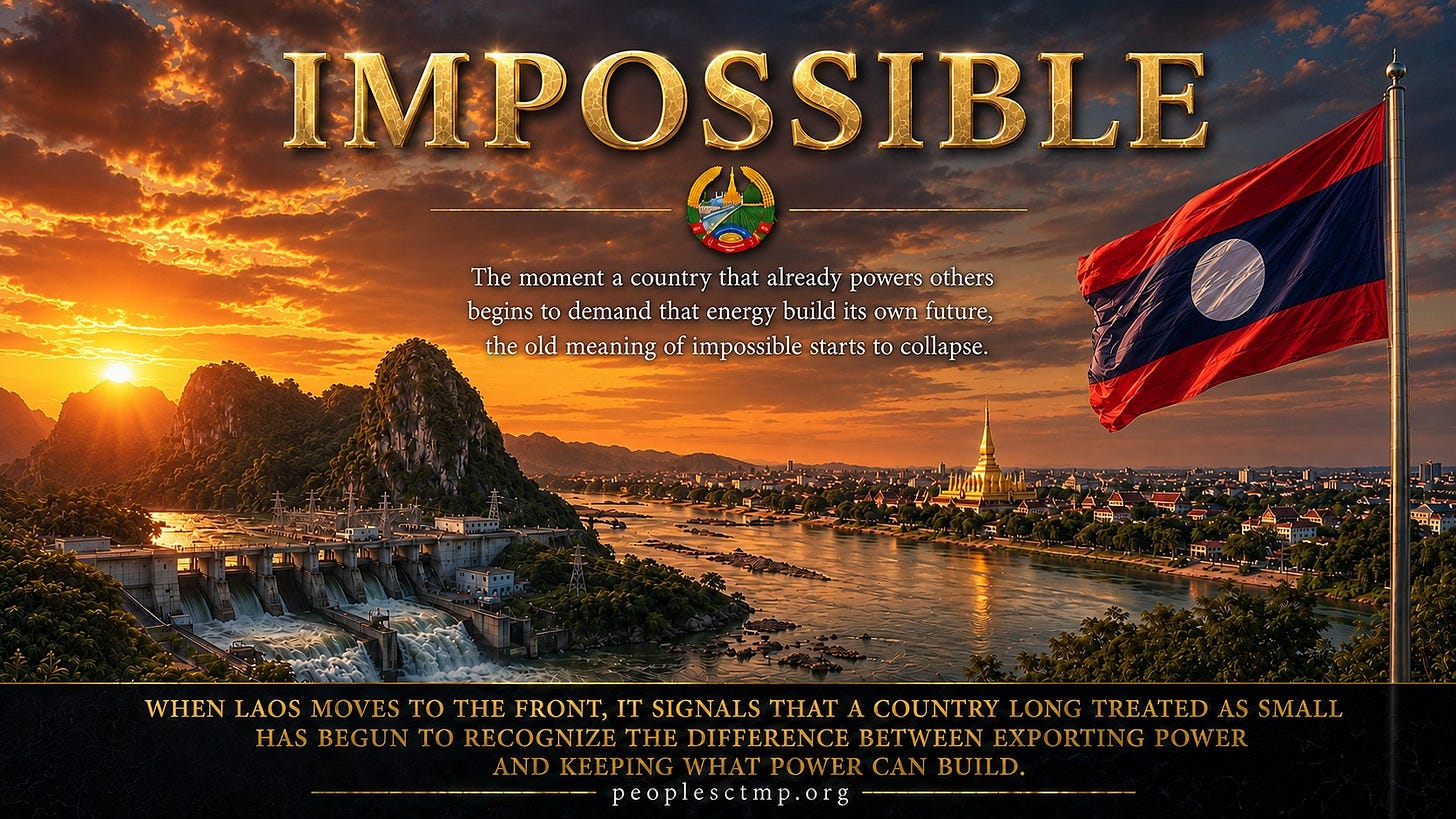
What its sudden rise on The Wall reveals about energy, dignity and the countries the world has trained itself not to see
When I saw Laos near the top of The Wall, I looked twice.
Not because Laos had no reason to be there. Quite the opposite. I looked twice because almost nobody outside the region had been talking about Laos, and then 1,105 Lao voices arrived with enough force to change the race.
For most of the world, Laos rarely arrives first.
It is rarely the first country named in a global energy discussion. It is rarely the first place international media look when they are searching for a story about economic power. It is rarely treated as the country that could alter the direction of anything beyond its own borders.
That number would disappear inside the population of a large city. It would not fill a major stadium. It would barely register in an election held in India, Brazil or the United States.
On The Wall, it changed the race.
Laos suddenly moved into the leading group of countries progressing toward their required count. A country of roughly 7.7 million people stood beside nations with tens or hundreds of millions. It did not get there because the system granted it a ceremonial place. It got there because enough people acted within a short enough period of time to make the rest of the world look.
That is the surface story.
The deeper story is about what happens when people who are accustomed to seeing their country treated as peripheral are given a mechanism through which one small action becomes publicly visible. It is about what energy means inside a country that already generates and exports enormous amounts of it. It is about the difference between national resources and personal prosperity. Most of all, it is about the moment private frustration becomes common knowledge.
Laos climbed a leaderboard. More importantly, it broke the order in which the world expects countries to matter.
The number is small. The meaning is not.
The Wall does not rank countries by raw totals. If it did, the largest populations would dominate permanently and most of the world would be reduced to spectators.
Every participating country instead has a required count based on 5 percent of its population. Countries are ranked by how far they have progressed toward that count. Laos has a required count of 385,000. Its 1,105 recorded voices represent approximately 0.29 percent of the journey to that trigger.
That does not mean 0.29 percent of the Lao population has signed. It means Laos has completed 0.29 percent of the required count that equals 5 percent of its population. The distinction matters because credibility matters. Laos is still a long way from 385,000.
Yet distance from the finish does not make the movement insignificant.
The first thousand voices are often psychologically harder to assemble than the next several thousand. Before a country begins moving, every person looking at an empty or nearly empty count faces the same private question: Am I the only one who sees this?
That question is costly. People hesitate when they believe they may be acting alone. They wait for a neighbour, a friend, a colleague or someone with a larger audience to move first. Everyone can privately want the same thing while publicly appearing to want nothing.
Then the number begins to rise.
At that point, the count stops being merely arithmetic. It becomes evidence. A person arriving from Laos no longer sees an empty space waiting for faith. They see more than a thousand other decisions already made. The next voice is no longer stepping into silence. It is joining something that has become visible.
That is how collective action often begins. Not with universal agreement. Not with a government announcement. Not with permission. It begins when people discover they were never as alone as they had been made to feel.
Laos understands the energy question better than most
To understand why the proposition behind The Wall could resonate in Laos, one has to understand the contradiction at the centre of the country’s modern economy.
Laos is already an energy-producing nation. Hydropower supplies roughly three-quarters of its electricity generation and underpins an export-oriented power sector, according to the International Energy Agency. A 2026 World Bank climate and development assessment reports that approximately four-fifths of installed electricity capacity comes from hydropower and that electricity accounted for 30 percent of the country’s exports in 2023. The World Bank describes an economy in which power generation is not a minor sector. It is one of the country’s defining economic facts.
For decades, Laos has been described as a potential battery for Southeast Asia. Rivers were treated as national assets. Dams, transmission lines and export agreements were presented as pathways to development. Electricity would cross borders. Foreign exchange would return. National growth would follow.
Some of that happened. Electricity access reached 96.5 percent of the population by 2024, an enormous achievement. Power generation expanded. Export revenues grew. Infrastructure connected Laos more deeply to neighbouring economies.
But the experience also taught a harder lesson.
A country can generate electricity without capturing enough of the industries built upon it. It can export power while importing many of the higher-value products that cheap power makes possible. It can possess the resource while jobs, manufacturing depth, technology, financing and ownership accumulate elsewhere. It can become essential to a regional system without ordinary families feeling essential to the decisions governing that system.
This is the difference between an energy project and an energy platform.
An energy project sells electrons. An energy platform uses abundant power as the foundation for everything that follows: water, steel, concrete, transportation, advanced manufacturing, food production, digital infrastructure and employment that does not vanish when construction ends.
That distinction sits at the centre of the People’s CTMP. The proposition is not that another large piece of infrastructure will somehow rescue people from above. The proposition is that renewable energy should become the productive base beneath an integrated economic system, and that the value created around that energy should not be allowed to escape through every available door.
People in Laos do not need an economist to explain why that difference matters. They have lived close enough to the existing model to recognize it.
They know a transmission line can pass through a country without carrying prosperity into every home.
Growth looks different from the kitchen table
Countries are often described through gross domestic product, export receipts and growth projections. Families experience an economy differently.
They experience it at the market when the same money buys less food. They experience it when a child’s schooling becomes an expense that must be reduced. They experience it when medicine is postponed. They experience it when the best available family strategy is for someone to leave.
In January 2025, 30.7 percent of surveyed Lao households reported cutting education spending because of inflation. Another 35.7 percent reported cutting healthcare spending. Among lower-income households, 36.2 percent were experiencing moderate to severe food insecurity. Those figures come from the World Bank’s continuing household welfare monitoring.
Those are not abstract percentages when you are living inside them.
They are a school uniform that has to last another year. A dental problem left alone. A meal made smaller without anyone at the table announcing why. A parent performing the quiet mathematics of which bill can wait and which one cannot.
The country has made real progress in stabilizing its economy. Inflation fell sharply from 26 percent in mid-2024 to 4 percent in October 2025. Growth continued. Government revenues improved. Those gains should be acknowledged because serious analysis does not erase progress to make suffering sound more dramatic.
But stabilization does not restore everything inflation has already taken. Nor does it remove the structural vulnerability. At the end of 2025, public debt remained approximately 82 percent of GDP. The International Monetary Fund continued to identify high external debt, low reserves, limited diversification and vulnerabilities in state-owned enterprises and the financial sector. The IMF’s 2025 consultation was clear that improvement and fragility now exist side by side.
That combination creates a particular psychology.
People hear that the economy is growing, yet they also know what disappeared from their own household. They hear that the country exports energy, yet they watch workers leave to find wages elsewhere. They are not rejecting development. They are asking why development can be so visible in the national statistics and still feel so distant from daily life.
When people leave, they carry more than labour
Migration is one of the clearest expressions of economic pressure because leaving home is rarely a casual calculation.
Lao workers have continued to seek better-paid opportunities abroad, particularly in Thailand. In 2024, the number of registered Lao migrants in Thailand rose as higher wages drew workers across the border. By January 2025, a third of the migrants captured in the latest household survey had left Laos during the previous year alone.
The money sent home matters enormously. In 2024, 8.6 percent of surveyed households received remittances averaging 22.9 million kip annually, an amount equal to roughly 76 percent of the annual minimum wage. These figures were reported in the World Bank’s May 2025 labour-market update.
There is gratitude in that money. There is also separation.
Every remittance may represent someone missing a birthday, a harvest, a funeral or an ordinary Tuesday evening at home. It can represent a young adult building another country’s economy because their own could not yet give their ability enough room. It can represent parents accepting distance because the alternative was not financially survivable.
Laos is exceptionally young. Around 60 percent of its population is under 30, according to UNFPA. That is either an extraordinary national advantage or a narrowing window. A young population can build industries, institutions and a new economic future. It can also leave, one worker at a time, if the future appears more tangible across the border.
This is where the implications of Laos’s rise on The Wall become much larger than 1,105 voices.
The deepest resource in Laos is not water moving through turbines. It is the human capacity of a young country. Electricity matters because of what people can do with it. If power is exported while human potential follows it out of the country, the balance sheet may record revenue while the nation absorbs a loss no spreadsheet can fully capture.
An integrated platform built around abundant renewable power speaks to that loss. It says energy should anchor capability. It should make room for skilled work, industrial learning, domestic supply chains and institutions able to retain value across generations.
That is not a guarantee. It is a direction. But direction matters enormously when the existing path has trained people to expect departure.
The Wall changed the size of a meaningful action
Most global systems reward scale that already exists.
Large economies have larger media markets, larger institutions, larger diplomatic networks and more people able to amplify an idea. Small countries are frequently invited into global conversations after the agenda has been written. They may be consulted, photographed and thanked, but rarely are they allowed to determine where the conversation begins.
The Wall reverses that logic.
India does not win because it has more than a billion people. Laos does not lose because it has fewer than eight million. Each country advances against its own population-based requirement. The unit of power is not absolute size. It is the proportion of people willing to move.
That changes the psychological distance between one person and a national result.
In a conventional global campaign, a Lao participant could reasonably believe their action would vanish. On The Wall, a family gathered around one table can alter the visible position of an entire country. A workplace can do it. A university group can do it. A village network, a diaspora community or a circle of friends can do it.
The action remains small. The evidence of the action does not.
That is one reason Laos may have moved so quickly. The country’s rise is likely the signature of connection. Someone shared the link. Someone else acted. The result was visible. Visibility gave the next person a reason to share again.
It would be easy to call this virality, but that misses the point. Virality spreads content. What happened here began producing coordination.
Approximately 66 percent of people in Laos were using the internet by 2024, according to World Bank data. That is more than enough connectivity for one committed network to cross provinces and borders rapidly. The Wall asks for no account, no name, no email and no payment. It asks for roughly 30 seconds and a choice of country.
The absence of personal recognition is part of its power.
Nobody receives status for being the 1,106th Lao voice. The individual disappears into the count, but the country becomes more visible because they were there. That is a very different social contract from platforms designed to turn every act into personal performance.
On The Wall, there is no profile to polish. There is only the public consequence.
What Laos has done to every other country
Laos has now created a problem for everyone who was waiting.
Before its rise, a person could look at The Wall and tell themselves that global movement required celebrities, institutions, advertising money or a country with a huge online population. Laos has weakened every one of those excuses.
It has shown that a relatively small number of coordinated people can move a country into global view.
That changes what silence means.
Silence once looked neutral. Now it has a rank.
When another country moves, yours can fall even if nobody removes a single voice from it. When a new network awakens in Laos, Tajikistan, Brazil, India or somewhere nobody is watching yet, every country standing still is repositioned by someone else’s decision.
There is no manufactured countdown here. No false claim that the opportunity disappears at midnight. The urgency comes from the public result. The Wall continues moving whether a person is ready or not.
That urgency is honest.
What people fear losing here is not a discount, a concert ticket or a fashionable moment. It is the chance to act before a consequential decision gathers momentum, followed by the realization that their country was absent because everyone assumed somebody else would speak first.
People do not need to sign The Wall. That is precisely why signing means something.
There is no purchase attached to it. No account to maintain. No reward offered for compliance. A person can close the page and continue with their day.
But they cannot honestly say afterward that their only possible role was to watch.
Laos has removed that comfort.
What the first country actually triggers
The Wall must be described precisely because precision is the line between public mandate and empty promotion.
The first country to reach its required count, equal to 5 percent of its population, triggers the first formal deployment review for the 50 MW renewable proof of concept.
It does not automatically receive a project. It does not purchase ownership of the CTMP. It does not compel a government to act. It earns the first formal review under the rules established in public.
That is still an extraordinary thing.
Traditional infrastructure begins in rooms ordinary people never enter. Financial institutions, governments, engineering firms and major investors determine what is possible, where it will be built and whose interests will be protected. The public is usually introduced after the central decisions have already hardened.
The Wall begins at the other end.
It asks where people are willing to establish enough visible public support that a formal review can no longer be treated as speculative. It does not replace engineering, law, finance or sovereign decision-making. It changes who creates the first undeniable signal.
Laos has moved closer to the front of that process with 1,105 voices.
It remains far from 385,000. Nobody serious should pretend otherwise. But every large movement is far from its destination until the day it is not. The relevant question is whether the first thousand remain isolated or become the proof that allows the next ten thousand to recognize one another.
That question now belongs to Laos.
It also belongs to every country watching Laos.
The countries people overlook may be the ones most ready to move
There is a larger warning in this.
The world often confuses lack of visibility with lack of ambition. A country receives little international coverage, so outsiders assume little is happening inside it. Its people are not continuously speaking in English on platforms monitored by Western institutions, so their hopes are treated as faint or unknowable.
That is intellectual laziness disguised as analysis.
Laos contains nearly eight million individual lives, 50 officially recognized ethnic groups and a generation connected enough to see the gap between what the world has and what their country has been told to accept. Its people can watch neighbouring economies industrialize. They can see the towers, factories, trains and wages across borders. They can understand exactly what cheap, reliable energy could support if its value were deliberately retained and multiplied.
They do not need to be taught to want dignity, opportunity or a reason for their children to remain close to home.
The sudden rise of Laos suggests that countries dismissed as “small markets” may possess something much more powerful than market size: compressed social distance. In a smaller population, one trusted network can reach a meaningful proportion of the country faster. A message can pass through families, workplaces and communities with an intimacy that enormous countries often cannot reproduce.
Large countries have scale. Smaller countries can have coherence.
The Wall gives coherence somewhere to become visible.
Laos is no longer waiting to be noticed
Perhaps the most important fact about the 1,105 Lao voices is that nobody had to announce them in advance.
There was no international campaign promising Laos a place at the table. No global institution selected it as the symbolic face of a new initiative. No one needed to explain to Lao people that their country was allowed to move.
They moved, and the table had to make room for the result.
That is what public agency looks like before the world finds a polished phrase for it.
The next stage is not inevitable. Momentum can stall. Attention can shift. Other countries can organize and pass Laos quickly. That possibility does not weaken the story. It sharpens it.
Laos now has something it did not have before: a visible position that can be gained, defended or lost.
Every Lao person who encounters The Wall will know that more than a thousand others have already been there. Every person in another country will know that waiting leaves the field open to people who did not wait.
That knowledge cannot be put back into the dark.
I do not need anyone to sign The Wall. It was deliberately designed not to beg. It will record those who come and continue without those who do not. The CTMP does not become more physically real because somebody clicks a button. Engineering remains engineering. Capital remains capital. Deployment remains subject to a formal review.
But public will has always been real, even when institutions could pretend not to see it.
The Wall makes that pretence harder.
Laos has just demonstrated why.
One thousand one hundred and five voices are not 385,000. They are not a mandate. They are not victory.
They are the end of the claim that Laos was not interested.
They are the end of the claim that smaller countries cannot move first.
They are the beginning of a question now travelling far beyond Laos:
If a country the world rarely expects to lead can suddenly place itself near the front, what exactly is your country waiting for?