Eight Hundred Languages, One Will: How Papua New Guinea Took The Wall
Founder & CEO, HLX | The Wall: 623,254 Voices | Steward, People’s CTMP | 50 MW Renewable PoC Design Complete | 300 GW Baseload Program | peoplesctmp.org
September 23, 2026
By Chris M. Coode
There is a force on this earth that has no equation.
It does not appear on any energy chart. It cannot be stored in a battery or priced on an exchange. Nobody has ever measured it in gigawatts. And yet every wall that has ever fallen, every empire that has ever ended, every right that was ever won by people who were told they could not have it, fell or ended or was won by exactly this force, and nothing else.
It is the collective will. Ordinary people, one at a time, deciding the same thing at the same time, until the deciding itself becomes a fact that the world has to arrange itself around.
I have spent thirty-seven years designing a machine that can deliver 300 gigawatts of firm, clean power at two and a half cents a kilowatt-hour. I want to tell you plainly that it is the second most powerful machine in this project. The first one has no steel in it at all.
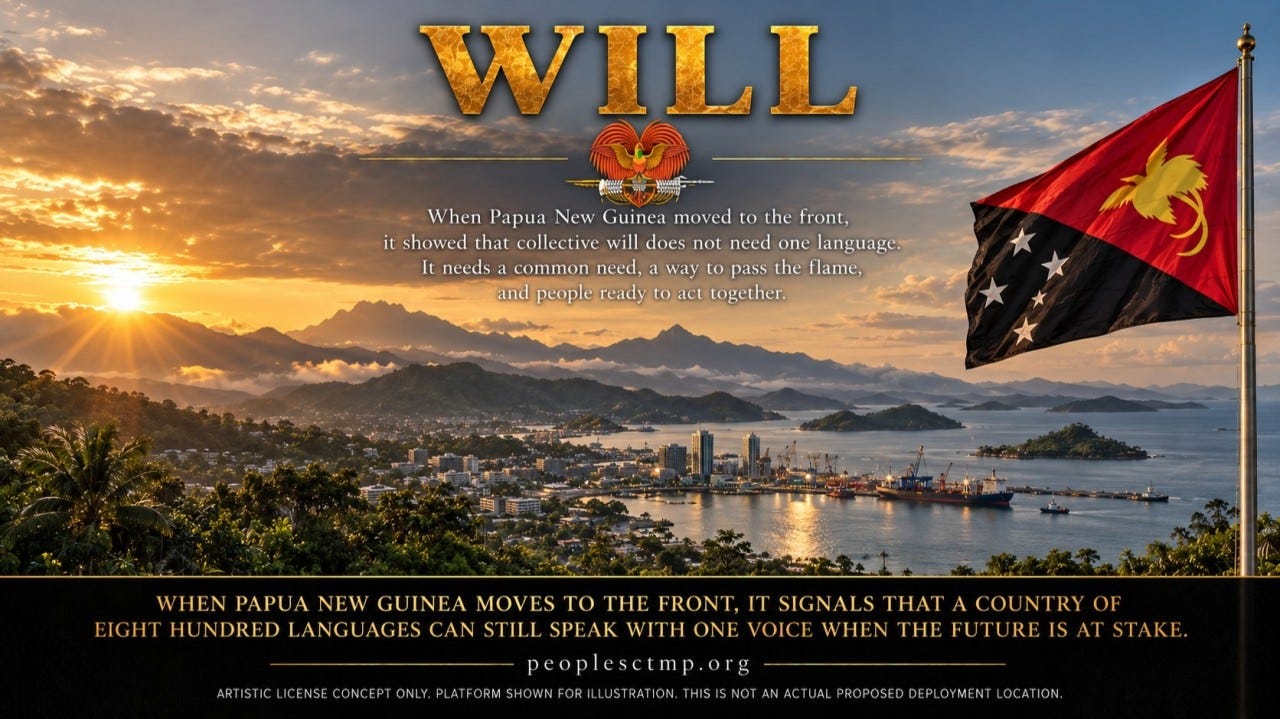
Last week the first machine switched on in Papua New Guinea. And a country of ten million people who share no common language, who were not on the board at all seven days ago, took first place in the world.
What the board recorded
The numbers first, because they carry themselves.
Papua New Guinea: 2,765 voices recorded. Required count 520,000. Progress 0.532 percent. First on earth.
Ireland: 1,245 voices. 0.479 percent. Second, and 138 voices from taking the lead.
India: 304,654 voices. 0.423 percent. Third, holding more than half of every voice on the planet.
Then Brazil, Pakistan, South Korea, Laos, the Central African Republic, all within a fraction of a percent, all climbing.
The Wall now carries 583,367 voices across 171 countries. We passed half a million and did not pause. In the same wave that lifted Papua New Guinea, sixteen other nations appeared for the first time: Timor-Leste, Hungary, Zimbabwe, Hong Kong, Uzbekistan, Andorra, El Salvador, Congo, Bosnia and Herzegovina, the Marshall Islands, Trinidad and Tobago, Somalia, Lesotho, Egypt, Qatar, Micronesia.
Every country climbs its own mountain, five percent of its own population, with a floor of 250,000 for the smallest. Rank is how far up the mountain a country has travelled, not how many people are standing on it. That is the only fair way to race a nation of ten million against a nation of one and a half billion. It is why India can hold half the world’s voices and stand third, and why the Highlands can lead.
Now understand what “led” means here. It does not mean Papua New Guinea has more people who want cheap power. India has a hundred times more. It means that, in proportion to its size, Papua New Guinea wanted it most, and wanted it fastest, and said so in public, in one week, with nothing pushing it.
That is collective will, measured. As far as I know, nobody has ever built an instrument that measures it before.
The country that ships its light away
Picture a girl in the Highlands doing her homework by the light of a kerosene lamp. Tonight, not in 1950.
Two hundred kilometres away on the coast, a liquefied natural gas train is loading a tanker for Tokyo. The gas under her country’s ground will light kitchens in Japan and China before the sun rises. It will not light hers. Fewer than one in five people in Papua New Guinea can flip a switch and expect anything to happen. The country exports energy and imports diesel to run the fraction of a grid it has, and when the diesel is late, Port Moresby goes dark in the middle of the working day and nobody is surprised.
Gold left. Copper left. Timber left. Gas is leaving now. The pattern is always the same: the resource goes, the money goes, the hole stays. A nation that sells its light to the world and reads by a flame.
I tell you this not to make you pity anyone. Pity is useless here and Papua New Guineans have no time for it. I tell you because a people who live inside a problem that specific do not need it explained to them. When the link arrived in the Highlands, nobody had to be persuaded that energy is the floor under everything. They have been standing on the floor with no lights on for a hundred years.
Recognition, when it happens to ten million people at once, looks exactly like one week.
Eight hundred languages
Here is what should stop you.
Papua New Guinea has more languages than any nation on earth. More than eight hundred. Villages a valley apart cannot understand each other. There is no shared newspaper, no shared television channel that reaches the whole country, no single tongue in which a national argument could even be had.
If collective will required a common language, Papua New Guinea would be the last place on earth it could form.
It formed there first.
The reason is a word in Tok Pisin, the trade language that stitches the country together: wantok. One talk. Your wantok are the people you are bound to and who are bound to you. The clan. The village. The cousin in the city who takes you in when you arrive with nothing. The uncle who pays the school fees when the harvest fails. Papua New Guinea is not held together by its state. It is held together by ten million people who each know exactly who their people are and what they owe them.
Now look at how The Wall spreads. There is no algorithm. There is no budget. There is a Flame Carrier, an anonymous relay participant known only by the last four digits of a badge, who does exactly one thing: moves the link across one human relationship, and lets go. No rank. No downline. Nothing earned. One person who has spoken, standing beside one who has not, for thirty seconds.
That is not a growth strategy in Papua New Guinea. That is wantok. That is the ordinary way that anything true has ever travelled there.
I designed the Flame Carrier for a world I believed had forgotten how to do this. There is a country of ten million people that never forgot, and it just showed the rest of us what the mechanism looks like at full speed.
Collective will does not need a common language. It needs a common floor and a way to pass the flame. Papua New Guinea had both.
The Pacific moves as one
Scroll past the top eight and a second story draws itself on the map.
Vanuatu, 1,249 voices. Fiji, 1,145. Samoa, 1,573. Kiribati, 602. Nauru, 592. Micronesia, 409. Tuvalu, Tonga, Palau, the Marshall Islands, all on the board now. Beside them Namibia at 0.83 percent of its required count, Moldova, Jamaica, Grenada, Saint Lucia, each moving faster than France, Germany, Japan and Canada combined.
The Pacific is climbing together.
Think about who these people are. They live on the islands the sea is coming for. They pay some of the highest electricity prices on earth, because a small island grid runs on imported diesel, and the diesel arrives by ship, and the price of the ship is set by a war somewhere else. When the oil market sneezes, Tuvalu catches pneumonia. Their leaders fly to a climate summit every year to ask the rich world for the one thing they cannot make for themselves, a floor under the price of energy, and every year they fly home with a communiqué.
Now read what Kiribati and Vanuatu and the Central African Republic saw when someone handed them the link. A machine that draws firm, clean baseload power from the ocean itself. Two and a half cents, fixed as a Charter constraint no operator has the authority to raise. Two billion cubic metres of drinking water a year, gifted to the host nation at zero. Built without debt, so no lender can ever call it. Built with no shutoff in the design, so nobody can ever hold a hospital hostage.
The ocean is the threat. The ocean is the source. Nobody had to explain that sentence to an islander. They knew it before they could swim.
And here is the thing about collective will that the Pacific just demonstrated. It is contagious across borders. Samoa did not move because Samoa was persuaded in isolation. Samoa moved because Fiji moved, and Fiji moved because Vanuatu moved, and the largest island in the region watched its small neighbours climb and understood that the moment had a shape. Will feeds will. The board makes the feeding visible. That is the entire reason it exists.
What one voice weighs in the Highlands
One piece of arithmetic, because it turns a feeling into a lever.
Papua New Guinea’s required count is 520,000. India’s is 72,000,000. Divide one by the other: 138. One voice in the Highlands moves its country as far up the mountain as 138 voices move India. Not because a Papua New Guinean cares more. Because the country is smaller and the rule is fair.
Against the United States a Papua New Guinean voice weighs 33. Against Pakistan, 23. Against Brazil, 21. Against Ireland, whose required count is 260,000, it weighs half, which is why Ireland, with fewer than half the voices, sits only 138 behind.
Now turn it around, because this is the part that should make a large country sweat. Every voice Papua New Guinea adds today costs India 138 voices just to hold its place. If the Highlands add a hundred tomorrow, India must add 13,800 or fall. Nobody in India did anything wrong. Nobody in India did anything. That is the point.
Collective will has a physics. In a small country, one person is a measurable fraction of the whole. In a large country, one person is the difference between a 138-to-one debt and a 138-to-one advantage, depending entirely on which side of the arithmetic they choose to stand. Both are the same fact. Your size relative to the leader sets your leverage. But leverage that sits unused is being used against you by everyone who picked theirs up.
This week, ten million people in the Pacific picked theirs up.
The rich country in second place
Ireland breaks a pattern I have written about for a year, and I want to be honest about that.
The wealthy world has mostly watched. France has 2 voices. Japan 15. Switzerland 7. Canada 78. The United States 8,515 from 340 million people, which rounds to nothing. I have said, many times, that the countries moving are the ones where the light switch is still a question, and the countries watching are the ones where it stopped being a question so long ago they cannot imagine it being asked again.
Ireland is asking.
1,245 voices. Second in the world. A wealthy, connected, English-speaking European nation running neck and neck with the poorest large country in the Pacific for first place on an infrastructure demand ledger.
Why? I can only tell you what the Irish already know. Data centres now consume roughly a fifth of all electricity on the Irish grid, and the share climbs every year. Ireland has become the server room of Europe, and the bill for that arrives in every household’s post. The grid operator warns. Ministers argue about moratoriums. A country that never had to think about where its power came from has been made to think about it, hard, by machines that never sleep.
I wrote three weeks ago that the full CTMP design produces about 5.9 times the electricity used by every data centre on earth. Somebody in Ireland read that sentence and did the arithmetic for their own island. Then they told a wantok. Then 1,244 more people did the same.
Ireland is 138 voices from first. That is one pub. One parish. One WhatsApp group in Cork deciding on a Tuesday that they would like the first review to happen on their coast.
That, too, is collective will. It does not care about your GDP. It only cares whether you have decided.
What the will is for
Let me be precise about what all this deciding is aimed at, because will without an object is just noise.
The Canal and Transshipment Mega Project is a design for 300 gigawatts of gravity-powered baseload electricity, firm more than 93 percent of all hours, at a posted tariff of two and a half US cents per kilowatt-hour that is fixed as a system constraint. Around that core sit seventeen integrated industrial verticals: steel, concrete, tunnel boring machines, long-distance transmission, desalination and a national water grid, hydrogen and ammonia and fertiliser, chip fabrication, data infrastructure, ports, rail, housing, research institutes.
For Papua New Guinea specifically, read those verticals as a list of the country’s wounds, answered point by point.
Power. The national system generates well under five terawatt-hours a year. A single module is engineered for roughly 2,500. That does not mean fewer blackouts. It means the first electric grid most of the country has ever had, fed by a source no diesel tanker can delay and no export contract can divert. The light staying home.
Water. Papua New Guinea has some of the lowest access to safe drinking water on earth, not because it lacks rain, it has more than almost anywhere, but because it lacks the energy to move water, treat it and keep it clean. Two billion cubic metres a year, gifted at zero, is drinking water for roughly a hundred million people at fifty litres a day. The country has ten million. That is not a solution to the water problem. That is the end of it, with ninety percent left over.
Work. The consolidated workforce assessment for one deployment specifies 25.9 million construction job years in the first operating year and a standing workforce of just over three million positions, with homes, schools and clinics built as first-mile infrastructure and paid as platform payroll from the first morning. Papua New Guinea is one of the youngest nations alive. Its young people board planes for Australian farms and Queensland mines because nothing on their own horizon is sized to hold them. Read the assessment as a parent in Lae and tell me it does not land.
Terms. This is a people who have watched extraction happen to them for a century. So a machine that cannot indebt them, cannot reprice them, cannot switch them off, and gifts its water by obligation is not an infrastructure proposal. It is the first offer in living memory where the fine print is on their side.
The 50 megawatt proof of concept is design complete. It gets built and it gets run. When it is working, the measured results carry us to 250 megawatts, and from there, module by proven module, to the 300 gigawatt core. Nobody leaps from 50 megawatts to 300 gigawatts and anyone who says otherwise is doing theatre. Increments. In public. Each one the proof for the next.
I have no doubt about the destination. What I have is discipline about the route, and a board that tells me every hour who is ready to walk it first.
Why you are still watching
Here is the part I have to say carefully, because I am about to describe something happening inside you.
You are reading this and you have not made your voice heard. Somewhere in the last five minutes a reasonable voice inside you said: interesting, later.
I know that voice. I have heard it from ministers and engineers and friends. It is not laziness. It is self-protection. If you act on something this large and it does not happen, you were a fool. If you watch, you were prudent. Watching feels like the position with no downside.
But collective will has a property that individual prudence cannot see. It is made entirely of people who stopped waiting for someone else to go first. Every one of the 583,367 voices on that board belongs to a person who had the same reasonable voice in their head and overrode it. The half million is not a crowd you can hide inside. It is half a million separate decisions not to hide.
And the board does not have a setting called wait. Your country’s rank falls when another country climbs, whether you moved or not. There is no neutral. There is acting, and there is falling.
There is one more thing, and it matters more than the arithmetic.
Almost everyone on The Wall is there because one specific person handed them the link. Not a campaign. A person. Someone looked them in the eye, or sent one message, and said: look at this.
Which means that right now, in your life, there is a person who will one day make their voice heard, and the only open question is who tells them. It might be a stranger in three months. It might be you tonight.
You will forget most of what you did this week. You will not forget whether you were the one who told them.
That is the whole of it. Collective will is not a crowd. It is a chain of individual people who each decided to be the link and not the gap.
Thirty-seven years
One section about me, and then I will get out of the way.
I have carried this design for thirty-seven years. I have been told it cannot be done by people who have never once had to explain to their own child why the lights went out. I have watched projects a fraction of this size get funded on a handshake because they promised the right people a cut, while a design that forbids the cut, structurally, by Charter, gets called naive. I have sat in rooms where the word realistic was used to mean the same as before.
I did not stop, and the reason is the same reason Papua New Guinea moved in a week.
Scarcity is a choice. Somebody made it long ago on behalf of everyone who came after, and we inherited it like weather. Every diesel generator in Port Moresby, every kerosene lamp in the Highlands, every island paying a war premium on its power, every Irish household paying for a server farm’s appetite, is downstream of that one decision.
I refused it. Not out of courage. Because once you see that it was a choice, refusing it is the only honest thing left.
And I knew from the beginning that I could not refuse it alone. No one can. A single will, however stubborn, is a man in a room with a drawing. Thirty-seven years taught me that the drawing only becomes a machine when enough people decide, together, in public, that they want it built where they live. That is why The Wall exists. Not to persuade anyone. To count them. To make the will visible, so it can see itself, so it can feed.
Tonight it fed in Papua New Guinea.
The honest column
Reaching a required count does not award a country a power plant. It awards a review: coastal access, bathymetry, subsurface integrity, corridor compatibility, grid relevance, and the host government’s own answer, under a published process. A government that declines is recorded as declining. The Wall measures what people want. It binds no state and never was built to.
Nothing has been built anywhere. Not one shovel. Every capacity and tariff figure in the public record is a requirement of a design, stated as such, in documents written so you can attack them. 116 countries are currently eligible for the first module; the rest are recorded for later deployment, and that too is published.
None of that softens a number above. Papua New Guinea leads. Ireland is 138 behind. Your country’s rank falls when others rise. Those are facts about the board, and the board is public. Go and check.
The lamp
Come back to the Highlands.
The girl finishes what she can of her homework. The kerosene is running low and kerosene costs money, so she stops before she is done. Her mother, who has never touched a light switch, does not know that this week her country took first place on a global ledger of demand for exactly the thing her daughter is missing. She does not know that a cousin in Lae or a nephew in Brisbane opened a page, found the bird of paradise flag, made their voice heard, handed it to one more wantok, and let go. Two thousand seven hundred and sixty-five times.
She does not know, and she does not need to. The board knows. And the first formal review, when Papua New Guinea reaches its mountain, will begin with a coastline and a set of measurements and a government’s answer, and if that answer is yes, it will end with her daughter’s lamp going into a drawer for good.
That is what a voice is. Not a click. A unit of will, placed on a scale that someone has spent a century pretending was not there.
There is no force on earth more powerful than enough of those units deciding at once. There never has been. Every wall that ever fell, fell to it.
Papua New Guinea placed 2,765 of them in a week and led the world.
Ireland is 138 behind.
Your country is somewhere on that board, or it is one of the 66 that still have no one. Either way, the distance between where it is and where it could be is one person deciding, and then one more.
Open The Wall Find your country. Make your voice heard.
Then hand it to one person you know, once, with one sentence of your own. And let go.
No account. No name. No email. No money. Thirty seconds.
Every country has its own required count. Every voice moves it.
MAKE YOUR COUNTRY COUNT.
Figures are as displayed on The Wall’s public Race Pulse at the time of writing, at 583,367 recorded voices across 171 countries, and will have moved by the time you read this. Required counts are published on the board: five percent of national population, with a floor of 250,000. 237 countries and territories are tracked; 116 are currently eligible for the first module. Papua New Guinea’s electrification rate, water access, generation and export figures reflect widely reported national statistics and are stated approximately (External). Ireland’s data centre share of grid electricity reflects published grid operator reporting (External). Module output, tariff, water gift, workforce and financing terms are stated requirements of the published design (Target). Nothing described in the design has been built.